Black women continue to face higher risks of poor pregnancy outcomes compared with whites, even after controlling for socioeconomic status (SES) and other traditional risk factors. Though some researchers consider racism the fundamental determinant of this disparity, most studies neglect the multidimensional nature of race and color. Studies show that skin tone matters—for example, darker-complexioned black men face more severe treatment in the criminal justice system and worse labor market outcomes than their lighter-complexioned counterparts.
Books
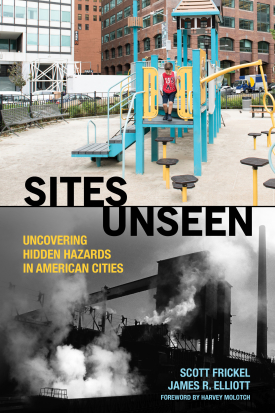
Sites Unseen
Uncovering Hidden Hazards in American Cities
About This Book
Winner of the 2020 Robert E. Park Award for Best Book from the Community and Urban Sociology Section of the American Sociological Association
A Volume in the American Sociological Association’s Rose Series in Sociology
“Sites Unseen is perhaps the most important contribution made in this century to our understanding of the distribution of environmental hazards in U.S. urban areas. Scott Frickel and James R. Elliott, two masterful sociologists, present their innovative and insightful research in this accessible but deeply scholarly work about how the history of cities affects the well-being of contemporary urban residents. This is a seminal work that is likely to spawn a wide variety of new research as well as aid and encourage social and environmental activists.”
—RICHARD YORK, professor of sociology and director and professor of environmental studies, University of Oregon
“This is a work of exceptional quality and profundity, the result of painstaking and systematic investigation of the largely hidden yet massive and ‘relentless accumulation’ of industrial hazards that exists throughout urban America. Scott Frickel and James R. Elliott present a twenty-first century theory and method of human ecology that requires us to expand our sensory capacities, and they give us a bonus: an innovative and empowering DIY Guide for those who seek to apply these tools to their own cities and neighborhoods. Sites Unseen will change forever the way we think about cities. I fervently hope that it also changes the way we live in and (re)make them.”
—DAVID N. PELLOW, Dehlsen Chair and professor of environmental studies, University of California, Santa Barbara
“Sites Unseen is an innovative and important book. Scott Frickel and James R. Elliott document in laser-like fashion how the poor and people of color are disproportionately burdened by exposure to a heretofore largely invisible landscape of industrial-era environmental hazards in American cities. By adroitly exposing the hazards and demonstrating how our regulatory apparatus seems capable of only handling the most extreme risks, Frickel and Elliott’s creative use of public data, methods, and findings lay the foundation for renewed research interest in environmental sociology and geography.”
—JAMES H. JOHNSON JR., William R. Kenan Jr. Distinguished Professor of Strategy and Entrepreneurship and director of the Urban Investment Strategies Center, University of North Carolina Kenan-Flager Business School
From a dive bar in New Orleans to a leafy residential street in Minneapolis, many establishments and homes in cities across the nation share a troubling and largely invisible past: they were once sites of industrial manufacturers, such as plastics factories or machine shops, that likely left behind carcinogens and other hazardous industrial byproducts. In Sites Unseen, sociologists Scott Frickel and James R. Elliott uncover the hidden histories of these sites to show how they are regularly produced and reincorporated into urban landscapes with limited or no regulatory oversight. By revealing this legacy of our industrial past, Sites Unseen spotlights how city-making has become an ongoing process of social and environmental transformation and risk containment.
To demonstrate these dynamics, Frickel and Elliott investigate four very different cities—New Orleans, Minneapolis, Philadelphia, and Portland, Oregon. Using original data assembled and mapped for thousands of former manufacturers’ locations dating back to the 1950s, they find that more than 90 percent of such sites have now been converted to urban amenities such as parks, homes, and storefronts with almost no environmental review. And because manufacturers tend to open plants on new, non-industrial lots rather than on lots previously occupied by other manufacturers, associated hazards continue to spread relatively unabated. As they do, residential turnover driven by gentrification and the rising costs of urban living further obscure these sites from residents and regulatory agencies alike.
Frickel and Elliott show that these hidden processes have serious consequences for city-dwellers. While minority and working class neighborhoods are still more likely to attract hazardous manufacturers, rapid turnover in cities means that whites and middle-income groups also face increased risk. Since government agencies prioritize managing polluted sites that are highly visible or politically expedient, many former manufacturing sites that now have other uses remain invisible. To address these oversights, the authors advocate creating new municipal databases that identify previously undocumented manufacturing sites as potential environmental hazards. They also suggest that legislation limiting urban sprawl might reduce the flow of hazardous materials beyond certain boundaries.
A wide-ranging synthesis of urban and environmental scholarship, Sites Unseen shows that creating sustainable cities requires deep engagement with industrial history as well as with the social and regulatory processes that continue to remake urban areas through time.
SCOTT FRICKEL is professor of sociology and environment and society at Brown University.
JAMES R. ELLIOTT is professor of sociology at Rice University.
RSF Journal
View Book Series
Sign Up For Our Mailing List
Apply For Funding
Books
Homeward
Life in the Year After Prison
About This Book
Winner of the 2019 Outstanding Book Award from the Inequality, Poverty, and Mobility Section of the American Sociological Association
2018 Choice Outstanding Academic Title
“Bruce Western, our foremost authority on mass incarceration, has filled in a yawning gap in the research on one of the great banes of our era. Homeward is a thorough and deeply illuminating study on the end-point of mass incarceration—the effort to reintegrate ex-offenders into our society. The challenges outlined in the book should not simply inform our reentry efforts, but should also make us question the American policy of handing down sentences, which, in some profound way, never really end.”
—Ta-Nehisi Coates, National Correspondent, The Atlantic
“In Homeward, Bruce Western probes in rich detail the lives of ex-prisoners in their first year of life back on the streets of Boston. He looks unflinchingly at the correlated web of adversities that men and women face in the transition out of prison, especially how violence, drug and alcohol addiction, mental illness, and family chaos exacerbate the stigma of a prison record in the reentry to society. Beautifully written and deeply researched, this book provides an important framework on social and criminal justice. The implications for policy are profound.”
—Robert J. Sampson, Henry Ford II Professor of the Social Sciences, Harvard University
In the era of mass incarceration, over 600,000 people are released from federal or state prison each year, with many returning to chaotic living environments rife with violence. In these circumstances, how do former prisoners navigate reentering society? In Homeward, sociologist Bruce Western examines the tumultuous first year after release from prison. Drawing from in-depth interviews with over one hundred individuals, he describes the lives of the formerly incarcerated and demonstrates how poverty, racial inequality, and failures of social support trap many in a cycle of vulnerability despite their efforts to rejoin society.
Western and his research team conducted comprehensive interviews with men and women released from the Massachusetts state prison system who returned to neighborhoods around Boston. Western finds that for most, leaving prison is associated with acute material hardship. In the first year after prison, most respondents could not afford their own housing and relied on family support and government programs, with half living in deep poverty. Many struggled with chronic pain, mental illnesses, or addiction—the most important predictor of recidivism. Most respondents were also unemployed. Some older white men found union jobs in the construction industry through their social networks, but many others, particularly those who were black or Latino, were unable to obtain full-time work due to few social connections to good jobs, discrimination, and lack of credentials. Violence was common in their lives, and often preceded their incarceration. In contrast to the stereotype of tough criminals preying upon helpless citizens, Western shows that many former prisoners were themselves subject to lifetimes of violence and abuse and encountered more violence after leaving prison, blurring the line between victims and perpetrators.
Western concludes that boosting the social integration of former prisoners is key to both ameliorating deep disadvantage and strengthening public safety. He advocates policies that increase assistance to those in their first year after prison, including guaranteed housing and health care, drug treatment, and transitional employment. By foregrounding the stories of people struggling against the odds to exit the criminal justice system, Homeward shows how overhauling the process of prisoner reentry and rethinking the foundations of justice policy could address the harms of mass incarceration.
BRUCE WESTERN is the Daniel and Florence Guggenheim Professor of Criminal Justice Policy and Professor of Sociology at Harvard University, and Co-Director of the Justice Lab at Columbia University.
Download
RSF Journal
View Book Series
Sign Up For Our Mailing List
Apply For Funding
Books
Who Will Care for Us?
Long-Term Care and the Long-Term Workforce
About This Book
“Who Will Care for Us? is a comprehensive and probing work on the challenges and opportunities of building a labor force to do some of the most consequential and sensitive work in our society: providing long-term care for others. Paul Osterman analyzes this complicated landscape with clarity and offers new, creative, and tractable approaches to policy.”
—David Weil, dean, Heller School for Social Policy and Management, Brandeis University, and former Wage and Hour Administrator, U.S. Department of Labor
“In Who Will Care for Us?, Paul Osterman provides important insights into the chall- enges and opportunities for the most important members of the long-term care workforce—the certified nursing assistants and home care aides who provide the lion’s share of services to very vulnerable populations. He combines the best of storytelling and robust scholarship to highlight the systemic factors that explain why this profession is so undervalued. As important, he offers a thoughtful range of policy and practice solutions to elevate this workforce and ultimately deliver better services to a diverse and growing long-term care population.”
—Robyn I. Stone, executive director and senior vice president for research, LeadingAge Center for Applied Research
“With the aging baby boom generation, long-term care will be one of the great policy challenges in the coming decades. In Who Will Care for Us?, Paul Osterman identifies one of the key barriers to achieving high-value long-term care: our underinvestment in how we pay and train the direct care workforce. He makes the compelling case that continuing with the status quo is not the answer. He argues for transforming the direct caregiver job to encompass a much wider set of roles. In order for this to occur, we need to not only retrain our workforce, but also reform many of the policies that have led us to neglect our caregivers.”
—David Grabowski, professor of health care policy, Harvard Medical School
The number of elderly and disabled adults who require assistance with day-to-day activities is expected to double over the next twenty-five years. As a result, direct care workers such as home care aides and certified nursing assistants (CNAs) will become essential to many more families. Yet these workers tend to be low-paid, poorly trained, and receive little respect. Is such a workforce capable of addressing the needs of our aging population? In Who Will Care for Us? economist Paul Osterman assesses the challenges facing the long-term care industry. He presents an innovative policy agenda that reconceives direct care workers’ work roles and would improve both the quality of their jobs and the quality of elder care.
Using national surveys, administrative data, and nearly 120 original interviews with workers, employers, advocates, and policymakers, Osterman finds that direct care workers are marginalized and often invisible in the health care system. While doctors and families alike agree that good home care aides and CNAs are crucial to the wellbeing of their patients, the workers report poverty-level wages, erratic schedules, exclusion from care teams, and frequent incidences of physical injury on the job. Direct care workers are also highly constrained by policies that specify what they are allowed to do on the job, and in some states are even prevented from simple tasks such as administering eye drops.
Osterman concludes that broadening the scope of care workers’ duties will simultaneously boost the quality of care for patients and lead to better jobs and higher wages. He proposes integrating home care aides and CNAs into larger medical teams and training them as “health coaches” who educate patients on concerns such as managing chronic conditions and transitioning out of hospitals. Osterman shows that restructuring direct care workers’ jobs, and providing the appropriate training, could lower health spending in the long term by reducing unnecessary emergency room and hospital visits, limiting the use of nursing homes, and lowering the rate of turnover among care workers.
As the Baby Boom generation ages, Who Will Care for Us? demonstrates the importance of restructuring the long-term care industry and establishing a new relationship between direct care workers, patients, and the medical system.
PAUL OSTERMAN is Nanyang Technological University (NTU) Professor of Human Resources and Management at the M.I.T. Sloan School of Management.
Download
RSF Journal
View Book Series
Sign Up For Our Mailing List
Apply For Funding
About This Book
From the Playground Extension Committee of the Russell Sage Foundation, this paper on landscape gardening for children’s recreation spaces was first presented at the second annual Playground Congress for the Playground Association of America in 1909.
CHARLES MULFORD ROBINSON was professor of civic design at University of Illinois at Urbana-Champaign.
Download
RSF Journal
View Book Series
Sign Up For Our Mailing List
Apply For Funding
About This Book
A 1908 pamphlet from the Department of Child Hygiene of the Russell Sage Foundation, campaigning for an end to the unsafe and noisy Independence Day celebrations that had been popular around the country at the time.
JULIA HYNEMAN BARNETT RICE, Department of Child Hygiene, Russell Sage Foundation
Download
RSF Journal
View Book Series
Sign Up For Our Mailing List
Apply For Funding
About This Book
A review of the development of the community center as a distinct institution and government agency, ten years after such a proposal was made to reformers the 1911 First National Conference on Civic and Social Center Development. The article first appeared in 1921 in the New York Evening Post and reprinted in the September-October 1921 number of the Community Center.
CLARENCE ARTHUR PERRY, Department of Child Hygiene, Russell Sage Foundation
Download
RSF Journal
View Book Series
Sign Up For Our Mailing List
Apply For Funding
Books
The Full Measure of Responsibility in Child-Helping Work
Publication Date
12 pages
About This Book
An introduction to the study of the work of child-helping societies, presented at the National Conference of Charities and Correction in 1906.
WILLIAM H. PEAR was manager of the Provident Society, Boston, Massachusetts.