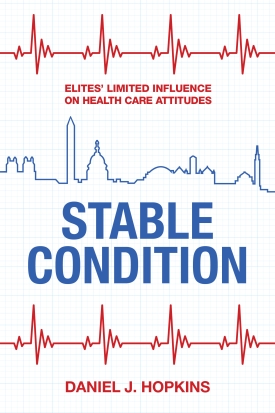
About This Book
This booklet examines transportation as a form of charitable aid, its effects on recipients, and better ways of helping.
In this booklet, Mary E. Richmond discusses the arguments for and against mothers’ pensions. She maintains that policies legislating that mothers stay home with their children may defend motherhood at the expense of mothers.
MARY E. RICHMOND was the director of the Charity Organization Department of the Russell Sage Foundation.
"The elite-level battle over the Affordable Care Act has consumed a decade, the ACA has transformed millions of lives—mostly for the better—and yet Daniel Hopkins’s brilliant new book, Stable Condition, shows that all this has barely moved a polarized public. What does this ‘stable condition’ mean for politicalscience and policymaking alike? Read this fascinating book to find out."
—JACOB S. HACKER, Stanley B. Resor Professor of Political Science, Yale University
The Affordable Care Act (ACA), the sweeping health care reform enacted by the Obama Administration in 2010, continues to be a contentious policy at the center of highly polarized political debates. Both before and after the law’s passage, political elites on both sides of the issue attempted to sway public opinion through two traditional approaches: messaging and policymaking itself. They operated under the assumption that the public’s personal experiences toward the law would make them more favorable. Yet these tried-and-true methods have had limited influence on public attitudes toward the ACA. Public opinion towards the ACA remained stable from 2010 to 2016, with more Americans opposing the law than supporting it. It was only after Donald Trump was elected in 2016 and the prospect of the law being repealed became a reality that public opinion swung in favor of the ACA. If traditional methods of influencing public opinion had little impact on attitudes towards the ACA, what did? In Stable Condition, political scientist Daniel J. Hopkins draws on survey data from 2009 to 2020 to assess how a variety of factors such as personal experience, political messaging, and partisanship did or did not affect public opinion on the ACA.
Hopkins finds that although personal experience with the ACA’s Medicaid expansion increased favorability among low-income Americans, it did not have a broader overall impact on public opinion. Personal experience with the Health Insurance Marketplace did not increase wider support for the ACA either. Due to the complex nature of the law, users of the Marketplace often did not realize they were benefiting from the ACA. Therefore, perceptions of the Marketplace were shaped by high-profile issues with the enrollment website and opposition to the individual mandate. These experiences ultimately offset one another, resulting in little discernable change in public opinion overall. Hopkins argues that political polarization was also responsible for elite’s limited influence and that public opinion on the ACA was largely determined by partisanship and political affiliation. Americans quickly aligned with their party’s stance on the law and were resistant to changing their beliefs despite the efforts of political elites.
Stable Condition is an illuminating examination of the limits of elites’ influence and the forces that shaped public opinion about the Affordable Care Act.
DANIEL J. HOPKINS is a professor of political science at University of Pennsylvania.
Housing instability is associated with numerous negative outcomes for adults and children, such as increased material hardship, limited healthcare access, and lower educational attainment. Housing assistance, including vouchers, is associated with improvements in these outcomes. However, the largest housing program, the Housing Choice Voucher program, is complicated, inflexible, and has administrative burdens for recipients.
In this pamphlet, Joseph Lee explains why playgrounds are necessary, how they should be constructed, and how to get people in the community interested in creating them.
JOSPEH LEE was known as the “Father of the Playground Movement.” He is the author of “The Home Playground,” published by the Russell Sage Foundation.
In this pamphlet, reprinted from the Proceedings of the Second Annual Playground Congress of the Playground Association of America, Joseph Lee discusses the ideal home playground.
JOSPEH LEE is considered the “Father of the Playground Movement.” He is the author of “Play and Playgrounds,” available on the Russell Sage Foundation site.
This booklet contains six papers from the National Conference of Social Work, which took place in Washington, DC, in May 1923. Four papers describe developments in particular sections of the United States. Two papers offer a national perspective. Together, the papers bear testimony to the similarity of children’s needs everywhere.
One reason that minority homeowners face a higher tax burden than non-minority homeowners is because they are less likely to appeal their assessed values. Economists Andrew Simon and David Novgorodsky and public policy scholar Justin Holz will examine the causes of racial discrepancies in property tax appeals. They will conduct an experiment and analyze data on property taxes and lottery winnings as well as credit score and income data for their study.
Public policy scholar Chloe Gibbs will examine the role of public policy and public investment in children’s education in facilitating women’s employment through three related studies. The first study will explore the impact of COVID-19 school re-openings and whether classes are taught remotely or in-person on maternal employment. The second study will examine the impact of increasing Head Start programming from part- to full-day on maternal employment.
This booklet provides advice on reforming Independence Day celebrations. It includes illustrated descriptions of safe celebrations; a list of state laws and city ordinances regulating the manufacture, sale, and use of explosives; and a collection of programs and suggestions.
LEE F. HANMER was associate director of the Department of Child Hygiene at the Russell Sage Foundation.