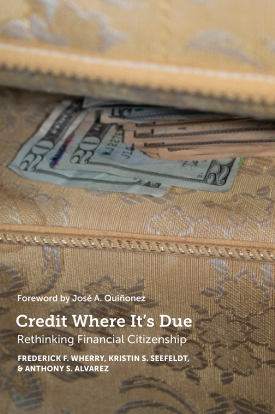
Credit Where It’s Due
About This Book
“Working hard and playing by the rules still casts aside millions. Credit Where It’s Due tells the inspiring story of the Mission Asset Fund’s pathway to belonging and financial citizenship. Inspired and well crafted, this book builds the case for making and illuminates how to make citizenship, immigrant integration, and democracy work for organizations, advocates, and anybody committed to building a better society.”
—THOMAS M. SHAPIRO, director and David R. Pokross Professor of Law and Social Policy, Institute on Assets and Social Policy, The Heller School, Brandeis University
“Credit Where It’s Due is an original and masterful examination that goes well beyond the crowded scholarly field of finance and economic exploitation to document the ways in which systems of finance stratify society in areas as basic as human decency, belonging, and recognition. But, far from simply a doom and gloom story, the book presents financial alternatives grounded in the depth of contemporary personal narratives of how finance can be dignity affirming and structured to empower rather than socially degrading and exploitive. This book will advance the field in profound ways.”
—DARRICK HAMILTON, executive director, Kirwan Institute for the Study of Race and Ethnicity, The Ohio State University
An estimated 45 million adults in the U.S. lack a credit score at time when credit invisibility can reduce one’s ability to rent a home, find employment, or secure a mortgage or loan. As a result, individuals without credit—who are disproportionately African American and Latino—often lead separate and unequal financial lives. Yet, as sociologists and public policy experts Frederick Wherry, Kristin Seefeldt, and Anthony Alvarez argue, many people who are not recognized within the financial system engage in behaviors that indicate their credit worthiness. How might institutions acknowledge these practices and help these people emerge from the financial shadows? In Credit Where It’s Due, the authors evaluate an innovative model of credit-building and advocate for a new understanding of financial citizenship, or participation in a financial system that fosters social belonging, dignity, and respect.
Wherry, Seefeldt, and Alvarez tell the story of the Mission Asset Fund, a San Francisco-based organization that assists mostly low and moderate-income people of color with building credit. The Mission Asset Fund facilitates zero-interest lending circles, which have been practiced by generations of immigrants, but have gone largely unrecognized by mainstream financial institutions. Participants decide how the circles are run and how they will use their loans, and the organization reports their clients’ lending activity to credit bureaus. As the authors show, this system not only helps clients build credit, but also allows them to manage debt with dignity, have some say in the creation of financial products, and reaffirm their sense of social membership. The authors delve into the history of racial wealth inequality in the U.S. to show that for many black and Latino households, credit invisibility is not simply a matter of individual choices or inadequate financial education. Rather, financial marginalization is the result of historical policies that enabled predatory lending, discriminatory banking and housing practices, and the rollback of regulatory protections for first-time homeowners.
To rectify these inequalities, the authors propose common sense regulations to protect consumers from abuse alongside new initiatives that provide seed capital for every child, create affordable short-term loans, and ensure that financial institutions treat low- and moderate income clients with equal respect. By situating the successes of the Mission Asset Fund in the larger history of credit and debt, Credit Where It’s Due shows how to prioritize financial citizenship for all.
FREDERICK F. WHERRY is professor of sociology at Princeton University.
KRISTIN S. SEEFELDT is associate professor of social work and associate professor of public policy at the University of Michigan.
ANTHONY S. ALVAREZ is assistant professor of sociology at California State University, Fullerton.