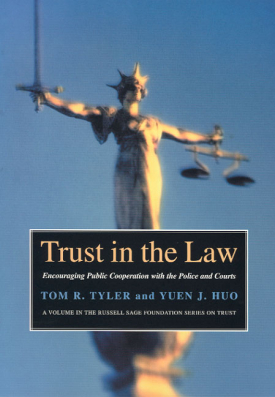
Trust in the Law
About This Book
"Trust in the Law is one of the most creative policy-relevant studies I have read. This book is replete with insightful arguments about variations in citizen responses to the criminal justice system, arguments that are theoretically derived and empirically based. Anyone concerned about effective law enforcement in the United States must read this book."
-William Julius Wilson, Harvard University
"Trust in the Law reports keystone findings in one of the most important research programs in social science in the past few decades. A landmark contribution; one that gives us genuine guidance on how to maintain the legitimacy of our institutions of social control. The societal importance of these findings is absolutely central, and surprisingly optimistic."
-John M. Darley, Princeton University
"Trust in the Law is a significant contribution to understanding why, when, and which citizens are most likely to comply with the police and the courts. The key is 'street-level bureaucrats' who are perceived as fair and trustworthy, and as treating citizens well. Tom Tyler and Yuen Huo make their case with detailed analysis of interviews that capture personal experiences among diverse ethnic groups in several cities. The result is a book that persuasively and refreshingly contradicts the rationale for current government practice. It is an important advance on Tyler's own path-breaking work on procedural justice and offers a major building block for a system of legal regulation built on an accurate human psychology."
-Margaret Levi, University of Washington
"In Trust in the Law, Yuen Huo and Tom Tyler have taken a major new step in work on psychological jurisprudence. Treating people fairly and convincing them that regulatory motives are honorable paves a path to trust in the law. Reckless resort to deterrence can rupture that path and shatter trust. These findings have profound importance for how we must change the direction of our regulatory policies."
-John Braithwaite, Chair, Regulatory Institutions Network, Australian National University
Public opinion polls suggest that American's trust in the police and courts is declining. The same polls also reveal a disturbing racial divide, with minorities expressing greater levels of distrust than whites. Practices such as racial profiling, zero-tolerance and three-strikes laws, the use of excessive force, and harsh punishments for minor drug crimes all contribute to perceptions of injustice. In Trust in the Law, psychologists Tom R. Tyler and Yuen J. Huo present a compelling argument that effective law enforcement requires the active engagement and participation of the communities it serves, and argue for a cooperative approach to law enforcement that appeals to people's sense of fair play, even if the outcomes are not always those with which they agree.
Based on a wide-ranging survey of citizens who had recent contact with the police or courts in Oakland and Los Angeles, Trust in the Law examines the sources of people's favorable and unfavorable reactions to their encounters with legal authorities. Tyler and Huo address the issue from a variety of angles: the psychology of decision acceptance, the importance of individual personal experiences, and the role of ethnic group identification. They find that people react primarily to whether or not they are treated with dignity and respect, and the degree to which they feel they have been treated fairly helps to shape their acceptance of the legal process. Their findings show significantly less willingness on the part of minority group members who feel they have been treated unfairly to trust the motives to subsequent legal decisions of law enforcement authorities.
Since most people in the study generalize from their personal experiences with individual police officers and judges, Tyler and Huo suggest that gaining maximum cooperation and consent of the public depends upon fair and transparent decision-making and treatment on the part of law enforcement officers. Tyler and Huo conclude that the best way to encourage compliance with the law is for legal authorities to implement programs that foster a sense of personal involvement and responsibility. For example, community policing programs, in which the local population is actively engaged in monitoring its own neighborhood, have been shown to be an effective tool in improving police-community relationships.
Cooperation between legal authorities and community members is a much discussed but often elusive goal. Trust in the Law shows that legal authorities can behave in ways that encourage the voluntary acceptance of their directives, while also building trust and confidence in the overall legitimacy of the police and courts.
TOM R. TYLER is professor of psychology at New York University.
YUEN J. HUO is professor of psychology at the University of California, Los Angeles
A Volume in the Russell Sage Foundation Series on Trust