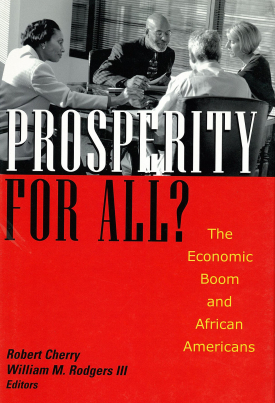
Prosperity For All?
About This Book
"This is an important and timely volume. Robert Cherry and William M. Rodgers III assembled an outstanding group of social scientist to examine the impact of the economic boom on African Americans. The careful and detailed analyses of the employment and earnings of African Americans in a tight labor market will be widely cited and discussed. Indeed, Prosperity for All? will undoubtedly become a standard reference for those who seek authoritative works on the economic prospects of black Americans."
-WILLIAM JULIUS WILSON, Harvard University
"To what extent do the tight labor markets of the late 1990s improve the employment and earnings of African Americans and other disadvantaged groups? How much of the deterioration in their employment prospects that occurred during the previous two decades is being reversed, and will these gains persist over time? Do discriminatory attitudes and behaviors among employers also persist, and to what extent do they diminish in tight markets? These are among the questions addressed in the set of papers edited by Robert Cherry and William M. Rodgers III. The editors should be commended for bringing together a distinguished group of researchers, and for generating a volume that addresses such important and timely questions in a convincing fashion."
-HARRY J. HOLZER, Michigan State University
"As Prosperity For All? goes to press, the rules of the new economy are being rewritten. This book offers powerful new evidence that at least one important rule from the old economy still applies: Sustained economic growth conveys substantial benefits for society's most vulnerable workers."
-ALAN KRUEGER, Princeton University
With the nation enjoying a remarkable long and robust economic expansion, AfricanAmerican employment has risen to an all-time high. Does this good news refute the notion of a permanently disadvantaged black underclass, or has one type of disadvantage been replaced by another? Some economists fear that many newly employed minority workers will remain stuck in low-wage jobs, barred from better-paying, high skill jobs by their lack of educational opportunities and entrenched racial discrimination. Prosperity for All? draws upon the research and insights of respected economists to address these important issues.
Prosperity for All? reveals that while African Americans benefit in many ways from a strong job market, serious problems remain. Research presented in this book shows that the ratio of black to white unemployment has actually increased over recent expansions. Even though African American men are currently less likely to leave the workforce, the number of those who do not find work at all has grown substantially, indicating that joblessness is now concentrated among the most alienated members of the population. Other chapters offer striking evidence that racial inequality is still pervasive. Among men, black high school dropouts have more difficulty finding work than their Latino or white counterparts. Likewise, the glass ceiling that limits minority access to higher paying promotions persists even in a strong economy. Prosperity for All? ascribes black disadvantage in the labor force to employer discrimination, particularly when there is strong competition for jobs. As one study illustrates, economic upswings do not appear to change racial preferences among employers, who remain less willing to hire African Americans for more skilled low-wage jobs.
Prosperity for All? offers a timely investigation into the impact of strong labor markets on low-skill African-American workers, with important insights into the issues engendered by the weakening of federal assistance, job training, and affirmative action programs.
ROBERT CHERRY is professor of economics at Brooklyn College and the Graduate Center of the City University of New York.
WILLIAM M. RODGERS III is chief economist of the U.S. Department of Labor. He is on leave from the College of William and Mary where he is the Frances L. and Edwin L. Cummings Associate Professor of Economics.
CONTRIBUTORS: Heather Boushey, Cecilia Conrad, Mary Corcoran, Sandra Danziger, Sheldon Danziger, William Darity Jr., Gregory E. DeFreitas, Richard B. Freeman, Colleen Heflin, Joyce P. Jacobsen, Chinhui Juhn, Ariel Kalil, Sanders Korenman, Laurence M. Levin, Judith Levine, Philip Moss, Samuell L. Meyers Jr., Cordelia W. Reimers, Daniel Rosen, Kristin Seefeldt, Kristine Siefert, William E. Spriggs, Chris Tilly, Richard Tolman, Rhonda M. Williams.