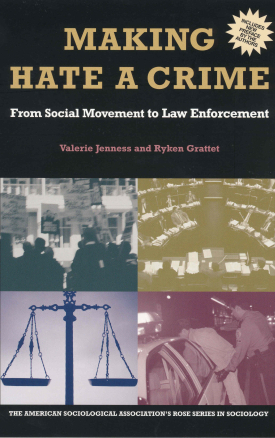
Making Hate a Crime
About This Book
A Volume in the American Sociological Association’s Rose Series in Sociology
Winner of the 2002 Outstanding Scholarship Award from the Crime and Delinquency Section of the Society for the Study of Social Problems
"As someone who has spent considerable time fighting and raising awareness of hate crimes, I am extremely impressed with this book's insightful analysis. It is exceptionally compelling work for those interested in understanding the intersection of civil rights, violence, and public policy. It's a must read for those who want to combat hate crime."
-U.S. Senator Dianne Feinstein (D-California)
"In this fascinating and important book, Valerie Jenness and Ryken Grattet show how social movement organizations, interest groups, and policy experts came to think that crimes motivated by hatred of social groups should be considered a special type of crime; how they managed to win media attention for this newly defined type of crime; how they convinced Congress and many state legislatures to accept their view and to enact hate crimes laws; how interpretations of hate crime laws by the courts and the police affect enforcement; and the impact hate crime laws are likely to have on American society. Making Hate a Crime is a well-written analysis of an important chapter in American politics, and will be of great interest to a wide audience concerned about hate crimes."
-Paul Burstein, University of Washington
"In their insightful new work, Jenness and Grattet effectively analyze the development of hate crime laws. How are we to explain the institutionalization of hate crime legislation? Was it a result of a rising tide of hate violence or simply the influence of interest group politics? This book presents a convincing case that it was neither. There are important sociological lessons to be learned from the pages of Making Hate a Crime."
-Jack Levin, Northeastern University
Violence motivated by racism, anti-Semitism, misogyny, and homophobia weaves a tragic pattern throughout American history. Fueled by recent high-profile cases, hate crimes have achieved an unprecedented visibility. Only in the past twenty years, however, has this kind of violence—itself as old as humankind—been specifically categorized and labeled as hate crime. Making Hate a Crime is the first book to trace the emergence and development of hate crime as a concept, illustrating how it has become institutionalized as a social fact and analyzing its policy implications.
In Making Hate a Crime Valerie Jenness and Ryken Grattet show how the concept of hate crime emerged and evolved over time, as it traversed the arenas of American politics, legislatures, courts, and law enforcement. In the process, violence against people of color, immigrants, Jews, gays and lesbians, women, and persons with disabilities has come to be understood as hate crime, while violence against other vulnerable victims-octogenarians, union members, the elderly, and police officers, for example-has not. The authors reveal the crucial role social movements played in the early formulation of hate crime policy, as well as the way state and federal politicians defined the content of hate crime statutes, how judges determined the constitutional validity of those statutes, and how law enforcement has begun to distinguish between hate crime and other crime. Hate crime took on different meanings as it moved from social movement concept to law enforcement practice. As a result, it not only acquired a deeper jurisprudential foundation but its scope of application has been restricted in some ways and broadened in others. Making Hate a Crime reveals how our current understanding of hate crime is a mix of political and legal interpretations at work in the American policymaking process. Jenness and Grattet provide an insightful examination of the birth of a new category in criminal justice: hate crime. Their findings have implications for emerging social problems such as school violence, television-induced violence, elder-abuse, as well as older ones like drunk driving, stalking, and sexual harassment. Making Hate a Crime presents a fresh perspective on how social problems and the policies devised in response develop over time.
VALERIE JENNESS is associate professor and chair of criminology, law, and society, as well as associate professor of sociology at the University of California, Irvine.
RYKEN GRATTET is associate professor of sociology at the University of California, Davis.