Books
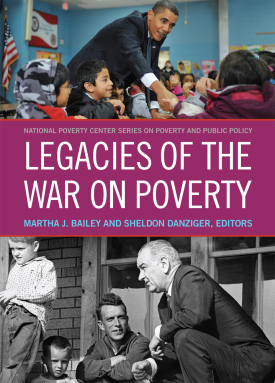
Legacies of the War on Poverty
About This Book
On the 50th anniversary of President Lyndon B. Johnson's declaration of "unconditional War on Poverty," January 8, 2014, the National Poverty Center at the University of Michigan's Gerald R. Ford School of Public Policy, the Russell Sage Foundation, and Spotlight on Poverty and Opportunity hosted a forum offering diverse perspectives on the effects of anti-poverty policies in the U.S. Click here to learn more about this special event.
“So, you thought we waged a war on poverty and lost? Well, actually, the record is a lot more nuanced than that, replete with both wins and losses, as this notable collection of essays by leading scholars demonstrates. Every serious student of poverty should read Legacies of the War on Poverty. So should many not-so-serious students.”
—ALAN S. BLINDER, Princeton University
“The War on Poverty, one of the most famous social experiments of the twentieth century, is conventionally represented as a failure second only to socialism. If you’re the type who prefers facts over sound bites, if you’re interested in the real legacy of this experiment, you’ll give Legacies of the War on Poverty pride of place on your bookshelf. With an all-star cast of contributors,
Legacies provides the definitive analysis of what worked and what didn’t, how our most cherished poverty-fighting institutions had their roots in the War, and why the expansive goals set out by President Johnson may yet be met. This is—quite simply—the best treatment ever of one of the grandest interventions ever.”
—DAVID B. GRUSKY, Stanford University
Many believe that the War on Poverty, launched by President Johnson in 1964, ended in failure. In 2010, the official poverty rate was 15 percent, almost as high as when the War on Poverty was declared. Historical and contemporary accounts often portray the War on Poverty as a costly experiment that created doubts about the ability of public policies to address complex social problems. Legacies of the War on Poverty, drawing from fifty years of empirical evidence, documents that this popular view is too negative. The volume offers a balanced assessment of the War on Poverty that highlights some remarkable policy successes and promises to shift the national conversation on poverty in America.
Featuring contributions from leading poverty researchers, Legacies of the War on Poverty demonstrates that poverty and racial discrimination would likely have been much greater today if the War on Poverty had not been launched. Chloe Gibbs, Jens Ludwig, and Douglas Miller dispel the notion that the Head Start education program does not work. While its impact on children’s test scores fade, the program contributes to participants’ long-term educational achievement and, importantly, their earnings growth later in life. Elizabeth Cascio and Sarah Reber show that Title I legislation reduced the school funding gap between poorer and richer states and prompted Southern school districts to desegregate, increasing educational opportunity for African Americans.
The volume also examines the significant consequences of income support, housing, and health care programs. Jane Waldfogel shows that without the era’s expansion of food stamps and other nutrition programs, the child poverty rate in 2010 would have been three percentage points higher. Kathleen McGarry examines the policies that contributed to a great success of the War on Poverty: the rapid decline in elderly poverty, which fell from 35 percent in 1959 to below 10 percent in 2010. Barbara Wolfe concludes that Medicaid and Community Health Centers contributed to large reductions in infant mortality and increased life expectancy. Katherine Swartz finds that Medicare and Medicaid increased access to health care among the elderly and reduced the risk that they could not afford care or that obtaining it would bankrupt them and their families.
Legacies of the War on Poverty demonstrates that well-designed government programs can reduce poverty, racial discrimination, and material hardships. This insightful volume refutes pessimism about the effects of social policies and provides new lessons about what more can be done to improve the lives of the poor.
MARTHA J. BAILEY is associate professor in the Department of Economics at the University of Michigan and faculty research fellow at the National Bureau of Economic Research.
SHELDON DANZIGER is the President of the Russell Sage Foundation. He was formerly the Henry J. Meyer Distinguished University Professor of Public Policy and director of the National Poverty Center at the Gerald R. Ford School of Public Policy at University of Michigan.
CONTRIBUTORS: Elizabeth Cascio, Chloe Gibbs, Harry J. Holzer, Bridget Terry Long, Jens Ludwig, Kathleen McGarry, Douglas L. Miller, Edgar O. Olsen,Sarah Heber, Katherine Swartz, Jane Waldfogel, Barbara Wolfe.
A Volume in the National Poverty Center Series on Poverty and Public Policy
Download
RSF Journal
View Book Series
Sign Up For Our Mailing List
Apply For Funding
Books
Fighting for Reliable Evidence
About This Book
“Truth-seeking social policymakers and serious students of social policy and social policy research will read and reread this book. Fighting for Reliable Evidence does not provide a permanent truth but it describes a forty-five year quest to understand what works and what does not work.”
—PAUL O’NEILL, former U.S. Secretary of the Treasury
“Fighting for Reliable Evidence is a fascinating review of the development of the commitment to use randomized experiments for learning about the effectiveness of current and proposed social welfare programs. It is written from two necessary perspectives: that of a pioneering government official striving to institutionalize experiments, and that of an innovator committed to developing an organization able to implement high-quality experiments. Between them, Judy Gueron and Howard Rolston demonstrate how feasible and useful experiments can be and have been. The history they tell is riveting, and the lessons they draw are compelling. No one else from inside the community of random assignment pioneers could have told it better. One day historians of science will use different assumptions to tell their version of the history of random assignment in the social sciences. But until then, this accessibly written book is THE history.”
—THOMAS D. COOK, Joan and Sarepta Harrison Chair of Ethics and Justice and Professor of Sociology, Psychology, and Education and Social Policy, Northwestern University
Once primarily used in medical clinical trials, random assignment experimentation is now accepted among social scientists across a broad range of disciplines. The technique has been used in social experiments to evaluate a variety of programs, from microfinance and welfare reform to housing vouchers and teaching methods. How did randomized experiments move beyond medicine and into the social sciences, and can they be used effectively to evaluate complex social problems? Fighting for Reliable Evidence provides an absorbing historical account of the characters and controversies that have propelled the wider use of random assignment in social policy research over the past forty years.
Drawing from their extensive experience evaluating welfare reform programs, noted scholar practitioners Judith M. Gueron and Howard Rolston portray randomized experiments as a vital research tool to assess the impact of social policy. In a random assignment experiment, participants are sorted into either a treatment group that participates in a particular program, or a control group that does not. Because the groups are randomly selected, they do not differ from one another systematically. Therefore any subsequent differences between the groups can be attributed to the influence of the program or policy. The theory is elegant and persuasive, but many scholars worry that such an experiment is too difficult or expensive to implement in the real world. Can a control group be truly insulated from the treatment policy? Would staffers comply with the random allocation of participants? Would the findings matter?
Fighting for Reliable Evidence recounts the experiments that helped answer these questions, starting with the income maintenance experiments and the Supported Work project in the 1960s and 1970s. Gueron and Rolston argue that a crucial turning point came during the 1980s, when Congress allowed states to experiment with welfare programs and foundations, states, and the federal government funded larger randomized trials to assess the impact of these reforms. As they trace these historical shifts, Gueron and Rolston discuss the ways that strategies for resolving theoretical and practical problems were developed, and they highlight the strict conditions required to execute a randomized experiment successfully. What emerges is a nuanced portrait of the potential and limitations of social experiments to advance empirical knowledge.
Weaving history, data analysis and personal experience, Fighting for Reliable Evidence offers valuable lessons for researchers, policymakers, funders, and informed citizens interested in isolating the effect of policy initiatives. It is an essential primer on welfare policy, causal inference, and experimental designs.
JUDITH M. GUERON is scholar in residence and President Emerita at MDRC.
HOWARD ROLSTON is principal associate at Abt Associates.
Related Events & Media
RSF Journal
View Book Series
Sign Up For Our Mailing List
Apply For Funding
Books
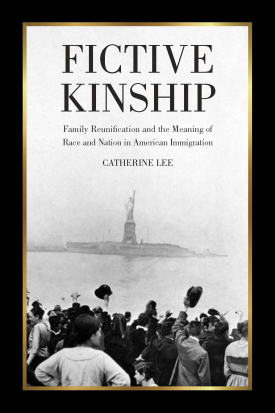
Fictive Kinship
Family Reunification and the Meaning of Race and Nation in American Immigration
About This Book
“Amid the current debates about immigration, highly skilled and unauthorized immigrants have taken the center stage. But in Catherine Lee’s carefully researched and written account, she reminds us that family unification remains the core of regular immigration policy. She traces family unification back to the nineteenth century and explains why families remain the core of policy and what the meaning of family is for racial and national issues. For those wanting to know what functions family unification serves for immigration policy, Fictive Kinship is required reading. Family unification will no doubt still be the core of policy. For, after all, what will become of the families of the undocumented who might become legal?”
—David M. Reimers, professor emeritus of history, New York University
“Fictive Kinship is a fascinating examination of what family has meant in the history of U.S. immigration. Family reunification has facilitated the entry of many immigrants, and as Professor Lee shows, it has done so long before passage of the 1965 Hart-Cellar Act. The book’s key contribution is showing how family has been fictively constructed, with its meaning shifting to support inclusionary and exclusionary positions and linked to ideas about the nation-state, race, and gender. This is critical reading for all those interested in immigration—and it reveals the critical place that the family plays in this process.”
—Katharine M. Donato, professor and chair, Department of Sociology, Vanderbilt University
Today, roughly 70 percent of all visas for legal immigration are reserved for family members of permanent residents or American citizens. Family reunification—policies that seek to preserve family unity during or following migration—is a central pillar of current immigration law, but it has existed in some form in American statutes since at least the mid-nineteenth century. In Fictive Kinship, sociologist Catherine Lee delves into the fascinating history of family reunification to examine how and why our conceptions of family have shaped immigration, the meaning of race, and the way we see ourselves as a country.
Drawing from a rich set of archival sources, Fictive Kinship shows that even the most draconian anti-immigrant laws, such as the Chinese Exclusion Act of 1882, contained provisions for family unity, albeit for a limited class of immigrants. Arguments for uniting families separated by World War II and the Korean War also shaped immigration debates and the policies that led to the landmark 1965 Immigration Act. Lee argues that debating the contours of family offers a ready set of symbols and meanings to frame national identity and to define who counts as “one of us.” Talk about family, however, does not inevitably lead to more liberal immigration policies. Welfare reform in the 1990s, for example, placed limits on benefits for immigrant families, and recent debates over the children of undocumented immigrants fanned petitions to rescind birthright citizenship. Fictive Kinship shows that the centrality of family unity in the immigration discourse often limits the discussion about the goals, functions and roles of immigration and prevents a broader definition of American identity.
Too often, studies of immigration policy focus on individuals or particular ethnic or racial groups. With its original and wide-ranging inquiry, Fictive Kinship shifts the analysis in immigration studies toward the family, a largely unrecognized but critical component in the regulation of immigrants’ experience in America.
CATHERINE LEE is associate professor of sociology and faculty associate at the Institute for Health, Health Care Policy, and Aging Research at Rutgers University.
Download
RSF Journal
View Book Series
Sign Up For Our Mailing List
Apply For Funding
Books
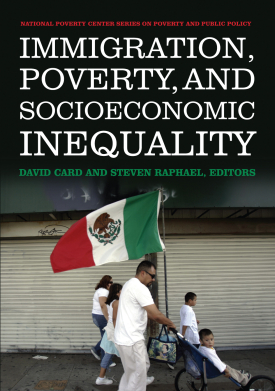
Immigration, Poverty, and Socioeconomic Inequality
About This Book
“Immigration, Poverty, and Socioeconomic Inequality offers a rigorous, multifaceted and up-to-the-minute reconsideration of the linkages between the historically high rates of U.S. immigration, the opportunities for economic advancement within and between generations, and the well-being of both immigrants and natives. It is a rare pleasure indeed when a group of distinguished scholars from across the spectrum of social sciences—economics, sociology, geography, and ethnography—join forces to mount a sustained intellectual advance on the frontier of a momentously important topic.”
—David Autor, professor and associate chair, Economics Department, MIT
“The highest and the lowest levels of education and poverty in the United States today are found among foreign-born ethnic groups. What has been the role of immigration in the widening of socioeconomic inequality? What have been the main modes of intergenerational mobility over time, between groups, and in different regions of the country? What sorts of public policies ameliorate, or exacerbate, such extraordinarily complex problems? This superb volume brings together two dozen leading economists and other social scientists to provide some of the most rigorous answers to these questions to date, setting the standard for future research into the immigration/poverty nexus.”
—Rubén G. Rumbaut, professor of sociology, University of California, Irvine
The rapid rise in the proportion of foreign-born residents in the United States since the mid-1960s is one of the most important demographic events of the past fifty years. The increase in immigration, especially among the less-skilled and less-educated, has prompted fears that the newcomers may have depressed the wages and employment of the native-born, burdened state and local budgets, and slowed the U.S. economy as a whole. Would the poverty rate be lower in the absence of immigration? How does the undocumented status of an increasing segment of the foreign-born population impact wages in the United States? In Immigration, Poverty and Socioeconomic Inequality, noted labor economists David Card and Steven Raphael and an interdisciplinary team of scholars provide a comprehensive assessment of the costs and benefits of the latest era of immigration to the United States.
Immigration, Poverty, and Socioeconomic Inequality rigorously explores shifts in population trends, labor market competition, and socioeconomic segregation to investigate how the recent rise in immigration affects economic disadvantage in the U.S. Giovanni Peri analyzes the changing skill composition of immigrants to the United States over the past two decades to assess their impact on the labor market outcomes of native-born workers. Despite concerns over labor market competition, he shows that the overall effect has been benign for most native groups. Moreover, immigration appears to have had negligible impacts on native poverty rates. Ethan Lewis examines whether differences in English proficiency explain this lack of competition between immigrant and native-born workers. He finds that parallel Spanish-speaking labor markets emerge in areas where Spanish speakers are sufficiently numerous, thereby limiting the impact of immigration on the wages of native-born residents. While the increase in the number of immigrants may not necessarily hurt the job prospects of native-born workers, low-skilled migration appears to suppress the wages of immigrants themselves. Michael Stoll shows that linguistic isolation and residential crowding in specific metropolitan areas has contributed to high poverty rates among immigrants. Have these economic disadvantages among low-skilled immigrants increased their dependence on the U.S. social safety net? Marianne Bitler and Hilary Hoynes analyze the consequences of welfare reform, which limited eligibility for major cash assistance programs. Their analysis documents sizable declines in program participation for foreign-born families since the 1990s and suggests that the safety net has become less effective in lowering child poverty among immigrant households.
As the debate over immigration reform reemerges on the national agenda, Immigration, Poverty, and Socioeconomic Inequality provides a timely and authoritative review of the immigrant experience in the United States. With its wealth of data and intriguing hypotheses, the volume is an essential addition to the field of immigration studies.
DAVID CARD is Class of 1950 Professor of Economics at the University of California, Berkeley.
STEVEN RAPHAEL is professor of public policy at the Goldman School of Public Policy at the University of California, Berkeley.
CONTRIBUTORS: Marianne P. Bitler, Irene Bloemraad, Sarah Bohn, Chistian Dustmann, Mark Ellis, Cybelle Fox, Tomasso Frattini, Robert G. Gonzales, Hilary W. Hoynes, Christel Kelser, Jennifer Lee, Ethan Lewis, Magnus Lofstrom, Renee Reichl Luthra, Douglas S. Massey, Giovanni Peri, Michael A. Stoll, Matthew Townley, Roger Waldinger, Richard Wright, Min Zhou.
A Volume in the National Poverty Center Series on Poverty and Public Policy
RSF Journal
View Book Series
Sign Up For Our Mailing List
Apply For Funding
Our latest U.S. 2010 report examines segregation levels and demographic trends among Asian Americans. Here is the abstract and some of the report's main findings:
This report summarizes what we know now about America’s several Asian minorities: their origins and growth, trends in their location within the country, their heterogeneity in social background and economic achievement, and their pattern of neighborhood settlement.
- The total Asian population more than doubled in two decades, reaching nearly 18 million. It is now almost as large as the Hispanic population was in 1990. The Indian population has grown fastest, now nearly four times its size in 1990.
- Most Asian nationalities remain predominantly foreign-born, as the pace of immigration keeps up with the growth of second and later generations in the U.S. The exception is Japanese, who are only 40.5% immigrant.
- Asians’ socioeconomic status was generally on a par with non-Hispanic whites (and therefore higher than Hispanics or African Americans). Indians and Japanese are the more advantaged nationalities, while Vietnamese have the highest unemployment, lowest income, and least education among these groups.
- Though a majority of Hawaiian residents are Asian, the largest numbers of most Asian groups are found in California (especially the Los Angeles metro and San Francisco Bay Area) and New York. Los Angeles’s Asian population has significantly greater shares of Filipinos, Japanese and Koreans, while New York is tilted toward Chinese and Indians.
- Although residential segregation of Asians within metropolitan areas has repeatedly been reported to be considerably lower than that of other minorities, the Chinese and Indian levels of segregation are as high as Hispanics and Vietnamese segregation is almost as high as that of African Americans. Segregation of Asian nationalities in Los Angeles and New York is even higher than the national metro average.
- Despite high segregation, every Asian nationality except Vietnamese lives on average in neighborhoods with higher income and share of college educated residents than do non-Hispanic whites. Vietnamese are nearly on par with the average white’s neighborhood.
- The Asian neighborhood advantage is most pronounced in the suburbs, supporting the characterization of Asian “ethnoburbs” in metropolitan regions with large Asian minorities.