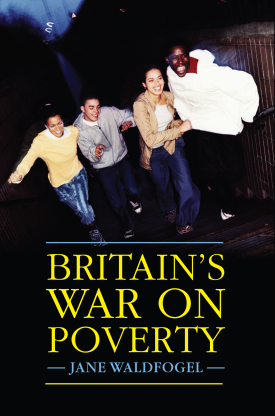
Britain's War on Poverty
About This Book
“[Waldfogel’s] carefully researched and balanced account demonstrates that committed governments can indeed implement social policies that improve the well-being of their citizens. Her very readable assessment of the British experiment also has relevance for other countries, especially the United States, and her excellent book deserves to be widely consulted.”
—POLITICAL SCIENCE QUARTERLY
“A developed country declaring a major war on poverty comes around once in a generation. People will want to know why they did it, how they went about it, but, even more crucially what the impact was on children. This book is the only one to cover all these dimensions and to do it with style. Britain’s War on Poverty isn’t about Britain—it’s about declaring war on poverty.”
—PAUL GREGG, University of Bristol
“America had a war on poverty and poverty won; the United Kingdom has waged the same war and is winning it by making steady progress against child poverty. Their child poverty rate is down by half from its starting point, and children are demonstrably better off based on polices they adopted and consistently financed and delivered. Why did the Brits do so much better than the Americans? This splendid book convincingly shows why and how a ‘true to its aims,’ well-financed, and persistent war on poverty can work in an Anglo- Saxon democracy. Jane Waldfogel shows how and why policy can make a difference against poverty if it is a high priority for a nation. Britain’s War on Poverty should be widely and carefully read by social policy analysts and advocates who seek a better future for America’s young children.”
—TIMOTHY M. SMEEDING, University of Wisconsin–Madison
“This timely volume tells the remarkable story of the British government’s attempt to end child poverty. Professor Waldfogel, who resides in the United Kingdom for several months every year, tells the story with color and passion, emphasizing the similarities and differences between anti-poverty policy in the United States and Britain. Perhaps most interesting and provocative are the lessons she draws from the British experience for a more sweeping commitment by America to greatly reduce the nation’s child poverty rate, which is now higher than it was in the 1970s. Scholars, advocates, and policymakers committed to reducing child poverty will find Britain’s War on Poverty packed with insights about how we should proceed.”
—RON HASKINS, Brookings Institution
In 1999, one in four British children lived in poverty—the third highest child poverty rate among industrialized countries. Five years later, the child poverty rate in Britain had fallen by more than half in absolute terms. How did the British government accomplish this and what can the United States learn from the British experience? Jane Waldfogel offers a sharp analysis of the New Labour government’s anti-poverty agenda, its dramatic early success and eventual stalled progress. Comparing Britain’s anti-poverty initiative to U.S. welfare reform, the book shows how the policies of both countries have affected child poverty, living standards, and well-being in low-income families and suggests next steps for future reforms.
Britain’s War on Poverty evaluates the three-pronged anti-poverty strategy employed by the British government and what these efforts accomplished. British reforms sought to promote work and make work pay, to increase financial support for families with children, and to invest in the health, early-life development, and education of children. The latter two features set the British reforms apart from the work-oriented U.S. welfare reforms, which did not specifically target income or program supports for children. Plagued by premature initiatives and what some experts called an overly ambitious agenda, the British reforms fell short of their intended goal but nevertheless significantly increased single-parent employment, raised incomes for low-income families, and improved child outcomes. Poverty has fallen, and the pattern of low-income family expenditures on child enrichment and healthy food has begun to converge with higher-income families.
As Waldfogel sees it, further success in reducing child poverty in Britain will rely on understanding who is poor and who is at highest risk. More than half of poor children live in families where at least one parent is working, followed by unemployed single- and two-parent homes, respectively. Poverty rates are also notably higher for children with disabled parents, large families, and for Pakistani and Bangladeshi children. Based on these demographics, Waldfogel argues that future reforms must, among other goals, raise working-family incomes, provide more work for single parents, and better engage high-risk racial and ethnic minority groups.
What can the United States learn from the British example? Britain’s War on Poverty is a primer in the triumphs and pitfalls of protracted policy. Notable differences distinguish the British and U.S. models, but Waldfogel asserts that a future U.S. poverty agenda must specifically address child poverty and the income inequality that helps create it. By any measurement and despite obstacles, Britain has significantly reduced child poverty. The book’s key lesson is that it can be done.
JANE WALDFOGEL is professor of social work and public affairs at the Columbia University School of Social Work and visiting professor at the Centre for Analysis of Social Exclusion at the London School of Economics and Political Science.