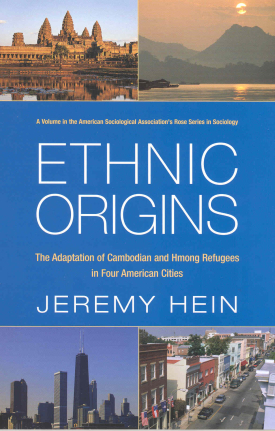
Ethnic Origins
About This Book
A Volume in the American Sociological Association’s Rose Series in Sociology
"In Ethnic Origins Jeremy Hein offers important insights into the ways in which two groups of Southeast Asian refugees to the United States-the animist Hmong, a distinct minority community in Laos, and the Buddhist Khmer, members of the Cambodian majority-become ethnic Americans. This many faceted study of adaptation and acculturation and the varied courses these two very different cultural groups follow is at once an informative, critical, and evocative examination of the backgrounds and experiences of what Hein calls some inconspicuous people living in 'some obscure places.' It is something more as well. Ethnic Origins is a fine example of the use of multiple methods of data-gathering-historical and archival research, structured surveys, focused interviews, and peer-group conversations, and a model of concise and compelling investigative reporting."
-PETER I. ROSE, Smith College
"In this meticulously researched and well-written book, Professor Hein offers a much-needed analysis of the impact of ethnic cultures on the experience of contemporary immigrants. His comparative methodology offers a powerful lens on these issues. Ethnic Origins is essential reading for those who are interested in the complex impact of history, culture, and structural location on the adaptation of immigrants."
-NAZLI KIBRIA, Boston University
"This impressive, in-depth study of Hmong and Cambodian refugees and immigrants in the United States is com parative in several senses of that word. Jeremy Hein examines the similarities and differences between the two groups by looking at their 'ethnic origins'-a shorthand moniker for their homeland histories, politics, social struc tures, and cultures-as well as the impact of locational characteristics on their patterns of adaptation. By analyz ing two large cities and two smaller towns, Hein concludes that the differences in locational characteristics have a lesser impact than ethnic origins. The book also sheds new light on how ethnic origins help filter the Hmong and Cambodian interactions with other peoples of color (especially African Americans and Asian Americans) and with European Americans. Most notably, Hein succinctly compares his own complex theoretical framework with those used by other social scientists. I know of no other studies that analyze key issues at both the theoretical and public-policy levels so systematically. A truly laudable achievement, this book encourages us to see race, ethnicity, and contemporary immigration into the United States in fresh and multidimensional ways."
-SUCHENG CHAN, University of California, Santa Barbara
"Ethnic Origins is an ambitious and original study of Cambodian and Hmong refugees in four midwestern loca tions that highlights the impact of distinctive ethnic origins-homeland histories, cultures, and politics-as well as the nature of place of settlement on the immigrant experience. The book is full of interesting material and contributes to our understanding of a host of topics in the immigration field, including the formation of pan-ethnic identities and the kind of welcome immigrants receive in small town white America as compared to large and diverse urban centers."
-NANCY FONER, Hunter College and the Graduate Center of the City University of New York
Immigration studies have increasingly focused on how immigrant adaptation to their new homelands is influenced by the social structures in the sending society, particularly its economy. Less scholarly research has focused on the ways that the cultural make-up of immigrant homelands influences their adaptation to life in a new country. In Ethnic Origins, Jeremy Hein investigates the role of religion, family, and other cultural factors on immigrant incorporation into American society by comparing the experiences of two little-known immigrant groups living in four different American cities not commonly regarded as immigrant gateways.
Ethnic Origins provides an in-depth look at Hmong and Khmer refugees—people who left Asia as a result of failed U.S. foreign policy in their countries. These groups share low socio-economic status, but are vastly different in their norms, values, and histories. Hein compares their experience in two small towns—Rochester, Minnesota and Eau Claire, Wisconsin—and in two big cities—Chicago and Milwaukee—and examines how each group adjusted to these different settings. The two groups encountered both community hospitality and narrow-minded hatred in the small towns, contrasting sharply with the cold anonymity of the urban pecking order in the larger cities. Hein finds that for each group, their ethnic background was more important in shaping adaptation patterns than the place in which they settled. Hein shows how, in both the cities and towns, the Hmong’s sharply drawn ethnic boundaries and minority status in their native land left them with less affinity for U.S. citizenship or “Asian American” panethnicity than the Khmer, whose ethnic boundary is more porous. Their differing ethnic backgrounds also influenced their reactions to prejudice and discrimination. The Hmong, with a strong group identity, perceived greater social inequality and supported collective political action to redress wrongs more than the individualistic Khmer, who tended to view personal hardship as a solitary misfortune, rather than part of a larger-scale injustice.
Examining two unique immigrant groups in communities where immigrants have not traditionally settled, Ethnic Origins vividly illustrates the factors that shape immigrants’ response to American society and suggests a need to refine prevailing theories of immigration. Hein’s book is at once a novel look at a little-known segment of America’s melting pot and a significant contribution to research on Asian immigration to the United States.
JEREMY HEIN is professor of sociology at the University of Wisconsin, Eau Claire.