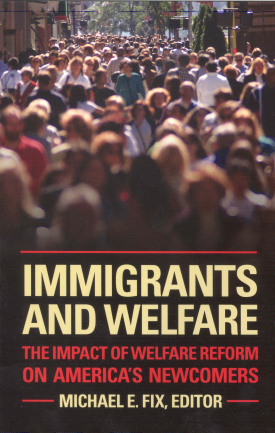
Immigrants and Welfare
About This Book
"Immigrants and Welfare assembles the authoritative set of papers on the history, law, and social science of immigration and welfare reform. It is required reading as the United States prepares for an epic exploration of immigration and immigrants in a well-ordered society: How do societies recruit their members? What are the criteria for membership? What characteristics are desirable and undesirable in recruits? What characteristics merit differential treatment? How do societies mentor their recruits? How do societies put boundaries on their bounty?"
-GUILLERMINA JASSO, Silver Professor, Department of Sociology, New York University
"In the mid-1990s, the U.S. government not only 'ended welfare as we know it,' but it also fundamentally altered its relationships with immigrants and their progeny through changes in welfare and immigration law that have been much less well-regarded in policy and research circles. The legislative changes created new distinctions in the definition of what it meant to be a member of U.S. society and to be eligible for needed assistance, drawing sharper lines between immigrants and natives, and within groups of immigrants. In this incisive volume, Michael E. Fix and his colleagues give us the most comprehensive compilation of the evidence on immigrants' use of public benefits before and after welfare reform. It both challenges some of the popular misconceptions about immigrants' costs to the polity that fueled a backlash against newcomers to the country in the welfare and immigration law changes of the 1990s, and vigorously informs us about the impacts of those changes for immigrants and their children. Immigrants and Welfare is timely and much-needed. Just as the nation prepares in the coming year to debate necessary comprehensive immigration reform, we can only hope that our leaders take these facts into account and lead us to where the evidence and our values suggest is a better place."
-AJAY CHAUDRY, director, Center on Labor, Human Services, and Population, The Urban Institute
"Immigrants and Welfare takes a careful look at the aftermath of the landmark welfare reform legislation of the mid-1990s. The volume's contributors examine the reweaving of the American safety net for immigrants and their families, both citizens and noncitizens. The research challenges oft-made assertions that the U.S. welfare system provides a strong magnet for immigrants destined to become dependent on public assistance, and instead points to the potential benefits of providing more coherent and less restrictive policies for new arrivals and their families. This informed volume is necessary reading for those interested in the continuing debate of U.S. immigration policy."
-MICHAEL J. WHITE, professor of sociology and director, Population Studies and Training Center, Brown University
The lore of the immigrant who comes to the United States to take advantage of our welfare system has a long history in America’s collective mythology, but it has little basis in fact. The so-called problem of immigrants on the dole was nonetheless a major concern of the 1996 welfare reform law, the impact of which is still playing out today. While legal immigrants continue to pay taxes and are eligible for the draft, welfare reform has severely limited their access to government supports in times of crisis. Edited by Michael Fix, Immigrants and Welfare rigorously assesses the welfare reform law, questions whether its immigrant provisions were ever really necessary, and examines its impact on legal immigrants’ ability to integrate into American society.
Immigrants and Welfare draws on fields from demography and law to developmental psychology. The first part of the volume probes the politics behind the welfare reform law, its legal underpinnings, and what it may mean for integration policy. Contributor Ron Haskins makes a case for welfare reform’s ultimate success but cautions that excluding noncitizen children (future workers) from benefits today will inevitably have serious repercussions for the American economy down the road. Michael Wishnie describes the implications of the law for equal protection of immigrants under the U.S. Constitution.
The second part of the book focuses on empirical research regarding immigrants’ propensity to use benefits before the law passed, and immigrants’ use and hardship levels afterwards. Jennifer Van Hook and Frank Bean analyze immigrants’ benefit use before the law was passed in order to address the contested sociological theories that immigrants are inclined to welfare use and that it slows their assimilation. Randy Capps, Michael Fix, and Everett Henderson track trends before and after welfare reform in legal immigrants’ use of the major federal benefit programs affected by the law. Leighton Ku looks specifically at trends in food stamps and Medicaid use among noncitizen children and adults and documents the declining health insurance coverage of noncitizen parents and children. Finally, Ariel Kalil and Danielle Crosby use longitudinal data from Chicago to examine the health of children in immigrant families that left welfare.
Even though few states took the federal government’s invitation with the 1996 welfare reform law to completely freeze legal immigrants out of the social safety net, many of the law’s most far-reaching provisions remain in place and have significant implications for immigrants. Immigrants and Welfare takes a balanced look at the politics and history of immigrant access to safety-net supports and the ongoing impacts of welfare.
MICHAEL E. FIX is senior vice president and director of studies at the Migration Policy Institute (MPI) and co-director of MPI’s National Center on Immigrant Integration Policy.
CONTRIBUTORS: Michael E. Fix, Frank D. Bean, Randy Capps, Danielle A. Crosby, Ron Haskins, Everett Henderson, Ariel Kalil, Neeraj Kaushal, Leighton Ku, Jennifer Van Hook, and Michael J. Wishnie.
Copublished with the Migration Policy Institute