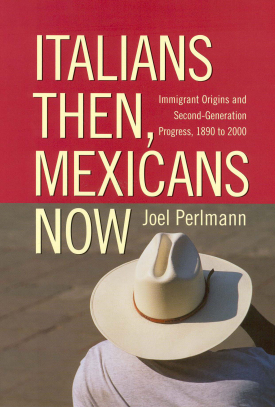
Italians Then, Mexicans Now
About This Book
"[N]ot only makes interesting reading, but also brings some clarifying historical insights to the immigration debate."
-Industrial and Labor Relations Review
"Will today's Mexican immigrants and their children follow the paths of the Italians and Poles of a century ago in moving up the economic ladder? Joel Perlmann's carefully drawn analysis tackles this much-debated question through a detailed and thoughtfully argued comparison of the Mexican second generation of today and the European second generation of the past. This insightful and stimulating book under scores the great value of past-present comparisons for understanding the trajectories of contemporary immigrants and their children."
-NANCY FONER, Hunter College and the Graduate Center of the City University of New York
"Italians Then, Mexicans Now is essential reading for anyone who hopes to make sense of the prospects of today's immigrants and their children, especially for groups like the Mexicans that are trapped in low-wage labor."
-RICHARD ALBA, Distinguished Professor, State University of New York, Albany
According to the American dream, hard work and a good education can lift people from poverty to success in the "land of opportunity." The unskilled immigrants who came to the United States from southern, central, and eastern Europe in the late 19th and early 20th centuries largely realized that vision. Within a few generations, their descendants rose to the middle class and beyond. But can today’s unskilled immigrant arrivals—especially Mexicans, the nation's most numerous immigrant group—expect to achieve the same for their descendants? Social scientists disagree on this question, basing their arguments primarily on how well contemporary arrivals are faring. In Italians Then, Mexicans Now, Joel Perlmann uses the latest immigration data as well as 100 years of historical census data to compare the progress of unskilled immigrants and their American-born children both then and now.
The crucial difference between the immigrant experience a hundred years ago and today is that relatively well-paid jobs were plentiful for workers with little education a hundred years ago, while today's immigrants arrive in an increasingly unequal America. Perlmann finds that while this change over time is real, its impact has not been as strong as many scholars have argued. In particular, these changes have not been great enough to force today’s Mexican second generation into an inner-city "underclass." Perlmann emphasizes that high school dropout rates among second-generation Mexicans are alarmingly high, and are likely to have a strong impact on the group’s well-being. Yet despite their high dropout rates, Mexican Americans earn at least as much as African Americans, and they fare better on social measures such as unwed childbearing and incarceration, which often lead to economic hardship. Perlmann concludes that inter-generational progress, though likely to be slower than it was for the European immigrants a century ago, is a reality, and could be enhanced if policy interventions are taken to boost high school graduation rates for Mexican children.
Rich with historical data, Italians Then, Mexicans Now persuasively argues that today’s Mexican immigrants are making slow but steady socio-economic progress and may one day reach parity with earlier immigrant groups who moved up into the heart of the American middle class.
JOEL PERLMANN is senior scholar at the Levy Economics Institute of Bard College and the Levy Institute Research Professor at the college.
Copublished with the Levy Economics Institute of Bard College