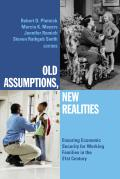
Old Assumptions, New Realities
About This Book
“Old Assumptions, New Realities deserves the attention of welfare analysts and policy-makers on both sides of the Atlantic as one of the first publications to tackle the future of the American welfare state.”
—SOCIOLOGICAL REVIEW
“[A]n impressive display of imaginative policy analysis that is practical, fact-based, value-laden, and thoughtful. This book is a must-read for sociologists interested in the evolution of new social policies and interested publics who are concerned that too many Americans are facing economic and social catastrophe.”
—CONTEMPORARY SOCIOLOGY
“Old Assumptions, New Realities brings together an impressive set of scholars offering new perspectives drawn from a rich diversity of disciplines and methods. By highlighting the key assumptions that underlie the U.S. social welfare system and whether these assumptions are appropriate, this book offers important insights on fundamental questions for social policy and research.”
—MARIA CANCIAN, professor of public affairs and social work and research affiliate, the Institute for Research on Poverty, the University of Wisconsin–Madison
“Ambitious and bold, Old Assumptions, New Realities challenges the reader to think about the huge gap between the old assumptions underlying the American welfare state and the new economic and social realities in which American families and children live. The editors and authors also offer a cornucopia of practical good ideas to narrow the gap.”
—IRWIN GARFINKEL, Mitchell I. Ginsberg Professor of Contemporary Urban Problems and codirector of the Population Research Center, Columbia University
“Over the past few decades, changes in labor markets and public policies have cast American families into a new era of insecurity. For low-skilled workers, the erosion of wages and paths to advancement has been exacerbated by a growing mismatch between social protections and social needs. How should we understand the new challenges we face, and how can we meet them effectively? Old Assumptions, New Realities is essential reading for anyone who seeks thoughtful and creative answers to these questions. The leading scholars assembled here provide a lucid and compelling analysis of the problem and offer innovative ideas for reform. This is publicly engaged social science at its best—an important intervention in public debate that is rooted in the best available research.”
—JOE SOSS, Cowles Chair for the Study of Public Service at the University of Minnesota
The way Americans live and work has changed significantly since the creation of the Social Security Administration in 1935, but U.S. social welfare policy has failed to keep up with these changes. The model of the male breadwinner-led nuclear family has given way to diverse and often complex family structures, more women in the workplace, and nontraditional job arrangements. Old Assumptions, New Realities identifies the tensions between twentieth-century social policy and twenty-first-century realities for working Americans and offers promising new reforms for ensuring social and economic security.
Old Assumptions, New Realities focuses on policy solutions for today’s workers—particularly low-skilled workers and low-income families. Contributor Jacob Hacker makes strong and timely arguments for universal health insurance and universal 401(k) retirement accounts. Michael Stoll argues that job training and workforce development programs can mitigate the effects of declining wages caused by deindustrialization, technological changes, racial discrimination, and other forms of job displacement. Michael Sherraden maintains that wealth-building accounts for children—similar to state college savings plans—and universal and progressive savings accounts for workers can be invaluable strategies for all workers, including the poorest. Jody Heymann and Alison Earle underscore the potential for more extensive work-family policies to help the United States remain competitive in a globalized economy. Finally, Jodi Sandfort suggests that the United States can restructure the existing safety net via state-level reforms but only with a host of coordinated efforts, including better information to service providers, budget analyses, new funding sources, and oversight by intermediary service professionals.
Old Assumptions, New Realities picks up where current policies leave off by examining what’s not working, why, and how the safety net can be redesigned to work better. The book brings much-needed clarity to the process of creating viable policy solutions that benefit all working Americans.
ROBERT D. PLOTNICK is professor of public affairs and adjunct professor of economics at the University of Washington.
MARCIA K. MEYERS is associate professor of social work and public affairs at the University of Washington.
JENNIFER ROMICH is associate professor of social work at the University of Washington.
STEVEN RATHGEB SMITH is Nancy Bell Evans Professor of Public Affairs at the Daniel J. Evans School of Public Affairs, University of Washington.
A West Coast Poverty Center Volume