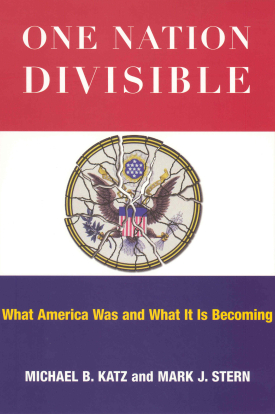
One Nation Divisible
About This Book
"Most of the book's facts and interpretations will be familiar to American historians and sociologists, but they can be thankful to have them integrated in a single, well-organized survey."
-THE JOURNAL OF AMERICAN HISTORY
"In this richly documented history, Michael B. Katz and Mark J. Stern brilliantly capture the dynamics of change and continuity that have shaped American society since the beginning of the twentieth century. With narrative grace and analytic rigor, they tell a story that weaves large-scale structural forces into the fabric of everyday life, and that challenges comforting notions about what it is that separates us from the past. Above all, it is a story that opens our eyes to the new, and old, and in some ways hardening patterns of inequality that continue to divide the United States in the new millennium. For historians, social scientists, and general readers alike, One Nation Divisible is an invaluable resource for understanding the nature, consequences, and manifestations of enduring inequality in a society that claims to embrace opportunity as its defining theme."
-ALICE O'CONNOR, associate professor of history, University of California, Santa Barbara
"To know where you are going, you need to know where you have been. No other book to my knowledge so succinctly, yet so masterfully, teases out the patterns and processes for the 'American Century,' providing both guidebook and compass for our history and identity-and for what we must confront to realize the American Dream for all."
-MIKE ROSE, professor of education, University of California, Los Angeles
"In One Nation Divisible, Michael B. Katz and Mark J. Stern offer a masterful review of how the United States came apart socially, economically, and demographically in the early decades of the twentieth century, how government was instrumental in putting the nation back together again in the wake of the Great Depression, and how social changes and economic transformations after the 1970s have combined with passive government and weak public leadership to divide us once again. Let us hope that many read this book to learn that government is not antithetical to a healthy market economy, but essential to its short-term viability and long-term success."
-DOUGLAS S. MASSEY, professor of sociology and public affairs, Office of Population Research, Princeton University and codirector of the Mexican Migration Project
American society today is hardly recognizable from what it was a century ago. Integrated schools, an information economy, and independently successful women are just a few of the remarkable changes that have occurred over just a few generations. Still, the country today is influenced by many of the same factors that revolutionized life in the late nineteenth century—immigration, globalization, technology, and shifting social norms—and is plagued by many of the same problems—economic, social, and racial inequality. One Nation Divisible, a sweeping history of twentieth-century American life by Michael B. Katz and Mark J. Stern, weaves together information from the latest census with a century’s worth of data to show how trends in American life have changed while inequality and diversity have endured.
One Nation Divisible examines all aspects of work, family, and social life to paint a broad picture of the American experience over the long arc of the twentieth century. Katz and Stern track the transformations of the U.S. workforce, from the farm to the factory to the office tower. Technological advances at the beginning and end of the twentieth century altered the demand for work, causing large population movements between regions. These labor market shifts fed both the explosive growth of cities at the dawn of the industrial age and the sprawling suburbanization of today. One Nation Divisible also discusses how the norms of growing up and growing old have shifted. Whereas the typical life course once involved early marriage and living with large, extended families, Americans today commonly take years before marrying or settling on a career path, and often live in non-traditional households. Katz and Stern examine the growing influence of government on trends in American life, showing how new laws have contributed to more diverse neighborhoods and schools, and increased opportunities for minorities, women, and the elderly. One Nation Divisible also explores the abiding economic paradox in American life: while many individuals are able to climb the financial ladder, inequality of income and wealth remains pervasive throughout society.
The last hundred years have been marked by incredible transformations in American society. Great advances in civil rights have been tempered significantly by rising economic inequality. One Nation Divisible provides a compelling new analysis of the issues that continue to divide this country and the powerful role of government in both mitigating and exacerbating them.
MICHAEL B. KATZ is Walter H. Annenberg Professor of History and research associate at the Population Studies Center at the University of Pennsylvania.
MARK J. STERN is professor of social welfare and history in the School of Social Work at the University of Pennsylvania.
A Volume in the RSF Census Series