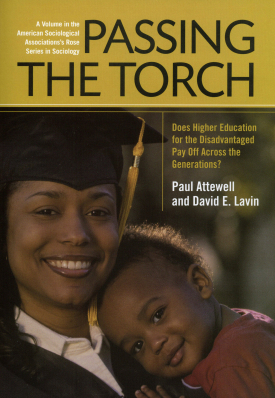
Passing the Torch
About This Book
A Volume in the American Sociological Association’s Rose Series in Sociology
Winner of the 2009 Grawemeyer Award for the Best Book in Education
Winner of the 2009 Outstanding Book Award of the American Educational Research Association
"Passing the Torch moves beyond the immediate goals of open admission to explore outcomes in the second generation .... In short, the middle-class boost that a CUNY education represented for these women did not fade away; their children did not regress to the earlier patterns of their grandparents' generation. Some questions remain. Did standards erode over time as charged? Were subsequent cohorts as fortunate as the first? For now, evidence trumps rhetoric and the evidence shows open admissions delivered on its promises."
-CONTEMPORARY SOCIOLOGY
"Passing the Torch provides compelling new evidence on the benefits of college enrollment for disadvantaged Americans often seen as not 'college material.' The authors track the career histories of almost two thousand women from low-income families who enrolled in one of the seventeen campuses of the City University of New York in the 1970s under its open admissions program .... The book makes a compelling case that public higher education is still a critically important mechanism for social mobility in the United States and that making college attainable for low-income youth deserves a top spot on the domestic policy agenda."
-RICHARD J. MURNANE, Thompson Professor of Education and Society, Harvard University Graduate School of Education
"Like the 1944 GI Bill, open admissions at CUNY and elsewhere opened college for those who had never dreamed it was possible. Passing the Torch shows how open access programs affected the first generation's occupations, earnings, family structure, asset accumulation, childrearing practices, community involvement, and paid dividends for the second generation's cognitive development and educational success .... The prose is lucid, the data are compelling, and the issues are urgent. Passing the Torch is must reading for anyone concerned about higher education, social policy, educational equity, families, race, children, and national productivity."
-CAROLINE HODGES PERSELL, professor of sociology, New York University
"This remarkable book will give a much-needed jolt to the conventional wisdom about open-access higher education. ... A landmark study, Passing the Torch vividly documents the critical role that open access continues to play in keeping the American dream alive for our least advantaged citizens. It is destined to take its place alongside Bowen and Bok's The Shape of the River as one of the best books on the impact of higher education on opportunity in America."
-JEROME KARABEL, professor of sociology, University of California, Berkeley
The steady expansion of college enrollment rates over the last generation has been heralded as a major step toward reducing chronic economic disparities. But many of the policies that broadened access to higher education—including affirmative action, open admissions, and need-based financial aid—have come under attack in recent years by critics alleging that schools are admitting unqualified students who are unlikely to benefit from a college education. In Passing the Torch, Paul Attewell, David Lavin, Thurston Domina, and Tania Levey follow students admitted under the City University of New York’s “open admissions” policy, tracking its effects on them and their children, to find out whether widening college access can accelerate social mobility across generations.
Unlike previous research into the benefits of higher education, Passing the Torch follows the educational achievements of three generations over thirty years. The book focuses on a cohort of women who entered CUNY between 1970 and 1972, when the university began accepting all graduates of New York City high schools and increasing its representation of poor and minority students. The authors survey these women in order to identify how the opportunity to pursue higher education affected not only their long-term educational attainments and family well-being, but also how it affected their children’s educational achievements. Comparing the record of the CUNY alumnae to peers nationwide, the authors find that when women from underprivileged backgrounds go to college, their children are more likely to succeed in school and earn college degrees themselves. Mothers with a college degree are more likely to expect their children to go to college, to have extensive discussions with their children, and to be involved in their children’s schools. All of these parenting behaviors appear to foster higher test scores and college enrollment rates among their children. In addition, college-educated women are more likely to raise their children in stable two-parent households and to earn higher incomes; both factors have been demonstrated to increase children’s educational success.
The evidence marshaled in this important book reaffirms the American ideal of upward mobility through education. As the first study to indicate that increasing access to college among today’s disadvantaged students can reduce educational gaps in the next generation, Passing the Torch makes a powerful argument in favor of college for all.
PAUL ATTEWELL and DAVID LAVIN are professors of sociology in the Graduate Center at the City University of New York.