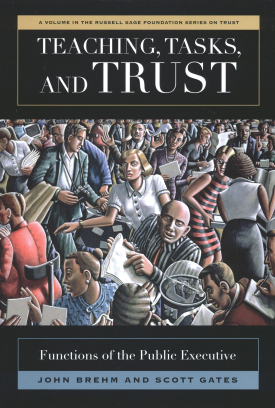
Teaching, Tasks, and Trust
About This Book
"John Brehm and Scott Gates are two of the only political scientists working today who actually take an interest in how government organizations work and how to improve their performance. They also bring enormous talent and empirical sophistication to their efforts. The result in Teaching, Tasks, and Trust is a delight to read-good social science that addresses practical questions of the performance of government organizations."
-STEVE KELMAN, Albert J. Weatherhead III and Richard W. Weatherhead Professor of Public Management, Kennedy School of Government, Harvard University
"The dominant paradigm in the study of bureaucracy holds that the manager's job is to design incentives to shape the self-interested response of subordinates. Swimming against the tide, John Brehm and Scott Gates show that there is a lot more to it than that. Teaching, Tasks, and Trust demonstrates that there are a number of subtle but fundamental tasks that are key to successful management, including 'providing political cover' for subordinates in order to build trust. These are lessons that should (but probably won't) change the way management is taught in business or public policy schools."
-GARY MILLER, professor of political science, Washington University in St. Louis
The mere word “bureaucracy” brings to mind images of endless lines, piles of paperwork, and frustrating battles over rules and red tape. But some bureaucracies are clearly more efficient and responsive than others. Why? In Teaching, Tasks, and Trust, distinguished political scientists John Brehm and Scott Gates show that a good part of the answer may be found in the roles that middle managers play in teaching and supporting the front-line employees who make a bureaucracy work.
Brehm and Gates employ a range of sophisticated modeling and statistical methods in their analysis of employees in federal agencies, police departments, and social service centers. Looking directly at what front-line workers say about their supervisors, they find that employees who feel they have received adequate training have a clearer understanding of the agency’s mission, which leads to improved efficiency within their departments. Quality training translates to trust – employees who feel supported and well-trained for the job are more likely to trust their supervisors than those who report being subject to constant monitoring and a strict hierarchy. Managers who “stand up” for employees—to media, government, and other agency officials—are particularly effective in cultivating the trust of their workers. And trust, the authors find, motivates superior job performance and commitment to the agency’s mission. Employees who trust their supervisors report that they work harder, put in longer hours, and are less likely to break rules. The authors extend these findings to show that once supervisors grain trust, they enjoy greater latitude in influencing how employees allocate their time while working.
Brehm and Gates show how these three executive roles are interrelated—training and protection for employees gives rise to trust, which provides supervisors with the leverage to stimulate improved performance among their workers. This new model—which frames supervisors as teachers and protectors instead of taskmasters—has widespread implications for training a new generation of leaders and creating more efficient organizations.
Bureaucracies are notorious for inefficiency, but mid-level supervisors, who are often regarded as powerless, retain tremendous power to build a more productive workforce. Teaching, Tasks, and Trust provides a fascinating glimpse into a bureaucratic world operating below the radar of the public eye—a world we rarely see while waiting in line or filling out paperwork.
JOHN BREHM is professor of political science at the University of Chicago.
SCOTT GATES is research professor at the International Peace Research Institute, Oslo, and professor at the Norwegian University of Science and Technology.
A Volume in the Russell Sage Foundation Series on Trust