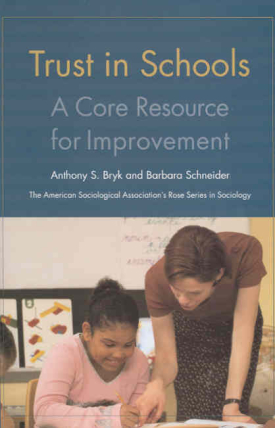
Trust in Schools
About This Book
A Volume in the American Sociological Association’s Rose Series in Sociology
"Anthony Bryk and Barbara Schneider argue a novel idea: that the extent of trust among the adults in schools is a crucial influence on how well schools work for children. They use a variety of research methods to probe the role that trust plays in the life of schools, and in students' learning. This is an important, original, and lucidly written contribution to understanding the processes of schooling, and a telling analysis of the requirements for school improvement."
-DAVID K. COHEN, University of Michigan
"Trust in Schools presents a compelling case of real world school reform. A must read for educators, administrators, and legislators working in the field today."
-RAMON CORTINES, New York City School System, Los Angeles School System
"Recent conceptual analyses of social capital bear fruit in Anthony Bryk and Barbara Schneider's insightful study of effective social relationships in school. The authors provide theoretical insights into how trust acts as a dimension of social capital and provide empirical evidence that trusting relationships among teachers, parents, and students promote school improvement. Their study expands the current debate on educational reform by stressing the central importance of social exchange in the process of school reform. This important work has immediate implications for educational policy and practice."
-MAUREEN T. HALLINAN, University of Notre Dame
"Anthony Bryk and Barbara Schneider have produced a work that genuinely deserves to be foundational. The arguments they lay out here, strongly supported with longitudinal data, both quantitative and qualitative, will affect the way we think about the problems of urban schools and about possible solutions for years to come. More forcefully than any work in many years, they remind us that we cannot frame the issues just in terms of organizational issues, pedagogical issues, and governance issues. The reality is that many urban schools are bedeviled by a set of social issues, centered on trust, which, if left unaddressed, will continue to frustrate our best efforts."
-CHARLES M. PAYNE, Duke University
Most Americans agree on the necessity of education reform, but there is little consensus about how this goal might be achieved. The rhetoric of standards and vouchers has occupied center stage, polarizing public opinion and affording little room for reflection on the intangible conditions that make for good schools. Trust in Schools engages this debate with a compelling examination of the importance of social relationships in the successful implementation of school reform.
Over the course of three years, Bryk and Schneider, together with a diverse team of other researchers and school practitioners, studied reform in twelve Chicago elementary schools. Each school was undergoing extensive reorganization in response to the Chicago School Reform Act of 1988, which called for greater involvement of parents and local community leaders in their neighborhood schools. Drawing on years longitudinal survey and achievement data, as well as in-depth interviews with principals, teachers, parents, and local community leaders, the authors develop a thorough account of how effective social relationships—which they term relational trust—can serve as a prime resource for school improvement. Using case studies of the network of relationships that make up the school community, Bryk and Schneider examine how the myriad social exchanges that make up daily life in a school community generate, or fail to generate, a successful educational environment. The personal dynamics among teachers, students, and their parents, for example, influence whether students regularly attend school and sustain their efforts in the difficult task of learning. In schools characterized by high relational trust, educators were more likely to experiment with new practices and work together with parents to advance improvements. As a result, these schools were also more likely to demonstrate marked gains in student learning. In contrast, schools with weak trust relations saw virtually no improvement in their reading or mathematics scores.
Trust in Schools demonstrates convincingly that the quality of social relationships operating in and around schools is central to their functioning, and strongly predicts positive student outcomes. This book offer insights into how trust can be built and sustained in school communities, and identifies some features of public school systems that can impede such development. Bryk and Schneider show how a broad base of trust across a school community can provide a critical resource as education professional and parents embark on major school reforms.
ANTHONY S. BRYK is Marshall Field IV Professor of Urban Education and Sociology, University of Chicago.
BARBARA SCHNEIDER is professor of sociology and human development, University of Chicago.