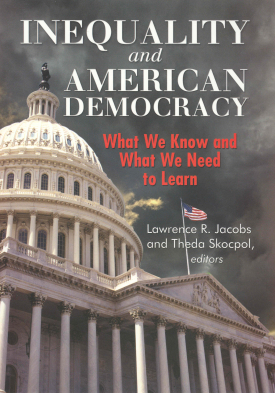
Cover image of the book Inequality and American Democracy
Books

Inequality and American Democracy

What We Know and What We Need to Learn
Editors
Lawrence Jacobs
Theda Skocpol
Paperback
$29.95
Add to Cart
Publication Date
6 in. × 9 in. 256 pages
ISBN
978-0-87154-414-8
Also Available From

About This Book

In the twentieth century, the United States ended some of its most flagrant inequalities. The "rights revolution" ended statutory prohibitions against women’s suffrage and opened the doors of voting booths to African Americans. Yet a more insidious form of inequality has emerged since the 1970s—economic inequality—which appears to have stalled and, in some arenas, reversed progress toward realizing American ideals of democracy. In Inequality and American Democracy, editors Lawrence Jacobs and Theda Skocpol headline a distinguished group of political scientists in assessing whether rising economic inequality now threatens hard-won victories in the long struggle to achieve political equality in the United States.

Inequality and American Democracy addresses disparities at all levels of the political and policy-making process. Kay Lehman Scholzman, Benjamin Page, Sidney Verba, and Morris Fiorina demonstrate that political participation is highly unequal and strongly related to social class. They show that while economic inequality and the decreasing reliance on volunteers in political campaigns serve to diminish their voice, middle class and working Americans lag behind the rich even in protest activity, long considered the political weapon of the disadvantaged. Larry Bartels, Hugh Heclo, Rodney Hero, and Lawrence Jacobs marshal evidence that the U.S. political system may be disproportionately responsive to the opinions of wealthy constituents and business. They argue that the rapid growth of interest groups and the increasingly strict party-line voting in Congress imperils efforts at enacting policies that are responsive to the preferences of broad publics and to their interests in legislation that extends economic and social opportunity. Jacob Hacker, Suzanne Mettler, and Dianne Pinderhughes demonstrate the feedbacks of government policy on political participation and inequality. In short supply today are inclusive public policies like the G.I. Bill, Social Security legislation, the War on Poverty, and the Voting Rights Act of 1965 that changed the American political climate, mobilized interest groups, and altered the prospect for initiatives to stem inequality in the last fifty years.

Inequality and American Democracy tackles the complex relationships between economic, social, and political inequality with authoritative insight, showcases a new generation of critical studies of American democracy, and highlights an issue of growing concern for the future of our democratic society.

LAWRENCE R. JACOBS is Walter F. and Joan Mondale Chair for Political Studies and director of the Center for the Study of Politics and Governance in the Humphrey Institute of Public Affairs and the Department of Political Science at the University of Minnesota.

THEDA SKOCPOL is Victor S. Thomas Professor of Government and Sociology and director of the Center for American Political Studies at Harvard University.

CONTRIBUTORS: Larry M. Bartels, Morris P. Fiorina, Jacob S. Hacker, Hugh Heclo, Rodney E. Hero, Suzanne Mettler, Benjamin I. Page, Dianne Pinderhughes, Kay Lehman Schlozman, Sidney Verba.

RSF Journal
View Book Series
Sign Up For Our Mailing List
Apply For Funding
Cover image of the book What Employers Want
Books

What Employers Want

Job Prospects for Less-Educated Workers
Author
Harry J. Holzer
Paperback
$24.95
Add to Cart
Publication Date
6 in. × 9 in. 192 pages
ISBN
978-0-87154-388-2
Also Available From

About This Book

A very important contribution to the field of labor economics, and in particular to the understanding of the labor market forworkers with relatively low skill levels. I think we have the sense that the market looks bad, but haven't been clear on how bad it is, or how it got that way. What Employers Want provides some of the answers and identifies the important questions. It is essential reading. —Jeffrey S. Zax, University of Colorado at Boulder

The substantial deterioration in employment and earnings among the nation's less-educated workers, especially minorities and younger males in the nation's big cities, has been tentatively ascribed to a variety of causes: an increase in required job skills, the movement of companies from the cities to the suburbs, and a rising unwillingness to hire minority job seekers. What Employers Want is the first book to replace conjecture about today's job market with first-hand information gleaned from employers about who gets hired. Drawn from asurvey of over 3,000 employers in four major metropolitan areas—Los Angeles, Boston, Atlanta, and Detroit—this volume provides a wealth of data on what jobs are available to the less-educated, in what industries, what skills they require, where they are located, what they pay, and how they are filled.

The evidence points to a dramatic surge in suburban, white-collar jobs. The manufacturing industry—once a steady employer of blue-collar workers—has been eclipsed by the expanding retail trade and service industries, where the vast majority of jobs are in clerical, managerial, or sales positions. Since manufacturing establishments have been the most likely employers to move from the central cities to the suburbs, the shortage of jobs for low-skill urban workers is particularly acute. In the central cities, the problem is compounded and available jobs remain vacant because employers increasingly require greater cognitive and social skills as well as specific job-related experience. Holzer reveals the extent to which minorities are routinely excluded by employer recruitment and screening practices that rely heavily on testing, informal referrals, and stable work histories. The inaccessible location and discriminatory hiring patterns of suburban employers further limit the hiring of black males in particular, while earnings, especially for minority females, remain low.

Proponents of welfare reform often assume that stricter work requirements and shorter eligibility periods will effectively channel welfare recipients toward steady employment and off federal subsidies. What Employers Want directly challenges this premise and demonstrates that only concerted efforts to close the gap between urban employers and inner city residents can produce healthy levels of employment in the nation's cities. Professor Holzer outlines the measures that will benecessary—targeted education and training programs, improved transportation and job placement, heightened enforcement of antidiscrimination laws, and aggressive job creation strategies. Repairing urban labor markets will not be easy. This book shows why.

HARRY J. HOLZER is currently Chief Economist at the U.S. Department of Labor and professor of economics at Michigan State University.

A Volume in the Multi-City Study of Urban Inequality

RSF Journal
View Book Series
Sign Up For Our Mailing List
Apply For Funding
Cover image of the book Social Statistics in Use
Books

Social Statistics in Use

Author
Philip M. Hauser
Hardcover
Add to Cart
Publication Date
6 in. × 9 in. 400 pages
ISBN
978-0-87154-375-2
Also Available From

About This Book

Shows why social statistics are important and how they are put to use in the interest of the public. Written by a sociologist who serves as Director of the Population Research Center at the University of Chicago, the book illustrates the many applications social statistics have for governmental agencies at the federal, state, and local levels; for the business community; for labor unions; for educators and researchers; and for the general public. The author provides a description of the major bodies of social statistical information, including population; births, deaths, and health; marriage, divorce, and the family; education; the labor force; crime; consumption and the consumer; recreation; governments; and public opinion polls.

PHILIP M. HAUSER is Lucy Flower Professor of Urban Sociology and director of the Population Research Center at the University of Chicago.

RSF Journal
View Book Series
Sign Up For Our Mailing List
Apply For Funding
Cover image of the book Help or Hindrance?
Books

Help or Hindrance?

The Economic Implications of Immigration for African Americans
Editors
Daniel S. Hamermesh
Frank D. Bean
Hardcover
$59.95
Add to Cart
Publication Date
6 in. × 9 in. 404 pages
ISBN
978-0-87154-387-5
Also Available From

About This Book

With recent immigration at a near record high, many observers fear that African Americans, particularly those in low skill jobs, are increasingly losing out to immigrants in the American labor market. Because today's immigrants are largely non-European and non-white, there is also speculation that their presence will intensify the competition for housing and educational opportunities among minority groups. Help or Hindrance? probes the foundation of these concerns with the first comprehensive investigation into the effects of immigration on African Americans.

With detailed economic analysis of African American job prospects, benefits, and working conditions, Help or Hindrance? demonstrates that although immigration does not appear to have affected the actual employment rate of blacks, it has contributed slightly to the widening gap between the annual earnings of black and white males. Those near the lowest skills level appear most affected, suggesting that the most likely losers are workers with abilities similar to those of immigrants. With many employers moving away from cities, access to housing and problems of segregation have also become integral to success in the job market. And within black neighborhoods themselves, the establishment of small immigrant businesses has raised concerns that these may hinder local residents from starting up similar ventures. Help or Hindrance? also examines how immigration has affected the educational attainment of African Americans. Increased competition for college affirmative action and remedial programs has noticeably reduced African Americans' access to college places and scholarships.

Help or Hindrance? offers compelling evidence that although immigration has in many ways benefited parts of American society, it has had a cumulatively negative effect on the economic prospects of African Americans. In concluding chapters, this volume provides an overview of possible policy interventions and evaluates them within the current social and political climate. Because the long-term impact of current immigration on social welfare remains unknown solutions are far from clear. Help or Hindrance? provides a valuable benchmark for discussion of immigration and racial equity in a time of rapid population change.

FRANK D. BEAN is the Ashbel Smith Professor of Sociology and professor of public affairs at the University of Texas at Austin.

DANIEL S. HAMERMESH is Edward Everett Hall Centennial Professor of Economics at the University of Texas at Austin. He is also research associate of the National Bureau of Economic Research.

CONTRIBUTORS: Frank D. Bean, Daniel S. Hamermesh, Julian R. Betts, George J. Borjas, Kristin F. Butcher, Robert W. Fairlie, Richard B. Freeman, Jeffrey T. Grogger, Caroline M. Hoxby, George E. Johnson, Linda Datcher Loury, Bruce D. Meyer, Cordelia W. Reimers, Peter H. Schuck, Marta Tienda, and Jeffrey S. Zax.

RSF Journal
View Book Series
Sign Up For Our Mailing List
Apply For Funding
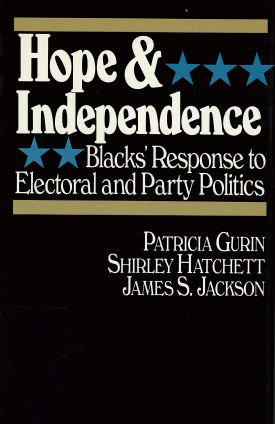
Cover image of the book Hope and Independence
Books

Hope and Independence

Blacks' Response to Electoral and Party Politics
Authors
Patricia Gurin
Shirley Hatchett
James S. Jackson
Hardcover
Add to Cart
Publication Date
6 in. × 9 in. 368 pages
ISBN
978-0-87154-374-5
Also Available From

About This Book

Over the past fifteen years, a New Black Politics has swept black candidates into office and registered black voters in numbers unimaginable since the days of Reconstruction. Based on interviews with a representative sample of nearly 1,000 voting-age black Americans, Hope and Independence explores blacks' attitudes toward electoral and party politics and toward Jesse Jackson's first presidential bid. Viewed in the light of black political history, the survey reveals enduring themes of hope (for eventual inclusion in traditional politics, despite repeated disappointments) and independence (a strategy of operating outside conventional political institutions in order to achieve incorporation).

The authors describe a black electorate that is less alienated than many have suggested. Blacks are more politically engaged than whites with comparable levels of education. And despite growing economic inequality in the black community, the authors find no serious class-based political cleavage. Underlying the widespread support for Jackson among blacks, a distinction emerges between "common fate" solidarity, which is pro-black, committed to internal criticism of the Democratic party, and conscious of commonality with other disadvantaged groups, and "exclusivist" solidarity, which is pro-black but also hostile to whites and less empathetic to other minorities. This second, more divisive type of solidarity expresses itself in the desire for a separate black party or a vote black strategy—but its proponents constitute a small minority of the black electorate and show surprisingly hopeful attitudes toward the Democratic party.

Hope and Independence will be welcomed by readers concerned with opinion research, the sociology of race, and the psychology of group consciousness. By probing the attitudes of individual blacks in the context of a watershed campaign, this book also makes a vital contribution to our grasp of current electoral politics.

PATRICIA GURIN is professor of psychology and faculty associate at the Institute for Social Research, University of Michigan.

SHIRLEY HATCHETT is research investigator at the Institute for Social Research.

JAMES A. JACKSON is professor of psychology and associate dean at the Rachkam School of Graduate Studies, University of Michigan, as well as research scientist at the Institute for Social Research.

RSF Journal
View Book Series
Sign Up For Our Mailing List
Apply For Funding
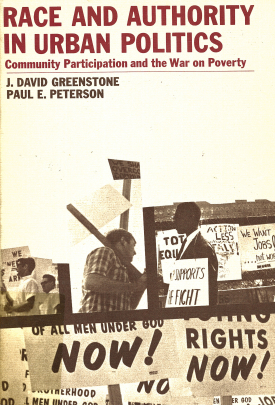
Cover image of the book Race and Authority in Urban Politics
Books

Race and Authority in Urban Politics

Authors
J. David Greenstone
Paul E. Peterson
Hardcover
Add to Cart
Publication Date
6 in. × 9 in. 384 pages
ISBN
978-0-87154-373-8
Also Available From

About This Book

What really happened when citizens were asked to participate in their community’s poverty programs? In this revealing new book, the authors provide an answer to this question through a systematic empirical analysis of a single public policy issue—citizen participation in the Community Action Program of the Johnson Administration’s “War on Poverty.” Beginning with a brief case study description and analysis of the politics of community action in each of America’s five largest cities—New York, Chicago, Los Angeles, Detroit, and Philadelphia—the authors move on to a fascinating examination of race and authority structures in our urban life.

In a series of lively chapters, Professors Greenstone and Peterson show how the coalitions that formed around the community action question developed not out of electoral or organizational interests alone, but were strongly influenced by our conceptions of the nature of authority in America. They discuss the factors that affected the development of the action program and they note that democratic elections of low-income representatives, however much preferred by democratic reformers, were an ineffective way of representing the interests of the poor.

The book stresses the way in which both machine and reform structures affected the ability of minority groups to organize effectively and to form alliances in urban politics. It considers the wide-ranging critiques made of the Community Action Program by conservative, liberal, and radical analysts and finds that all of them fail to appreciate the significance and intensity of the racial cleavage in American politics.

J. DAVID GREENSTONE is professor and chairman of the Political Science Department at the University of Chicago.

PAUL E. PETERSON is associate professor in the Department of Political Science and Education at the University of Chicago.

RSF Journal
View Book Series
Sign Up For Our Mailing List
Apply For Funding
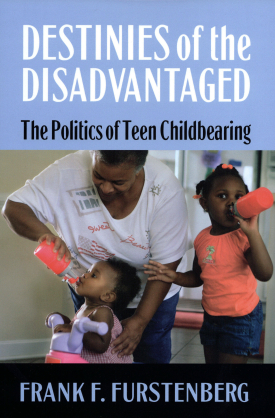
Cover image of the book Destinies of the Disadvantaged
Books

Destinies of the Disadvantaged

The Politics of Teen Childbearing
Author
Frank F. Furstenberg
Paperback
$28.95
Add to Cart
Publication Date
6 in. × 9 in. 216 pages
ISBN
978-0-87154-329-5
Also Available From

About This Book

Winner of the Society for Research on Adolesence Social Policy Award for Best Authored Book, 2006-2008

Teen childbearing has risen to frighteningly high levels over the last four decades, jeopardizing the life chances of young parents and their offspring alike, particularly among minority communities. Or at least, that’s what politicians on the right and left often tell us, and what the American public largely believes. But sociologist Frank Furstenberg argues that the conventional wisdom distorts reality. In Destinies of the Disadvantaged, Furstenberg traces the history of public concern over teen pregnancy, exploring why this topic has become so politically powerful, and so misunderstood.

Based on over forty years of Furstenberg’s research on teen childbearing, Destinies of the Disadvantaged relates how the issue emerged from obscurity to become one of the most heated social controversies in America. Both slipshod research by social scientists and opportunistic grandstanding by politicians have contributed to public misunderstanding of the issue. Although out-of-wedlock teen pregnancy rose notably between 1960 and 1990—a cause for concern given the burdens of single motherhood at a young age—this trend did not reflect a rise in the rate of overall teen pregnancies. In fact, teen pregnancy actually declined dramatically in the 1960s and 1970s. The number of unmarried teenage mothers rose after 1960, not because more young women became pregnant, but because those who did increasingly chose not to rush into marriage. Furstenberg shows how early social science research on this topic exaggerated the adverse consequences of early parenthood both for young parents and for their children. Researchers also inaccurately portrayed single teenage motherhood as a phenomenon concentrated among minorities. Both of these misapprehensions skewed subsequent political debates. The issue became a public obsession and remained so during the 1990s, even as rates of out-of-wedlock teen childbearing plummeted. Addressing teen pregnancy was originally a liberal cause, led by advocates of family planning services, legalized abortion, and social welfare programs for single mothers. The issue was later adopted by conservatives, who argued that those liberal remedies were encouraging teen parenthood. According to Furstenberg, the flexible political usefulness of the issue explains its hold on political discourse.

The politics of teen parenthood is a fascinating case study in the abuse of social science for political ends. In Destinies of the Disadvantaged, Furstenberg brings that tale to life with the perspective of a historian and the insight of an insider, and provides the straight facts needed to craft effective policies to address teen pregnancy.

FRANK F. FURSTENBERG is the Zellerbach Family Professor of Sociology and a research associate in the Population Studies Center at the University of Pennsylvania, and chair of the MacArthur Foundation Research Network on Transitions to Adulthood.
 

RSF Journal
View Book Series
Sign Up For Our Mailing List
Apply For Funding
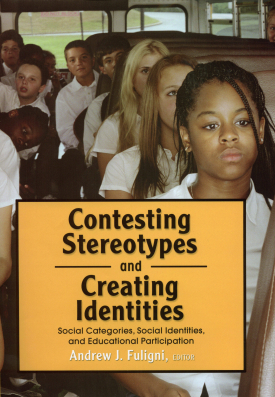
Cover image of the book Contesting Stereotypes and Creating Identities
Books

Contesting Stereotypes and Creating Identities

Social Categories, Social Identities, and Educational Participation
Editor
Andrew J. Fuligni
Hardcover
Add to Cart
Publication Date
6 in. × 9 in. 288 pages
ISBN
978-0-87154-298-4
Also Available From

About This Book

Since the end of legal segregation in schools, most research on educational inequality has focused on economic and other structural obstacles to the academic achievement of disadvantaged groups. But in Contesting Stereotypes and Creating Identities, a distinguished group of psychologists and social scientists argue that stereotypes about the academic potential of some minority groups remain a significant barrier to their achievement. This groundbreaking volume examines how low institutional and cultural expectations of minorities hinder their academic success, how these stereotypes are perpetuated, and the ways that minority students attempt to empower themselves by redefining their identities.

The contributors to Contesting Stereotypes and Creating Identities explore issues of ethnic identity and educational inequality from a broad range of disciplinary perspectives, drawing on historical analyses, social-psychological experiments, interviews, and observation. Meagan Patterson and Rebecca Bigler show that when teachers label or segregate students according to social categories (even in subtle ways), students are more likely to rank and stereotype one another, so educators must pay attention to the implicit or unintentional ways that they emphasize group differences. Many of the contributors contest John Ogbu’s theory that African Americans have developed an “oppositional culture” that devalues academic effort as a form of “acting white.” Daphna Oyserman and Daniel Brickman, in their study of black and Latino youth, find evidence that strong identification with their ethnic group is actually associated with higher academic motivation among minority youth. Yet, as Julie Garcia and Jennifer Crocker find in a study of African-American female college students, the desire to disprove negative stereotypes about race and gender can lead to anxiety, low self-esteem, and excessive, self-defeating levels of effort, which impede learning and academic success. The authors call for educational institutions to diffuse these threats to minority students’ identities by emphasizing that intelligence is a malleable rather than a fixed trait.

Contesting Stereotypes and Creating Identities reveals the many hidden ways that educational opportunities are denied to some social groups. At the same time, this probing and wide-ranging anthology provides a fresh perspective on the creative ways that these groups challenge stereotypes and attempt to participate fully in the educational system.

ANDREW J. FULIGNI is professor of psychiatry and behavioral sciences at the University of California, Los Angeles, and co-director of Family Research Consortium IV. This volume was produced by the Russell Sage Foundation Working Group on Social Identity and Institutional Engagement.

CONTRIBUTORS: Joshua Aronson, Meredith Bachman, Rebecca S. Bigler, Daniel Brickman, Jennifer Crocker, William E. Cross, Jr., Carol S. Dweck, Sonia DeLuca Fernandez, Andrew J. Fuligni, Anne Galletta, Julie A. Garcia, Brian Girard, Catherine Good, Jason S. Lawrence, April Leininger, Ramaswami Mahalingam, Magdalena Martinez, Elizabeth Birr Moje, Carla O'Connor, Daphna Oyserman, Meagan M. Patterson, Marjorie Rhodes, Gwendelyn J. Rivera, and Diane N. Ruble.

RSF Journal
View Book Series
Sign Up For Our Mailing List
Apply For Funding
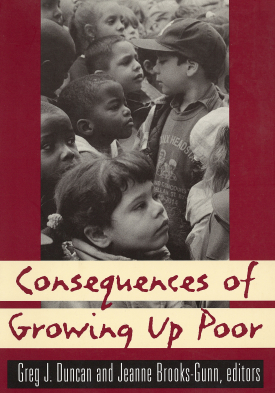
Cover image of the book Consequences of Growing Up Poor
Books

Consequences of Growing Up Poor

Editors
Greg J. Duncan
Jeanne Brooks-Gunn
Paperback
$34.95
Add to Cart
Publication Date
6.63 in. × 9.25 in. 672 pages
ISBN
978-0-87154-144-4
Also Available From

About This Book

One in five American children now live in families with incomes below the povertyline, and their prospects are not bright. Low income is statistically linked with a variety of poor outcomes for children, from low birth weight and poor nutrition in infancy to increased chances of academic failure, emotional distress, and unwed childbirth in adolescence. To address these problems it is not enough to know that money makes a difference; we need to understand how. Consequences of Growing Up Poor is an extensive and illuminating examination of the paths through which economic deprivation damages children at all stages of their development.

In Consequences of Growing Up Poor, developmental psychologists, economists, and sociologists revisit a large body of studies to answer specific questions about how low income puts children at risk intellectually, emotionally, and physically. Many of their investigations demonstrate that although income clearly creates disadvantages, it does so selectively and in a wide variety of ways. Low-income preschoolers exhibit poorer cognitive and verbal skills because they are generally exposed to fewer toys, books, and other stimulating experiences in the home. Poor parents also tend to rely on home-based child care, where the quality and amount of attention children receive is inferior to that of professional facilities. In later years, conflict between economically stressed parents increases anxiety and weakens self-esteem in their teenaged children.

Although they share economic hardships, the home lives of poor children are not homogenous. Consequences of Growing Up Poor investigates whether such family conditions as the marital status, education, and involvement of parents mitigate the ill effects of poverty. Consequences of Growing Up Poor also looks at the importance of timing: Does being poor have a different impact on preschoolers, children, and adolescents? When are children most vulnerable to poverty? Some contributors find that poverty in the prenatal or early childhood years appears to be particularly detrimental to cognitive development and physical health. Others offer evidence that lower income has a stronger negative effect during adolescence than in childhood or adulthood.

Based on their findings, the editors and contributors to Consequences of Growing Up Poor recommend more sharply focused child welfare policies targeted to specific eras and conditions of poor children's lives. They also weigh the relative need for income supplements, child care subsidies, and home interventions. Consequences of Growing Up Poor describes the extent and causes of hardships for poor children, defines the interaction between income and family, and offers solutions to improve young lives.

JEANNE BROOKS-GUNN is Virginia and Leonard Marx Professor of Child Development at Teachers College, Columbia University. She is also director of the Center for Young Children and Families, and co-directs the Adolescent Study Program at Teachers College.

GREG J. DUNCAN is professor of education and social policy and a faculty associate in the Institute for Policy Research at Northwestern University.

CONTRIBUTORS: Terry Adams, William Axinn, Bernard Boulerice, Jeanne Brooks-Gunn, Karen P. Carver, Katherine Jewsbury Conger, Rand D. Conger, Mary Corcoran, Randal D. Day, Greg J. Duncan, Glen H. Elder, Jr., Thomas L. Hanson, Robert M. Hauser, Robert Haveman, Donald J. Hernandez, Pamela K. Klebanov, Sanders Korenman, Ellen L. Lipman, Nancy Maritato, Susan E. Mayer, Sara S. McLanahan, Jane E. Miller, Natalie C. Mullis, The National Institute of Child Health and Development (NICHD), David R. Offord, Linda Pagani, Kathleen M. Paasch, H. Elizabeth Peters, Judith R. Smith, Megan M. Sweeney, Jay D. Teachman, Elizabeth Thomson, Arland Thornton, Richard E. Tremblay, Kathryn Wilson, and Barbara Wolfe.

RSF Journal
View Book Series
Sign Up For Our Mailing List
Apply For Funding
Cover image of the book To Be an Immigrant
Books

To Be an Immigrant

Author
Kay Deaux
Paperback
$31.95
Add to Cart
Publication Date
6 in. × 9 in. 272 pages
ISBN
978-0-87154-085-0
Also Available From

About This Book

Immigration is often discussed in broad, statistical terms, with a focus on how it affects labor markets, schools, and social services. But at its most basic level, immigration is a process that affects people and their identities in deeply personal ways. In To Be an Immigrant, social psychologist Kay Deaux explores the role of both social conditions and individual capacities in determining how well immigrants adapt to life in their new homelands, and makes a strong case for the relevance of social psychology in immigration studies.

To Be an Immigrant looks at how immigrants are defined, shaped, and challenged by the cultural environment they encounter in their new country and offers an integrated psychological framework for studying the immigrant experience. Deaux argues that in addition to looking at macro-level factors like public policies and social conditions and micro-level issues like individual choices, immigration scholars should also study influences that occur on an intermediate level, such as interpersonal encounters. Each of these three levels of analysis is essential to understanding how immigrants adapt to a new homeland and form distinct identities. As a case study for her framework, Deaux examines West Indians, exploring their perceptions of the stereotypes they face in the United States and their feelings of connection to their new home. Though race plays a limited role in the West Indies, it becomes more relevant to migrants once they arrive in the United States, where they are primarily identified by others as black, rather than Guyanese or Jamaican. Deaux’s research adds to a growing literature in social psychology on stereotype threat, which suggests that negative stereotypes about one’s group can hinder an individual’s performance. She finds that immigrants who have been in the United States longer and identify themselves as African American suffer from the negative effects of stereotype threat more than recent immigrants.
 
More than a discrete event, immigration can be understood as a life-long process that continues to affect people well after they have migrated. To Be an Immigrant takes a novel approach to the study of immigration, looking at how societal influences help shape immigrants and their understanding of who they are.

KAY DEAUX is a Distinguished Professor of Psychology at the Graduate Center,  City University of New York.

RSF Journal
View Book Series
Sign Up For Our Mailing List
Apply For Funding