Temperature stress – physical stress induced by excessive heat or cold – may affect cognitive performance, labor capacity, and workplace safety, suggesting that climate change might reduce earnings and job quality for many low-skilled workers. Could global warming, therefore, exacerbate economic inequality? And how resistant will companies be to implementing adaptive technologies, such as air conditioning and outdoor cooling stations, that could reduce the impacts of temperature stress? Environmental and labor economist R.
Increased earnings inequality can largely be accounted for by increased variation in the wages paid to similar workers by different companies. These “firm effects” suggest a lack of competition in the labor market and an increase in companies’ ability to dictate terms of employment. Lack of competition in the labor market also reduces wage growth. Economists Laura Giuliano and Arindrajit Dube will examine how companies set wages and why they differ.
In the past three decades, automation has increased enormously and automation has rapidly become one of the most debated political and economic issues in many countries. Despite rising interest in the topic, little is known about the causes and consequences of automation on individual companies and individual workers. Economists Sydnee Caldwell and Marco Tabellini will examine the effects of automation on workers’ employment trajectories and their political behaviors.
Slow wage growth and growing wage inequality are two major economic policy issues. One possible explanation is that declining unionization and the weakening of labor market institutions, such as minimum wage and employment protection regulation, contribute to these problems. A complementary explanation is that the consolidation of market power among a few large companies has reduced worker compensation.
Many studies have documented inconsistencies in judicial behavior. For example, federal appeals court judges become more politicized before elections and more unified during war time. Refugee asylum judges are two percentage points more likely to deny asylum to refugees if their previous decision granted asylum. Economists Daniel L. Chen and Elliott Ash will examine biases in human decision-making, focusing on judges and physicians. They will measure biases through 1) appeals and their outcomes for asylum and circuit court judges and 2) malpractice claims and their outcomes for physicians.
Although studies of job postings and the skills and knowledge needed for occupations have described the supply and demand side of the job market, few studies have assessed what skills are taught to college students and how they impact job market outcomes. Computational social scientist Morgan Frank and economist Sarah Bana will use a novel dataset of three million university course syllabi to examine skills taught in courses over the last decade.
Books
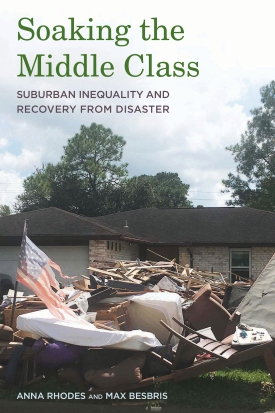
Soaking the Middle Class
Suburban Inequality and Recovery from Disaster
Publication Date
6 in. × 9 in.
244 pages
ISBN
978-0-87154-716-3
About This Book
“Soaking the Middle Class tells the complex story of disaster recovery in a White middle-class suburb. It is driven by the chilling narrative of the water rising, escape, and inspiring and awesome stories of rebuilding. But not everyone rebounds the same. Behind an appearance of homogeneity are forces—both structural and individual—that widen gaps in wealth and resources. As an ever more volatile environment threatens to soak us all, this book is essential reading for how to create a broader and more equitable safety net.”
—MARY PATTILLO, Northwestern University
“A powerful book about one of the most urgent problems of the century: how to avoid going under in an era of catastrophic climate change. Drawing on an unusually deep and extensive study of an inundated suburban community, Anna Rhodes and Max Besbris show how class-based inequalities determine who bounces back from disaster and who gets bogged down or displaced. Soaking the Middle Class is timely and important for everyone who calls this warm, wet planet home.”
—ERIC KLINENBERG, New York University
“As climate change causes more extreme weather many middle-class Americans assume that their financial and social resources, their insurance, as well as help from the government, would protect them from financial ruin should they be caught in a disaster. In this eye-opening sociological account of how Hurricane Harvey affected one middle class suburb in Houston, Anna Rhodes and Max Besbris show that the disaster had very unequal effects, with some people able to build back better, and others not able to get back on their feet. Soaking the Middle Class is a cogently argued and wide-ranging book that opens our eyes to how disaster puts us all at risk.”
—MARY C. WATERS, Harvard University
Extreme weather is increasing in scale and severity as global warming worsens. While poorer communities are typically most vulnerable to the negative effects of climate change, even well-resourced communities are increasingly vulnerable as climate-related storms intensify. Yet little is known about how middle-class communities are responding to these storms and the resulting damage. In Soaking the Middle Class, sociologists Anna Rhodes and Max Besbris examine how a middle-class community recovers from a climate-related disaster and how this process fosters inequality within these kinds of places.
In 2017, Hurricane Harvey dropped record-breaking rainfall in Southeast Texas resulting in more than $125 billion in direct damages. Rhodes and Besbris followed 59 flooded households in Friendswood, Texas, for two years after the storm to better understand the recovery process in a well-resourced, majority-White, middle-class suburban community. As such, Friendswood should have been highly resilient to storms like Harvey, yet Rhodes and Besbris find that the recovery process exacerbated often-invisible economic inequality between neighbors. Two years after Harvey, some households were in better financial positions than they were before the storm, while others still had incomplete repairs, were burdened with large new debts, and possessed few resources to draw on should another disaster occur.
Rhodes and Besbris find that recovery policies were significant drivers of inequality, with flood insurance playing a key role in the divergent recovery outcomes within Friendswood. Households with flood insurance prior to Harvey tended to have higher incomes than those that did not. These households received high insurance payouts, enabling them to replace belongings, hire contractors, and purchase supplies. Households without coverage could apply for FEMA assistance, which offered considerably lower payouts, and for government loans, which would put them into debt. Households without coverage found themselves exhausting their financial resources, including retirement savings, to cover repairs, which put them in even more financially precarious positions than they were before the flood.
The vast majority of Friendswood residents chose to repair and return to their homes after Hurricane Harvey. Even this devastating flood did not alter their plans for long-term residential stability, and the structure of recovery policies only further oriented homeowners towards returning to their homes. Prior to Harvey, many Friendswood households relied on flood damage from previous storms to judge their vulnerability and considered themselves at low risk. After Harvey, many found it difficult to assess their level of risk for future flooding. Without strong guidance from federal agencies or the local government on how to best evaluate risk, many residents ended up returning to potentially unsafe places.
As climate-related disasters become more severe, Soaking the Middle Class illustrates how inequality in the United States will continue to grow if recovery policies are not fundamentally changed.
ANNA RHODES is Assistant Professor of Sociology, Rice University
MAX BESBRIS is Assistant Professor of Sociology, University of Wisconsin-Madison