Although state merit-based grants provide resources to facilitate college access, these programs also function to further perpetuate inequalities in higher education. In addition to eligibility constraints on the front end, most programs also require continuing college students to maintain a baseline level of academic performance in order to continue receiving financial assistance. The implications of losing grant aid are likely to be heterogeneous across socioeconomic groups given the tenuous affordability of college.
Books
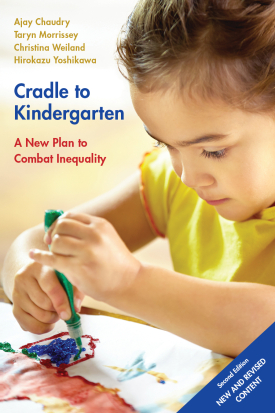
Cradle to Kindergarten
A New Plan to Combat Inequality, 2nd Edition
About This Book
“This powerful book should be mandatory reading for anyone who cares about our nation. The authors provide compelling evidence that by neglecting what science shows our children and families really need, we are imperiling our future. Even more importantly, they offer a plan to support all our children and their parents, ensuring that each of our children has the opportunity to thrive.”
—David T. Ellwood, Isabelle and Scott Black Professor of Political Economy, and director, Malcolm Wiener Center for Social Policy, Harvard Kennedy School
Early care and education in the United States is in crisis. The period between birth and kindergarten is a crucial time for a child’s development. Yet vast racial, ethnic, and socioeconomic disparities that begin early in children’s lives contribute to starkly different long-term outcomes for adults. Compared to other advanced economies, child care and preschool in the U.S. are scarce, prohibitively expensive, and inadequate in quality for most middle- and low-income families. To what extent can early-life opportunities provide these children with the same life chances of their affluent peers and contribute to reduced social inequality in the long term, and across generations? The updated second edition of Cradle to Kindergarten offers a comprehensive, evidence-based strategy that diagnoses the obstacles to accessible early education and charts a path to opportunity for all children.
The U.S. government invests less in children under the age of five than do most other developed nations. Most working families must seek private child care, but high-quality child care options are expensive relative to the means of most families. This means that children from lower-income households, who would benefit most from high-quality early education, are the least likely to attend them. Existing policies, such as pre-kindergarten in some states, are only partial solutions, and what exists varies tremendously in terms of access and quality.
To address these deficiencies, the authors propose to overhaul the early care and education system, beginning with a federal paid parental leave policy that provides both mothers and fathers with time and financial support after the birth of a child. They also advance an expansion of the child care tax credit, and a new child care assurance program that provides grant assistance towards the cost of high-quality early care for low- and moderate-income families. Their plan establishes universal, high-quality early education in the states starting by age three, and a reform of the Head Start program that would include more intensive services for families living in areas of concentrated poverty and experiencing multiple adversities from the earliest point in these most disadvantaged children’s lives. They conclude with an implementation plan and contend that these reforms are attainable well within a ten-year timeline.
Reducing educational and economic inequalities requires that all children have robust opportunities to learn and fully develop their capacities and have a fair shot at success. Cradle to Kindergarten presents a blueprint for fulfilling this promise by expanding access to educational and financial resources at a critical stage of child development.
Ajay Chaudry is a writer on social policy and research professor at New York University, and former Deputy Assistant Secretary for Human Services Policy at the U.S. Department of Health and Human Services in the administration of President Barack Obama.
Taryn Morrissey is Associate Professor of Public Administration and Policy at American University.
Christina Weiland is Associate Professor of Education at the University of Michigan.
Hirokazu Yoshikawa is the Courtney Sale Ross Professor of Globalization and Education at the Steinhardt School of Culture, Education, and Human Development, and Co-Director of the Global TIES for Children Center at New York University.
RSF Journal
View Book Series
Sign Up For Our Mailing List
Apply For Funding
Books
The Work of the Little Theatres
The Groups They Include, the Plays They Produce, Their Tournaments, and the Handbooks They Use
Publication Date
228 pages
About This Book
A survey of amateur and community theatrical productions and activity in the early twentieth century, in particular dramatics for children through public and private schools, playground and community centers, and various voluntary organizations. With a selected bibliography for amateur workers in drama.
Clarence Arthur Perry was the author of Wider Use of the School Plant, Housing for the Machine Age, and The Rebuilding of Blighted Areas.
Download
RSF Journal
View Book Series
Sign Up For Our Mailing List
Apply For Funding
Books
The Use of Standardized Tests in Elementary Schools
Technical Report No. 2 on the Social Consequences of Testing
Publication Date
221 pages
About This Book
This is the second in a series of technical reports presenting tabulations of basic data resulting from questionnaires and interview schedules used in connection with the Russell Sage Foundation program of research on the social consequences of testing, which aimed to examine the possible social impacts of the use of standardized ability tests (such as intelligence, aptitude, and achievement tests) in schools and occupational settings in the United States.
DAVID A. GOSLIN was staff sociologist at the Russell Sage Foundation and author of The School in Contemporary Society.
Download
RSF Journal
View Book Series
Sign Up For Our Mailing List
Apply For Funding
About This Book
The Department of Child Helping of the Russell Sage Foundation completed a detailed study of 151 public institutions for delinquent youth in the United States in 1924, including a few private institutions supported chiefly by public funds. The work of such schools is unique, technical, and vitally important, but up to the time that this study was undertaken no complete and detailed information regarding these institutions was available. The department undertook the study with the goal of informing the public and awakening its interest in these schools, and of assisting trustees and superintendents to improve the methods, standards, and conditions of their work. This book examines academics, physical care, and parole for delinquent girls, as well as building conditions, salaries in training schools, record-keeping, and community aspects of institutional life.
Margaret Reeves was field agent of the Russell Sage Foundation and director of the State Bureau of Child Welfare, Santa Fe, New Mexico.
Download
RSF Journal
View Book Series
Sign Up For Our Mailing List
Apply For Funding
Books
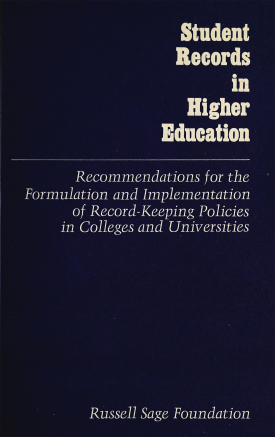
Student Records in Higher Education
Recommendations for the Formulation and Implementation of Record-Keeping Policies in Colleges and Universities
Publication Date
23 pages
About This Book
Report of a conference sponsored by the Russell Sage Foundation at the Sterling Forest Conference Center, Tuxedo, New York, June 12–14, 1972. Topics include the collection and use of student records and the classification, maintenance, and retention of such records.
Participants: Robert L. Arnstein, Paul H. Black, Edward J. Bloustein, K. Patricia Cross, Paul Doty, Robert M. Fano, David A. Goslin, George T. Gregory, Samuel Hendel, Michael A. Liethen, Walter P. Metzger, Jane D. Moorman, Drew Olim, Margaret E. Perry, Peter B. Reads, Vivien Stewart, Dyckman W. Vermilye, Alan F. Westin
David A. Goslin, Conference Chairman
Download
RSF Journal
View Book Series
Sign Up For Our Mailing List
Apply For Funding
About This Book
Part of a series documenting annual research and activity in the field of social work. It is a record of organized efforts in the United States to deal with social problems and social conditions. Topics include adult education, health, mental hygiene, crime and penal conditions, children, community organization, the disabled, and religious social work.
Fred S. Hall was joint author of American Marriage Laws.
Download
RSF Journal
View Book Series
Sign Up For Our Mailing List
Apply For Funding
About This Book
Factors influencing American education are numerous, various, and complex; it is impossible to conceive of any single set of factors that adequately explain what is happening in our schools. This volume attempts to describe some aspects of the New York City school system in order to provide a factual basis and perspective for examining and planning educational programs and policies. Staffing, school organization and programs, population change and school enrollment, and permissive zoning are discussed.
Eleanor Bernert Sheldon was sociologist and executive associate at the Russell Sage Foundation. Raymond A. Glazier was chief of the Bureau of Community Statistical Services at the Community Council of Greater New York.
Download
RSF Journal
View Book Series
Sign Up For Our Mailing List
Apply For Funding
About This Book
A report on the proceedings of the second National Service Conference, held April 2-4, 1967, in Washington, regarding the pros and cons of using national service to address a range of national problems, including improved health and education, the War on Poverty, and related challenges.
Contributors: Charles S. Benson, Roland M. Bixler, Jacob Clayman, Eli Ginzberg, Curtis Aller, Roger W. Little, Leon Bramson, Reed Martin, Mildred Robbins, Michael B. Katz, Dorothy M. Knoell, Leon M. Lessinger, Hyman Frankel, A. P. Angelides, Sydney Howe, Ruth Hagy Brod, Harold Taylor, John Naisbitt, Richard Graham, Al Carp, Jack Howard, David Squire, Donald Brown, Felix Rimberg, Dennis J. Clark, Homer Hagedorn, William Josephson, H. Donald Wilson, Terrence Cullinan, William A. Delano, Joshua L. Miner, Dyke W. Williams, David Dichter, Edward F. Hall, Robert Bird
Donald J. Eberly was National Service Secretariat.
Download
RSF Journal
View Book Series
Sign Up For Our Mailing List
Apply For Funding
About This Book
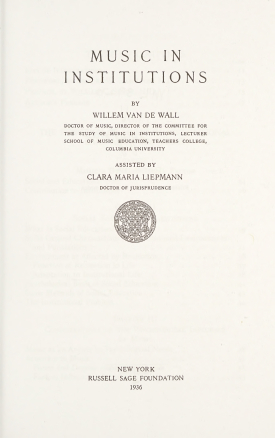
A systematic presentation of the aims, methods, and cautions to be observed in the field of music in welfare work, made for music educators and musicians in the institutional fields. It stems from the author’s experience as director of the Bureau of Mental Health of the Commonwealth of Pennsylvania.
Willem van de Wall was director of the Committee for the Study of Music In Institutions, and lecturer in the School of Music Education, Teachers College, Columbia University. Assisted by Clara Maria Liepmann.