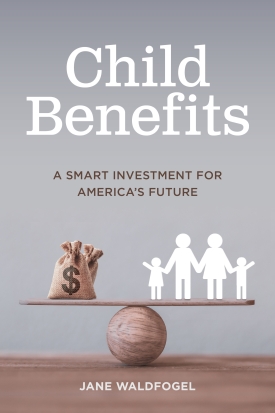
Cover image of the book Child Benefits
Books

Child Benefits

A Smart Investment for America's Future
Author
Jane Waldfogel
Paperback
$42.50
Add to Cart
Publication Date
6 in. × 9 in. 224 pages
ISBN
978-0-87154-871-9

About This Book

"Conservatives in other countries have long supported universal child benefits as an important tool for tackling child poverty while encouraging work and family stability. American conservatives have been more skeptical, but, as Jane Waldfogel demonstrates with wide-ranging evidence, child benefits are one pro-family policy that deserves support across the political spectrum."
-JOSH McCABE, director of social policy, Niskanen Center

"In this well-researched and informative book, Jane Waldfogel examines the case for child benefits in the United States. Woven with evidence and history, and tackling head-on the trade-offs embedded in the policy debate, Child Benefits is exactly what we need for this moment."
-HILARY HOYNES, Chancellor's Professor of Economics and Public Policy, Goldman School of Public Policy, University of California, Berkeley

"If you're interested in child poverty and in issues and challenges that government benefits and programs for children now face, do not miss Child Benefits. It is full of keen insights, thoughtful and deeply informative discussions, and wisdom about where we as a nation should go from here. And it's written in a clear, nontechnical, and highly readable manner that should appeal to a broad audience, which the book very much deserves."
-ROBERT GREENSTEIN, visiting fellow in economic studies, The Brookings Institution, and founder and president emeritus, Center on Budget and Policy Priorities

The United States has one of the highest child poverty rates among wealthy countries and stands out among its peers as the only country that does not offer a child benefit – regular payments from the government to most or all families with children, not conditioned on parental employment. During the temporary expansion of the Child Tax Credit (CTC) in 2021, the CTC functioned as a child benefit, and the child poverty rate fell to the lowest level ever recorded in the United States. Despite this decrease, the CTC expansion was not renewed. Concerns about enacting a child benefit include the cost, the possibility of misuse of money by parents, and how it might affect parental employment and fertility. In Child Benefits, social policy scholar Jane Waldfogel details the history and origins of child benefits around the world and comprehensively assesses how child benefits affect family spending, fertility, employment, child poverty, and child wellbeing to address such concerns and to determine the benefits of enacting such a policy permanently.

Drawing on research from peer countries in the Organization for Economic Cooperation and Development as well as the United States, Waldfogel shows that a child benefit would prevent poverty and hardship and protect children from deep poverty and income instability. The research is clear that families would spend the money from a child benefit on food, clothing, and other items for their children and that a child benefit would not have large negative impacts on parental employment or family decisions about fertility. It also shows that a child benefit would promote short- and longer-term child and family wellbeing. Child benefits have been shown to enhance opportunity and benefit society through healthier and better-educated young adults and stronger and more stable families. And rigorous benefit-cost analyses indicate that a child benefit, while costly, would more than pay for itself, yielding a large return on investment.

Waldfogel evaluates four current, major proposals for a child benefit and provides recommendations for a policy that would deliver the best outcomes for children and families and the best return on investment. She argues that such a policy would be more generous, not tied to parental employment or earnings, available to all parents but phased out for higher-income families, delivered in monthly payments through the tax system, and provided in addition to existing social programs.

Child Benefits provides fascinating insights on the history and impacts of child benefits and makes a clear and definitive argument for the establishment of a child benefit in the United States.
About the Author

JANE WALDFOGEL is the Compton Foundation Centennial Professor for the Prevention of Children’s and Youth Problems at the Columbia University School of Social Work and a visiting professor at the Centre for Analysis of Social Exclusion at the London School of Economics.

RSF Journal
View Book Series
Sign Up For Our Mailing List
Apply For Funding
Cover image of the book What American Cities Are Doing for the Health of School Children
Books

What American Cities Are Doing for the Health of School Children

Author
the Department of Child Hygiene
Ebook
Publication Date
43 pages

About This Book

This booklet discusses what 1,038 U.S. cities are doing for the health of school children. The first part discusses medical inspection, including the history of medical inspection, administration, and kinds of medical inspection. The second part covers hygiene of the school room, including outdoor recesses, individual drinking cups and sanitary fountains, modern methods of dusting and sweeping, and instruction in alcohol, tobacco, tuberculosis, and first aid.

RSF Journal
View Book Series
Sign Up For Our Mailing List
Apply For Funding
Cover image of the book Play for Children in Institutions
Books

Play for Children in Institutions

Author
Robert K. Atkinson
Ebook
Publication Date
44 pages

About This Book

This booklet presents the result of a study of play for children in institutions presented in a series of five conferences at the invitation of the State Board of Charities of New York. It discusses the function and value of play as well as requisites for play and the adaptation of play for various age groups.

ROBERT K. ATKINSON was a researcher who studied children’s institutions in the United States.

RSF Journal
View Book Series
Sign Up For Our Mailing List
Apply For Funding
Cover image of the book The Future of the Church and Independent Schools in Our Southern Highlands
Books

The Future of the Church and Independent Schools in Our Southern Highlands

Author
John C. Campbell
Ebook
Publication Date
19 pages

About This Book

This booklet discusses schools in the North and Lowland South known as “mountain mission schools” as distinguished from public schools and from well-endowed private schools. After describing the character of these schools, it describes how these schools can have a positive impact on generations of people in the region.

JOHN C. CAMPBELL was the secretary of the Southern Highland Division of the Russell Sage Foundation.

RSF Journal
View Book Series
Sign Up For Our Mailing List
Apply For Funding
Cover image of the book The Effect of Physical Defects on School Progress
Books

The Effect of Physical Defects on School Progress

Author
Leonard P. Ayres
Ebook
Publication Date
7 pages

About This Book

This article from The Psychological Clinic, reprinted as an RSF booklet the same year, attempts to examine possible relations between physical disability and school progress in children.

LEONARD P. AYRES was director of the Division of Education at the Russell Sage Foundation.

RSF Journal
View Book Series
Sign Up For Our Mailing List
Apply For Funding
Cover image of the book Directory of Training Courses for Recreation Leaders
Books

Directory of Training Courses for Recreation Leaders

Authors
Marguerita P. Williams
Lee F. Hanmer
Ebook
Publication Date
61 pages

About This Book

This booklet provides a list of courses for training leaders of recreation programs. It includes courses offered by universities, colleges, and state normal schools; courses offered by schools of physical education and other training schools; courses offered by national organizations for training leaders in their activities; courses offered by local agencies for training leaders; and other special courses.

MARGUERITA P. WILLIAMS worked in the Department of Recreation at the Russell Sage Foundation.

LEE F. HANMER was associate director of the Department of Child Hygiene at the Russell Sage Foundation.

RSF Journal
View Book Series
Sign Up For Our Mailing List
Apply For Funding

Time is increasingly being viewed as a resource that is inequitably distributed by race and ethnicity, with implications for inequities in mobility, stress, and health. Examples of time impositions that racial minorities face, due to an imbalance of community resources, may include excessive travel time to work or quality schools and waiting in line for basic services. Public health scholar Linnea Evans will investigate how structural racism impacts racial differences in time-use. She will analyze data from the American Time Use Survey, the U.S.

Cover image of the book When Care Is Conditional
Books

When Care Is Conditional

Immigrants and the U.S. Safety Net
Author
Dani Carrillo
Paperback
$35.00
Add to Cart
Publication Date
6 in. × 9 in. 212 pages
ISBN
978-0-87154-474-2

About This Book

"When Care Is Conditional brings together trenchant analysis and deeply moving humanity to understand the barriers faced by Latinx immigrants and their strategies for well-being as they negotiate conditional care in the United States. Through nuanced research and the voices of ordinary people, Dani Carrillo shows how immigration policy, residential location, and, especially, gender shape who can get help, how much, and under what conditions. Beautifully written, this book is a must-read for scholars, policymakers, and philanthropists dedicated to advancing everyone’s well-being."
—IRENE BLOEMRAAD, Class of 1951 Professor of Sociology, University of California, Berkeley

"When Care Is Conditional is a critical reassessment of the failure of social protection in the United States through the lens of low-wage immigrants. Dani Carrillo offers a bottom-up examination of the patchwork of safety net institutions and the perennial difficulty of accessing them. In doing so, she disrupts the idyllic view of the suburbs and reveals how immigrant networks and civil society try to help fill in the gap. More than just a structural accounting, this book centers the importance of cultural narratives and stigmas in reinforcing 'conditional care' and in doing so helps us understand the dynamics of exclusion for all vulnerable racialized communities."
—SHANNON GLEESON, Edmund Ezra Day Professor and chair, Department of Labor Relations, Law, and History, Cornell University

"Dani Carrillo deftly weaves policy history with personal narratives of Latinx immigrants to lay bare how restrictive immigration policies undermine the well-being of families that too often are living in the shadows of our communities and society. The book comes at a critical time in our national, state, and local dialogue around immigration and social policy. When Care Is Conditional is critical reading for scholars, policymakers, and practitioners alike."
—SCOTT W. ALLARD, Associate Dean for Research and Engagement and Daniel J. Evans Endowed Professor of Social Policy, Evans School of Public Policy and Governance, University of Washington

From its inception, the public safety net in the United States has excluded many people because of their race, gendered roles, or other factors. As a result, they must prove their moral worthiness to get resources for themselves and their families. In When Care Is Conditional, sociologist Dani Carrillo reveals the ramifications of this conditional safety net by focusing on one particularly vulnerable population: undocumented immigrants.

Through in-depth interviews with Latinx immigrants in northern California, Carrillo examines three circumstances—place, gender, and immigration status—that intersect to influence an individual’s access to health care, food assistance, and other benefits. She demonstrates that place of residence affects undocumented immigrants’ ability to get care since more services are available in urban areas, where many immigrants cannot afford to live, than suburban areas, where public transportation is limited. She also shows that while both men and women who are undocumented have difficulty obtaining care, men often confront more challenges. Undocumented women who are pregnant or mothers are eligible for some government safety net programs and rely on informal coethnic networks or a “guiding figure”—a relative, friend, neighbor, or coworker—who explains how to get care and makes them feel confident in accessing it. Most undocumented men, in contrast, are not eligible for public programs except in a medical emergency and often lack someone to guide them directly to care. Men sometimes steer one another to jobs through worker centers—where they may learn about various services and take advantage of those that increase their employability, like English or computer classes—but a culture of masculinity leads them to downplay medical problems and seek health care only in a crisis.  

As undocumented immigrants navigate this exclusionary system, Carrillo finds that they resist the rhetoric stigmatizing them as lawbreakers. Dismissing the importance of “papers” and highlighting their work ethic, they question the fairness of U.S. immigration policies and challenge ideas about who deserves care.

Carrillo offers concrete recommendations, such as improving labor conditions and reexamining benefit eligibility, to increase access to care for not only undocumented immigrants but also people who have been excluded because of their race, criminal record, gender identity, sexual orientation, or disability. She argues that working with and across populations creates a powerful form of solidarity in advocating for inclusive care.

When Care Is Conditional provides compelling insights into how safety net and immigration policies intersect to affect people’s everyday lives and calls for a cultural shift so that the United States can provide unconditional care for all.

DANI CARRILLO is a senior researcher and civic technologist.

RSF Journal
View Book Series
Sign Up For Our Mailing List
Apply For Funding

Despite decades of legislative attempts to address gender and racial/ethnic pay gaps, disparities persist. Social epidemiologist Lisa Bates will examine how New York City’s 2022 pay transparency law, which mandates that all job postings provide a “good faith” minimum and maximum salary range, affects the jobs that applicants apply for, their pay expectations, and salary negotiations and outcomes. She will conduct a survey for her study.

Cover image of the book Poverty in the Pandemic
Books

Poverty in the Pandemic

Policy Lessons from COVID-19
Author
Zachary Parolin
Paperback
$42.50
Add to Cart
Publication Date
6 in. × 9 in. 288 pages
ISBN
978-0-87154-672-2

About This Book

"An important and engaging book that is a ‘must read’ for anyone interested in U.S. poverty, whether they be general readers or people working in the poverty field. Perhaps the best new book on U.S. poverty this year."
—ROBERT GREENSTEIN, founder and president emeritus, Center on Budget and Policy Priorities, and visiting fellow, Economic Studies, the Brookings Institution

"Zachary Parolin has given us the most comprehensive and thoughtful summary of how the pandemic affected the poorest amongst us and the policy lessons that emerged from this experience. The sudden onset of COVID underlined how those who were most at risk of poverty were affected, by how much monthly poverty changed and how policy responded, and the lasting consequence of the pandemic for the poorest Americans. Whether the outcome was disparities in job loss, material hardship, income, assets, mental health consequences, or the effects of childcare and school closures on children and their families, it is all masterfully brought together in this compact and highly readable volume."
—TIMOTHY M. SMEEDING, Lee Rainwater Distinguished Professor of Public Affairs and Economics, La Follette School of Public Affairs, University of Wisconsin

"Despite our nation’s enormous wealth, the United States entered the pandemic with high rates of poverty and systematic inequities by race and ethnicity. The public health crisis led to enormous loss of life and economic vitality. The federal government, straddling two administrations, responded in kind with a massive policy response. Zachary Parolin’s comprehensive and readable book studies poverty and inequity in the United States during the COVID-19 pandemic. He assembles a wide range of evidence documenting how poverty acts as a preexisting risk factor for health and economic hardship experienced during this period. He also shows how a robust policy response mitigated the worst of the economic shock and how this can help point the way forward in the next generation of antipoverty policy. A must read for anyone wanting to understand the consequences of poverty and structural inequalities in America."
—HILARY HOYNES, professor of public policy and economics and Haas Distinguished Chair of Economic Disparities, University of California, Berkeley

At the close of 2019, the United States saw a record-low poverty rate. At the start of 2020, the COVID-19 pandemic threatened to upend that trend and plunge millions of Americans into poverty. Contrary to such fears, and despite the highest unemployment rate since the Great Depression, the poverty rate declined to the lowest in modern U.S. history. In Poverty in the Pandemic social policy scholar Zachary Parolin provides a data-rich account of how poverty influenced the economic, social, and health consequences of the COVID-19 pandemic in the U.S., as well as how the country’s policy response led to historically low poverty rates.

Drawing on dozens of data sources—ranging from debit and credit card spending, the first national databases of school and childcare center closures in the U.S., and bi-weekly Census-run surveys on well-being—Parolin finds that those already living in poverty at the start of the pandemic experienced a greater likelihood of contracting and dying from COVID, as well as losing their job. Additionally, he found that students from poor families suffered the greatest learning losses as a result of school closures and the shift to distance learning during the pandemic.

However, unprecedented legislative action by the U.S. government, including the passage of the Families First Coronavirus Response Act (FFCRA), the Coronavirus Aid, Relief, and Economic Security (CARES) Act, and the American Rescue Plan (ARP) helped mitigate the economic consequences of the pandemic and lifted around 18 million Americans out of poverty. Based on the success of these policies, Parolin concludes with policy suggestions that the U.S. can implement in more ‘normal’ times to improve the living conditions of low-income households after the pandemic subsides, including expanding access to Unemployment Insurance, permanently expanding the Child Tax Credit, promoting greater access to affordable, high-quality healthcare coverage, and investing more resources into the Census Bureau’s data-collection capabilities. He also details a method of producing a monthly measurement of poverty, to be used in conjunction with the traditional annual measurement, in order to better understand the intra-year volatility of poverty that many Americans experience.

Poverty in the Pandemic provides the most complete account to date of the unique challenges that low-income households in the U.S. faced during the COVID-19 pandemic and policies that have been proven to help them as we move forward.

ZACHARY PAROLIN is an assistant professor of social policy at Bocconi University and a senior research fellow at Columbia University.

RSF Journal
View Book Series
Sign Up For Our Mailing List
Apply For Funding