Books

RSF: Beyond Deaths of Despair

New Research on the Health and Well-Being of Low- and Moderately Educated Americans
Authors
Anne Case
Andrew J. Cherlin
Angus Deaton
Paperback
$29.95
Add to Cart
Publication Date
7 in. × 10 in. 160 pages
ISBN
978-0-87154-029-4

About This Book

The term “deaths of despair” was coined in 2015 by economists Anne Case and Angus Deaton to describe the increasing mortality rate for White Americans without college degrees due to drug over-doses, suicide, and alcoholic liver disease. These deaths were attributed to the despondency experienced by the White working class, who were left behind by changes in the American economy. However, the mortality picture has changed since then. Mortality rates are now rising among both Black and White Americans without a college degree. Nearly all major causes of death are increasing more, or decreasing less, for people without college degrees. The educational gap in mortality has become so severe that, in 2021, adult life expectancy was more than eight years higher among college graduates. In this double issue of RSF, Case, Deaton, sociologist Andrew J. Cherlin, and an interdisciplinary group of contributors move beyond the concept of “deaths of despair” to explore the widening educational gap in mortality. 

Issue 5 provides new perspectives on the education gap in mortality as well as new viewpoints on the non-college population. Christopher L. Foote and colleagues show that much of the educational gap in mortality may be due to smoking. One of the most popular explanations for the growing mortality gap is that college unlocks better job opportunities. However, Sam Arenberg and Sam Stripling find that what may matter for longer life expectancy is not so much having a “good” job as having a job at all, as high school dropouts with jobs have lower mortality rates than college graduates without them. Victor Tan Chen and colleagues reveal that people with opioid use disorders experience “precarity chains”: overlapping, connected hazards that combine to put people at increased risk of substance abuse.

Issue 6 also gives new viewpoints on the non-college population and examines geographic and international variation in mortality. Grace Landrum-Hall and colleagues discover that men with health issues repeatedly enter and exit the formal labor force—referred to as “churning”—owing to inflexible employer policies and insufficient income support program policies. Jennifer Karas Montez and col-leagues show that rural areas and small cities have seen increases in mortality, while large urban areas have seen decreases. Iliya Gutin and colleagues find that the educational gap in health and well-being is typically larger in the US than in Britain. This may be because education in the US—and the resulting higher salaries—allows for more access to health-promoting resources.

This double issue of RSF provides fascinating insights into the stark and alarming mortality gap between those with and without a college degree in the US.
About the Author

ANNE CASE is Alexander Stewart 1886 Professor of Economics and Public Affairs, Emeritus, Princeton University 

ANDREW J. CHERLIN is Benjamin H. Griswold III Professor Emeritus of Public Policy, Johns Hopkins University 

ANGUS DEATON is Dwight D. Eisen- hower Professor of International Affairs, Emeritus and Professor of Economics and International Affairs, Emeritus, Princeton University 

CONTRIBUTORS: Emily Q. Ahonen, Sarah B. Andrea, Sam Arenberg, Charis Bridger Staatz, Victor Tan Chen, HwaJung Choi, Jennifer Beam Dowd, Paula Fomby, Christopher L. Foote, Lauren Gaydosh, Marjory L. Givens, Iliya Gutin, Sarah Halpern-Meekin, Katrina Hamilton, Ilana M. Horwitz, V. Joseph Hotz, Grace Landrum-Hall, Meiying Li, Kaylee T. Matheny, Ellen Meara, Shannon M. Monnat, Jennifer Karas Montez, Kelly Musick, Kaitlin N. Piper, George Ploubidis, Megan M. Reynolds, Robert F. Schoeni, Judith A. Seltzer, Jonathan Skinner, Luke R. Stewart, Sam Stripling, Adam Talkington, Andrea Tilstra, Erin C. Tucker, Emily E. Wiemers, Megan R. Winkler, Douglas A. Wolf 6 | RSF JOURNAL

RSF Journal
View Book Series
Sign Up For Our Mailing List
Apply For Funding

Crime Control and Prevention Districts (CCPDs) are voter-approved, municipal subgovernment units that allow Texas municipalities to dedicate local sales tax revenue to crime control and prevention. However, there is little evidence on whether CCPDs improve criminal justice outcomes. Public administration scholar Jie Tao will estimate the impact of the adoption of CCPDs on municipal crime rates, offense clearance rates, and racial disparities in arrest rates.

The United States is experiencing an unprecedented intensification of interior immigration enforcement, with ICE arrests reaching their highest daily levels in over a decade in 2025. Prior research suggests that intensified immigration enforcement can simultaneously suppress civic engagement, reduce economic activity, and erode trust in public institutions. However, most existing evidence is geographically limited, restricted to a single outcome domain, or is only available after extensive delays.

The Scarcity Loop
Books

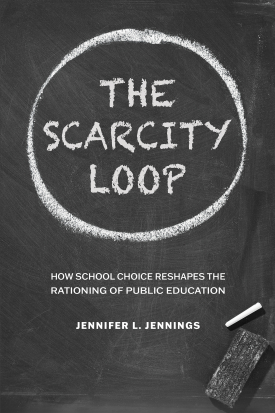
The Scarcity Loop

How School Choice Reshapes the Rationing of Public Education
Author
Jennifer L. Jennings
Paperback
$35.00
Add to Cart
Publication Date
6 in. × 9 in.
ISBN
978-0-87154-529-9

About This Book

School choice promises to free families from the limits of where they live. The Scarcity Loop asks what happens when that promise is made in school systems where more children seek desirable schools than those schools can serve. Focused on New York City’s high school admissions system, sociologist Jennifer L. Jennings argues that choice becomes another way to ration scarce educational opportunity, shifting where rationing happens, who must manage it, and how families understand the outcomes that follow.

Jennings begins with the admissions process itself. New York City asks every eighth grader to choose from hundreds of options. On paper, the system offers extraordinary possibility. But that possibility still has to be converted into a seat. Someone has to learn the rules, compare schools, manage deadlines, make trips, and decide how much risk a thirteen-year-old can bear. Jennings calls this the work of getting in and shows that the capacity to do that work is not evenly distributed. Some families enter choice systems with the flu-ency and flexibility to turn options into opportunity. Others confront these systems with fewer supports and far less room for error. Some teenagers shoulder decisions with little adult help. Counselors trans-late complicated rules under impossible constraints. Principals are not passive actors: Jennings shows how they recruit and adapt as they try to build, manage demand for, and maintain the reputation of schools that families will choose.

Jennings contends that reforms meant to expand access can reorganize the very competition they aim to resolve. As one barrier recedes, another becomes more consequential. Residence matters less, but advantage does not disappear; it travels through information, timing, and familiarity with the rules. Inequality persists, not because nothing changes, but because advantage finds new points of entry as reforms change rules. As the work of securing opportunity shifts, so do understandings of inequality. Unequal outcomes can come to look less like consequences of how educational opportunities are organized and more like reflections of how families navigate the system.

Drawing on more than 450 interviews, participant observation, administrative data, and archival research, The Scarcity Loop follows students, parents, counselors, and principals as they navigate school choice at scale. Jennings traces who must do the work of making choice real, clarifying what is at stake when public education becomes something families must know how to secure.

About the Author

JENNIFER L. JENNINGS is Class of 1988 Professor of Domestic Policy, Professor of Sociology and Public Affairs, and the director of the Education Research Section, Princeton University

RSF Journal
View Book Series
Sign Up For Our Mailing List
Apply For Funding

Nursing homes have long faced staffing shortages, which are exacerbated by low pay and poor working conditions. Increasing immigration and employing immigrant workers could be a remedy for these challenges. Economists Delia Furtado and Karen Shen, economist and legal scholar Catalina Amuedo-Dorantes, and public policy scholars Krista Ruffini and Yulya Truskinovsky will investigate the impact of greater local availability of immigrant workers on nursing home staffing practices and job quality.

In the United States, thousands of people experiencing homelessness are arrested and charged with crimes each year. Often, these charges stem from laws that criminalize acts and behaviors associated with homelessness, such as sleeping in public areas and panhandling. Advocates commonly argue that housing and social services will reduce these behaviors. Public policy scholars Andrew Sullivan and Stephanie Casey Pierce will collect data on extreme weather plans across the 100 largest counties in the United States.