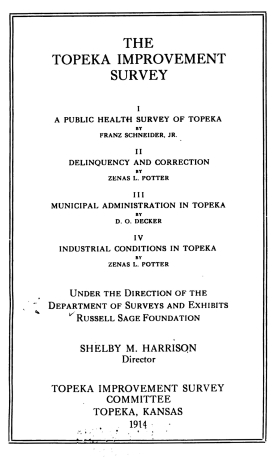
Cover image of the book Delinquency and Correction
Books

Delinquency and Correction

Author
Zenas L. Potter
Ebook
Publication Date
276 pages

About This Book

A volume of the Topeka Improvement Survey, a survey of health conditions in Topeka, Kansas, in 1914, this report examines the courts, police departments, and city and county jails. Juvenile delinquency and preventative work are explored. Published with A Public Health Survey of Topeka by Franz Schneider, Jr., Municipal Administration in Topeka by D. O. Decker, and Industrial Conditions in Topeka by Zenas L. Potter.

ZENAS L. POTTER, Department of Surveys and Exhibits, Russell Sage Foundation
RSF Journal
View Book Series
Sign Up For Our Mailing List
Apply For Funding
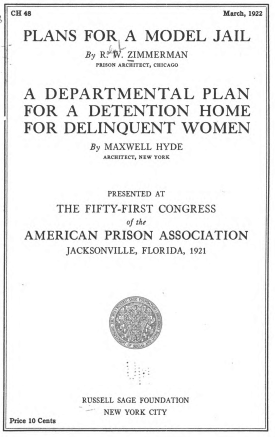
Cover image of the book A Departmental Plan for a Detention Home for Delinquent Women
Books

A Departmental Plan for a Detention Home for Delinquent Women

Author
Maxwell Hyde
Ebook
Publication Date
18 pages

About This Book

Presented at the fifty-first congress of the American Prison Association in 1921, this pamphlet attempts to develop proper, universal plans for a detention home for women. Arguing that each prison would have specific building requirements and characteristics, the author presents several well-established canons of architecture and building which should be followed in any jail, emphasizing humane conditions and required needs. Printed with Plans for a Model Jail by R. W. Zimmerman.

MAXWELL HYDE, architect, New York
RSF Journal
View Book Series
Sign Up For Our Mailing List
Apply For Funding
Cover image of the book Employment for Jail Prisoners in Wisconsin
Books

Employment for Jail Prisoners in Wisconsin

Author
Hornell Hart
Ebook
Publication Date
106 pages

About This Book

Presented at the fifty-first congress of the American Prison Association in 1921, this paper presents a practice adopted by Wisconsin at the turn of the century that involved finding employment for county jail prisoners with farmers and other employers in the immediate vicinity of the jail. Printed with How the Vermont Plan Reforms Jail Prisoners by Frank H. Tracy.

HORNELL HART, Iowa State University

RSF Journal
View Book Series
Sign Up For Our Mailing List
Apply For Funding
Cover image of the book Weathering Katrina
Books

Weathering Katrina

Culture and Recovery among Vietnamese Americans
Author
Mark J. VanLandingham
Paperback
$32.50
Add to Cart
Publication Date
6 in. × 9 in. 166 pages
ISBN
978-0-87154-872-6
Also Available From

About This Book

Weathering Katrina is a very thoughtful and elegantly executed monograph by a master of the craft. It is social science at its best.”

— Kai Erikson, William R. Kenan, Jr. Professor Emeritus of Sociology and American Studies, Yale University

“Mark VanLandingham’s book, Weathering Katrina, tells a fascinating story of how the Vietnamese community in New Orleans East survived a major natural disaster and thrived afterward. It makes a significant contribution to the literature on disasters, community resilience, and ethnic culture.”

 —Min Zhou, professor of sociology and Asian American studies, University of California, Los Angeles

In 2005, Hurricane Katrina devastated New Orleans. The principal Vietnamese-American enclave was a remote, low-income area that flooded badly. Many residents arrived decades earlier as refugees from the Vietnam War and were marginally fluent in English. Yet, despite these poor odds of success, the Vietnamese made a surprisingly strong comeback in the wake of the flood. In Weathering Katrina, public health scholar Mark VanLandingham analyzes their path to recovery, and examines the extent to which culture helped them cope during this crisis.

Contrasting his longitudinal survey data and qualitative interviews of Vietnamese residents with the work of other research teams, VanLandingham finds that on the principal measures of disaster recovery—housing stability, economic stability, health, and social adaptation—the Vietnamese community fared better than other communities. By Katrina’s one-year anniversary, almost 90 percent of the Vietnamese had returned to their neighborhood, higher than the rate of return for either blacks or whites. They also showed much lower rates of post-traumatic stress disorder than other groups. And by the second year after the flood, the employment rate for the Vietnamese had returned to its pre-Katrina level.

While some commentators initially attributed this resilience to fairly simple explanations such as strong leadership or to a set of vague cultural strengths characteristic of the Vietnamese and other “model minorities”, VanLandingham shows that in fact it was a broad set of factors that fostered their rapid recovery. Many of these factors had little to do with culture. First, these immigrants were highly selected—those who settled in New Orleans enjoyed higher human capital than those who stayed in Vietnam. Also, as a small, tightly knit community, the New Orleans Vietnamese could efficiently pass on information about job leads, business prospects, and other opportunities to one another. Finally, they had access to a number of special programs that were intended to facilitate recovery among immigrants, and enjoyed a positive social image both in New Orleans and across the U.S., which motivated many people and charities to offer the community additional resources. But culture—which VanLandingham is careful to define and delimit—was important, too. A shared history of overcoming previous challenges—and a powerful set of narratives that describe these successes; a shared set of perspectives or frames for interpreting events; and a shared sense of symbolic boundaries that distinguish them from broader society are important elements of culture that provided the Vietnamese with some strong advantages in the post-Katrina environment.

By carefully defining and disentangling the elements that enabled the swift recovery of the Vietnamese in New Orleans, Weathering Katrina enriches our understanding of this understudied immigrant community and of why some groups fare better than others after a major catastrophe like Katrina.

MARK J. VANLANDINGHAM is the Thomas C. Keller Professor at the Tulane University School of Public Health and Tropical Medicine.

RSF Journal
View Book Series
Sign Up For Our Mailing List
Apply For Funding
Cover image of the book Places in Need
Books

Places in Need

The Changing Geography of Poverty
Author
Scott W. Allard
Paperback
$32.50
Add to Cart
Publication Date
6 in. × 9 in. 308 pages
ISBN
978-0-87154-519-0
Also Available From

About This Book

“Scott W. Allard is one of the nation’s foremost experts on poverty, and Places in Need is a tour de force. This carefully-researched book offers more than innovative economic analysis and important lessons for social policy. It represents a deeply moral call to update our thinking about vulnerable people across America and rethink outdated assumptions about how to assist them. Places in Need must become required reading for anyone who seeks to understand modern American poverty, let alone begin to combat it.”

—Arthur Brooks, president, American Enterprise Institute

Places in Need tells the story of how poverty has grown dramatically in suburban America due to displacement, immigration, and job loss and how the existing social safety net is ill-equipped to address this new challenge. Scott W. Allard’s analysis expertly marshals both quantitative and qualitative data to give a nuanced account of the difficulties of meeting social needs in suburban locales. His insights and policy recommendations should be carefully studied by policymakers and social service providers as they come to grips with this new reality.”

—Paul Jargowsky, Professor of Public Policy, Rutgers University, Camden

“An exceptionally rich book that astutely focuses on key current issues related to the geography of poverty in the United States and trends therein. Scott W. Allard’s analysis is impressive in both its breadth and depth. His insights regarding the implications of geographic location for anti-poverty policy—how best to support low-income individuals and families in urban, suburban, and rural areas—make Places in Need essential reading for scholars, policymakers, and policy practitioners alike.”

Lawrence M. Berger, Vilas Distinguished Achievement Professor of Social Work and director, Institute for Research on Poverty, University of Wisconsin

Americans think of suburbs as prosperous areas that are relatively free from poverty and unemployment. Yet, today more poor people live in the suburbs than in cities themselves. In Places in Need, social policy expert Scott W. Allard tracks how the number of poor people living in suburbs has more than doubled over the last 25 years, with little attention from either academics or policymakers. Rising suburban poverty has not coincided with a decrease in urban poverty, meaning that solutions for reducing poverty must work in both cities and suburbs. Allard notes that because the suburban social safety net is less developed than the urban safety net, a better understanding of suburban communities is critical for understanding and alleviating poverty in metropolitan areas.

Using census data, administrative data from safety net programs, and interviews with nonprofit leaders in the Chicago, Los Angeles, and Washington, D.C. metropolitan areas, Allard shows that poor suburban households resemble their urban counterparts in terms of labor force participation, family structure, and educational attainment. In the last few decades, suburbs have seen increases in single-parent households, decreases in the number of college graduates, and higher unemployment rates. As a result, suburban demand for safety net assistance has increased. Concerning is evidence suburban social service providers—which serve clients spread out over large geographical areas, and often lack the political and philanthropic support that urban nonprofit organizations can command—do not have sufficient resources to meet the demand.

To strengthen local safety nets, Allard argues for expanding funding and eligibility to federal programs such as SNAP and the Earned Income Tax Credit, which have proven effective in urban and suburban communities alike. He also proposes to increase the capabilities of community-based service providers through a mix of new funding and capacity-building efforts.

Places in Need demonstrates why researchers, policymakers, and nonprofit leaders should focus more on the shared fate of poor urban and suburban communities. This account of suburban vulnerability amidst persistent urban poverty provides a valuable foundation for developing more effective antipoverty strategies.

SCOTT W. ALLARD is professor of public policy at the University of Washington’s Daniel J. Evans School of Public Policy and Governance.

RSF Journal
View Book Series
Sign Up For Our Mailing List
Apply For Funding

Excessive use of force by police officers remains a matter of concern and a divisive political issue. Yet, research on variations in officer-involved killings is rare, primarily due to the lack of reliable data. Sociologist Joscha Legewie and law and policy expert Jeffrey Fagan will compile and analyze two comprehensive datasets on police killings, one that collects all incidents between 2013 and 2015; and another that collects all incidents in the largest 50 police departments between 2000 and 2015. 

Cover image of the book Children of the Great Recession
Books

Children of the Great Recession

Editors
Irwin Garfinkel
Sara McLanahan
Christopher Wimer
Publication Date
6 in. × 9 in. 247 pages
ISBN
978-1-61044-859-8
Also Available From

About This Book

Many working families continue to struggle in the aftermath of the Great Recession, the deepest and longest economic downturn since the Great Depression. In Children of the Great Recession, a group of leading scholars draw from a unique study of nearly 5,000 economically and ethnically diverse families in twenty cities to analyze the effects of the Great Recession on parents and young children. By exploring the discrepancies in outcomes between these families—particularly between those headed by parents with college degrees and those without—this timely book shows how the most disadvantaged families have continued to suffer as a result of the Great Recession.

Several contributors examine the recession’s impact on the economic well-being of families, including changes to income, poverty levels, and economic insecurity. Irwin Garfinkel and Natasha Pilkauskas find that in cities with high unemployment rates during the recession, incomes for families with a college-educated mother fell by only about 5 percent, whereas families without college degrees experienced income losses three to four times greater. Garfinkel and Pilkauskas also show that the number of non-college-educated families enrolled in federal safety net programs—including Medicaid, the Earned Income Tax Credit, and the Supplemental Nutrition Assistance Program (or food stamps)—grew rapidly in response to the Great Recession.

Other researchers examine how parents’ physical and emotional health, relationship stability, and parenting behavior changed over the course of the recession. Janet Currie and Valentina Duque find that while mothers and fathers across all education groups experienced more health problems as a result of the downturn, health disparities by education widened. Daniel Schneider, Sara McLanahan and Kristin Harknett find decreases in marriage and cohabitation rates among less-educated families, and Ronald Mincy and Elia de la Cruz-Toledo show that as unemployment rates increased, nonresident fathers’ child support payments decreased. William Schneider, Jeanne Brooks-Gunn, and Jane Waldfogel show that fluctuations in unemployment rates negatively affected parenting quality and child well-being, particularly for families where the mother did not have a four-year college degree.

Although the recession affected most Americans, Children of the Great Recession reveals how vulnerable parents and children paid a higher price. The research in this volume suggests that policies that boost college access and reinforce the safety net could help protect disadvantaged families in times of economic crisis.

IRWIN GARFINKEL is the Mitchell I. Ginsberg Professor of Contemporary Urban Problems and co-founding director of the Columbia Population Research Center (CPRC) at Columbia University.

SARA MCLANAHAN is the William S. Tod Professor of Sociology and Public Affairs at Princeton University.

CHRISTOPHER WIMER is Research Scientist at the Columbia Population Research Center (CPRC) at Columbia University.

RSF Journal
View Book Series
Sign Up For Our Mailing List
Apply For Funding
Cover image of the book Hard Bargains
Books

Hard Bargains

The Coercive Power of Drug Laws in Federal Court
Author
Mona Lynch
Paperback
$29.95
Add to Cart
Publication Date
6 in. × 9 in. 220 pages
ISBN
978-0-87154-511-4
Also Available From

About This Book

Winner of the 2017 Michael J. Hindelang Award from the American Society of Criminology

“In this timely and engaging book, Mona Lynch exposes and examines how draconian federal drug laws operate on the ground. Drawing upon extensive and meticulous research, Lynch paints a disturbing portrait of a flawed system of justice in which Congress has provided remarkable power to prosecutors to induce guilty pleas in drug cases by threatening additional charges that in many cases would double or triple the sentence imposed after conviction at trial. The failure of prosecutors to exercise discretion is matched by the inability of judges to do so, because decades-long sentences are usually mandated by Congress itself. Original, accessible, and critically important, Hard Bargains is a must-read for scholars, lawmakers, lawyers, and citizens interested in achieving more proportional and equitable federal drug policies.”

KATE STITH, Lafayette S. Foster Professor of Law, Yale Law School

“Mona Lynch demonstrates convincingly how changes in U.S. sentencing and drug laws have concentrated the power to punish in the hands of prosecutors. Through on-the-ground research in three contrasting districts, Hard Bargains portrays region-specific ways in which such power is deployed. Weakened due process and the destruction of myriad lives, especially among African American men, is the outcome everywhere. This thoroughly researched and most readable book reveals the urgency of law reform.”

JOACHIM J. SAVELSBERG, professor of sociology and law, Arsham and Charlotte Ohanessian Chair, University of Minnesota

The convergence of tough-on-crime politics, stiffer sentencing laws, and jurisdictional expansion in the 1970s and 1980s increased the powers of federal prosecutors in unprecedented ways. In Hard Bargains, social psychologist Mona Lynch investigates the increased power of these prosecutors in our age of mass incarceration. Lynch documents how prosecutors use punitive federal drug laws to coerce guilty pleas and obtain long prison sentences for defendants—particularly those who are African American—and exposes deep injustices in the federal courts.

As a result of the War on Drugs, the number of drug cases prosecuted each year in federal courts has increased fivefold since 1980. Lynch goes behind the scenes in three federal court districts and finds that federal prosecutors have considerable discretion in adjudicating these cases. Federal drug laws are wielded differently in each district, but with such force to overwhelm defendants’ ability to assert their rights. For drug defendants with prior convictions, the stakes are even higher since prosecutors can file charges that incur lengthy prison sentences—including life in prison without parole. Through extensive field research, Lynch finds that prosecutors frequently use the threat of extremely severe sentences to compel defendants to plead guilty rather than go to trial and risk much harsher punishment. Lynch also shows that the highly discretionary ways in which federal prosecutors work with law enforcement have led to significant racial disparities in federal courts. For instance, most federal charges for crack cocaine offenses are brought against African Americans even though whites are more likely to use crack. In addition, Latinos are increasingly entering the federal system as a result of aggressive immigration crackdowns that also target illicit drugs.

Hard Bargains provides an incisive and revealing look at how legal reforms over the last five decades have shifted excessive authority to federal prosecutors, resulting in the erosion of defendants’ rights and extreme sentences for those convicted. Lynch proposes a broad overhaul of the federal criminal justice system to restore the balance of power and retreat from the punitive indulgences of the War on Drugs.

MONA LYNCH is Professor of Criminology, Law & Society at the University of California, Irvine.

RSF Journal
View Book Series
Sign Up For Our Mailing List
Apply For Funding

Extensive research documents large and growing disparities in academic achievement and educational attainment between those at the top and bottom of the income distribution. Researchers have increasingly used state-level school administrative data to examine disparities in outcomes. Administrative data, compared to surveys, have near-universal population coverage, comprehensive information on achievement and attainment, and fewer problems with non-response and attrition. However, they lack detailed measures of socioeconomic status.