Delaware’s Student Excellence Equals Degree (SEED) scholarship, established in 2005, originally covered tuition for associate degree programs for students with a minimum of 2.5 GPA and expanded in 2021 to include workforce training, and removed GPA requirements for these shorter-term programs. Economist Florence Ran and education and social policy scholar Hojung Lee will estimate the impacts of SEED on college enrollment, credential attainment, employment, and earnings.
In 2025, the Trump administration cancelled the Food Security Supplement to the December Current Population Survey (CPS-FSS), which forms the basis for a longstanding annual report on food security. These data are needed to track how vulnerable families are faring in a time of rising prices, economic uncertainty, and cuts to welfare programs.
Books
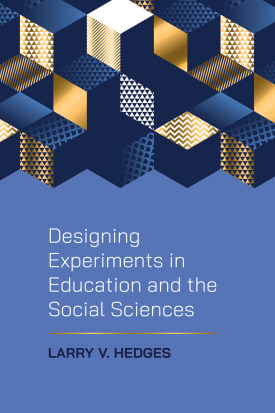
Designing Experiments in Education and the Social Sciences
Publication Date
6 in. × 9 in.
ISBN
978-0-87154-596-1
About This Book
"This book offers a comprehensive, modern guide to designing experiments in education. It leads readers through each stage of the research process, from developing logic models and selecting samples to choosing appropriate experimental designs. The text covers both single-level and multilevel experiments, with clear and careful attention to statistical power throughout, as well as discussion of moderator effects. Real-world examples and references to practical tools are integrated to support both understanding and application. Designing Experiments in Education and the Social Sciences serves as an excellent textbook and a valuable resource for researchers planning and conducting impact studies in education.”
—JESSACA SPYBROOK, professor of research methods, University of South Carolina
“Few scholars have influenced experimental design as profoundly as Larry Hedges. This book brings that influence into a single volume, grounded in the challenges of real-world research. For me, Hedges’s summer training institute was invaluable preparation for working on education field experiments, and Designing Experiments in Education and the Social Sciences is a powerful complement to that experience.”
—MICHAEL J. WEISS, senior fellow, postsecondary education, MDRC
“I want to congratulate Larry Hedges for providing a single, authoritative new account of experimental design in education with broad implications for the social sciences and medicine. Social experiments occur in a multilevel world, where participants are embedded in social settings such as families, classrooms, schools, neighborhoods, hospitals, or physician practices. In some studies, the aim is to change the entire setting and not just the behavior of individual persons. Even when the behavior of the individual person is the focus of change, that person is influenced by peers and practitioners. We now have a book, Designing Experiments in Education and the Social Sciences, that fully recognizes the consequences of these basic facts for experimental design in a social world.”
—STEPHEN RAUDENBUSH, Lewis-Sebring Distinguished Service Professor, Department of Sociology, the College, and the Harris School of Public Policy Studies, University of Chicago
Randomized experiments—often referred to as the gold standard of research design—are generally accepted as the type of studies that provide the strongest evidence about cause and effect. There has been a wide adoption of experimental methods in agriculture, medicine, industrial design, and laboratory social sciences, such as experimental psychology, where conditions can be controlled. Since then, there has been an increase in the use of field experiments to provide evidence of cause and effect beyond the laboratory. However, the social settings in which these studies take place complicate the design and evaluation of experiments because their social contexts must be taken into account in order for the experiment to provide useful and unambiguous results. In Designing Experiments in Education and the Social Sciences, statistician Larry V. Hedges details how to design educational and social science field experiments that are sensitive enough to provide clear-cut evidence on the effects of social interventions.
Hedges draws on one hundred years of statistical theory and classic experimental design in Designing Experiments in Education and the Social Sciences. Highlighting the social-structural information embedded in field experiments, he links this history with contemporary statistical methods in the social sciences to explain how to design social experiments that are adequately sensitive to determine the influence of an intervention. He covers the four basic research designs—and thirty-nine elaborations of those designs—that are used most often in social experiments while also introducing additional, more complex, designs. He brings together, in the same notation, work on experimental design, design sensitivity, and optimal design of experiments for the most frequently used research designs in education and the social sciences, emphasizing their conceptual consistency. Hedges also discusses the practical problems of how to recruit and maintain a sample throughout the duration of an experiment.
Designing Experiments in Education and the Social Sciences is an essential resource for researchers planning educational and social field experiments and graduate students.
RSF Journal
View Book Series
Sign Up For Our Mailing List
Apply For Funding
Books
Folk Dancing: Illustrating the Educational, Civic, and Moral Value of Folk Dancing
Publication Date
26 pages
About This Book
This illustrated booklet discusses the moral value of folk dancing. Part I covers folk and national dances. Part II covers the use of folk dancing in a public school system, as shown by its use by the girls’ branch of the Public Schools Athletic League of New York City.
LUTHER H. GULICK was director of the Department of Child Hygiene at the Russell Sage Foundation.
Download
RSF Journal
View Book Series
Sign Up For Our Mailing List
Apply For Funding
About This Book
This booklet contains a list of books, reports, and magazine articles that deal with the topic of recreation. It is arranged by subject, with annotations on the more formal publications, many of which deal with other phases of recreation than the subject under which they are listed. Subjects include play and games, storytelling, folk dancing, sports, holidays, school gardens, boys’ and girls’ clubs, public parks, and walking clubs, among other topics.
RSF Journal
View Book Series
Sign Up For Our Mailing List
Apply For Funding
About This Book
This booklet includes correspondence from Margaret Woodrow Wilson, a daughter of President Woodrow Wilson and a champion of the social-center cause. She appeals to the State Federations composing the General Federation of Women’s Clubs to take up this timely and important task. The correspondence is followed by a typed list of essential provisions of an adequate social-center law.
RSF Journal
View Book Series
Sign Up For Our Mailing List
Apply For Funding
About This Book
This booklet reports on the results of a survey on school social centers sent to 774 school superintendents. It includes charts on cities that reported having schoolhouse social or recreation centers at which there were some paid workers and that reported schools with libraries. The booklet also discusses civic aspects of recent social-center development.
CLARENCE A. PERRY was an urban planner, sociologist, and educator.
RSF Journal
View Book Series
Sign Up For Our Mailing List
Apply For Funding
Books
A Comparative Study of Public School Systems in the Forty-Eight States
Publication Date
33 pages
About This Book
This booklet is aimed at legislators, school workers, and others interested in public education and provides facts concerning school conditions in all the states. Topics include investment in the school building, expenditure per school-age child, the length of the school year and attendance, workers and wages, textbook legislation, medical inspection legislation, and tests of efficiency, among other topics.
RSF Journal
View Book Series
Sign Up For Our Mailing List
Apply For Funding
About This Book
This booklet discusses how social centers promote reform movements. It notes that social centers provide patriotic education of immigrants through public ceremonies held for their naturalization, civic and health education, the promotion of baby welfare, the elevation of political discussions, and the dignification of voting through the maintenance of balloting booths. The booklet concludes with a list of foundation pamphlets on the topic of the social center.
CLARENCE A. PERRY was an urban planner, sociologist, and educator.
RSF Journal
View Book Series
Sign Up For Our Mailing List
Apply For Funding
About This Book
This booklet comments on the increase in the number of vacation schools—that is, schools that reopen in June after the conclusion of the regular school year. It discusses how the schools are affecting elementary education and provides a list of cities offering vacation classes as well statistics regarding the number of buildings used, the number of sessions held, and the frequency of classes, among other topics.
CLARENCE A. PERRY was an urban planner, sociologist, and educator.