About This Book
This pamphlet provides recommendations for safer celebratory traditions for the Fourth of July.
August H. Brunner, Department of Child Hygiene, Russell Sage Foundation
This pamphlet provides recommendations for safer celebratory traditions for the Fourth of July.
August H. Brunner, Department of Child Hygiene, Russell Sage Foundation
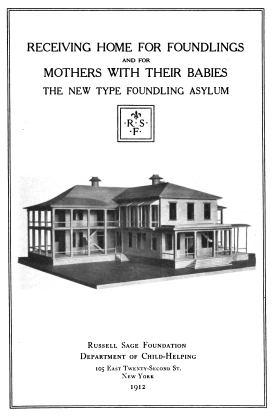
A model aimed for use by various institutions that provide asylum to orphaned children and struggling mothers, including temporary receiving homes into which mothers who might otherwise abandon their children are received with them. The model is designed to exhibited the chief sanitary features which the medical profession recognize as essential to success in saving the lives and improving the vitality of the babies who must have institutional care temporarily.

From the foreword: “Every other winter the legislatures of about forty states meet in deliberative session. They consider approximately 1,000 bills on educational questions and enact about 200 of them into law. This pamphlet has been compiled with the object of making available to legislators, school workers, and others having at heart the interests of public education, salient facts concerning school conditions in all the states. The figures have been derived from official sources and every care exercised to insure their accuracy. Every endeavor has been made to avoid complexities and technicalities. The object of the work is to render available to each state the experience of all.
Including a directory of institutions dealing with tuberculosis in the United States and Canada. Compiled under the direction of the National Association for the Study and Prevention of Tuberculosis by Philip P. Jacobs.
From the Introduction: “The development of the anti-tuberculosis activity in the United States during the last ten years has been so rapid and the extension of its field so varied that the need of a comprehensive survey of the work is obvious. A similar situation was met in 1904 by the appearance of the ‘Directory of Institutions Dealing with Tuberculosis’ compiled by Miss Lilian Brandt and published by the New York Charity Organization Society in cooperation with the National Association for the Study and Prevention of Tuberculosis. The present volume includes a revision of that directory as an important section of its contents.”
A report concerning what to do with the distress caused by unemployment and how the community is to bear the burden imposed upon it, aiming to serve community agencies that must deal with the phases of unemployment during times of industrial depression.
The purpose of this handbook is to suggest activities for after-school occasions and to indicate sources of information about them. The material is arranged in such a way as to serve readily community-center officials who view problems of organization objectively, who regard themselves as trustees of certain spaces and facilities in a school building which they are to utilize for the enhancement of the neighborhood’s common life.
Clarence Arthur Perry, Department of Recreation of the Russell Sage Foundation
A selection from the papers written by Mary E. Richmond, edited with biographical notes by Joanna C. Colcord, director of the Charity Organization Department, Russell Sage Foundation, and Ruth Z.S. Mann.
MARY E. RICHMOND was director of the Charity Organization Department at the Russell Sage Foundation.
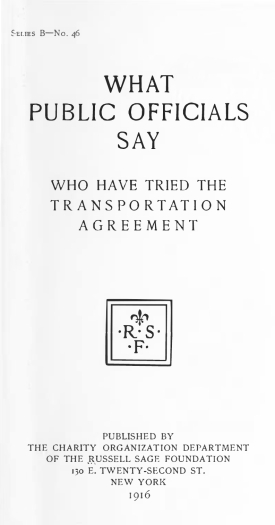
A report on the adoption of the Transportation Agreement, with contributions from Alexander M. Wilson, assistant director of the Department of Public Health and Charities of Philadelphia; Mabel Tibbot, overseer of the poor, Fort Dodge, Iowa; George S. Wilson, secretary of the Board of Charities, District of Columbia; and the State Board of Charities of Missouri, in a “Letter of Advice to County Courts.”
A look at athletic exercises promoted by the Girls’ Branch of the Public Schools Athletic League, including folk dancing, relays, and athletic competitions. From the Playground Association Committee of America.
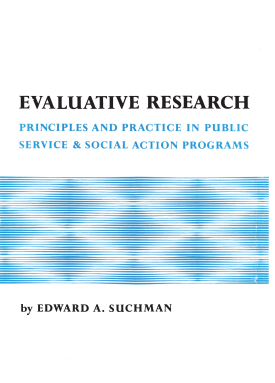
Proving that any program designed to change our social behavior is doing what it set out to do is one of the most difficult problems faced by social science. Yet those responsible for such a program must attempt an evaluation of its results if they are to achieve the support they need. Edward A. Suchman, one of the world's foremost experts in measuring social behavior, presents the most comprehensive study of evaluation available to date.
In Evaluative Research he describes the techniques used to determine empirically the extent to which social goals are actually being achieved, to locate the barriers to the achievement of these goals, and to discover the unanticipated consequences of social actions.
The book is divided into three main sections, representing the conceptual, the methodological, and the administrative aspects of evaluation. It begins with a brief historical account and a general critique of the current status of evaluation studies. The introduction is followed by a conceptual analysis of the evaluative process, including a discussion of different levels of objectives. The methodological section includes an analysis of various research designs applicable to evaluative research. The place of evaluation in the administrative process is related to program planning, demonstration, and operation. Administrative resistance and barriers to evaluation are examined along with the problems in the utilization of the findings.
The book concludes with a brief exposition on the relationship of evaluative research to social experimentation stressing the potential contribution which public service and social action programs can make to our knowledge of administrative science and social change.
This book will have many uses. It will aid the evaluative research person in striking a balance between rigorous method and the situation in which he must function. For the operating practitioner, the book will explain what competent evaluation involves. Administrators will find the volume and invaluable aid.