"Patchwork Apartheid is a landmark study of racial capitalism and social inequality in the United States. By putting newly available data into dialogue with detailed local histories, Colin Gordon takes readers beyond the storylines and summary facts that typically guide discussions of residential segregation in America. More than any other work I know, this book brings residential segregation into focus as a social, economic, and political process in motion—and as a process in which private actors and market agreements played preeminent roles in constructing the nation’s racial and spatial boundaries. Beautifully written and powerfully argued, Patchwork Apartheid should appeal to public and academic audiences alike. It is essential reading for anyone who wants to understand the origins, operations, and consequences of residential segregation in America."
—JOE SOSS, Cowles Chair for the Study of Public Service, University of Minnesota
"Colin Gordon is a singular historian, and this is a singular book. Patchwork Apartheid itemizes the schemes and evasions by which white homeowners continued to insist on their right to assert and convey their right to all-white neighborhoods (and an all-white sector of the housing market) long after the United States Supreme Court had ruled those rights to be legally unenforceable. Gordon is a master of summoning historical particulars into a dramatic refiguration of our understanding of the time and space of American history."
—WALTER JOHNSON, Winthrop Professor of History and professor of African and African American Studies, Harvard University
"Patchwork Apartheid is a remarkable contribution to the rapidly evolving scholarship on the origins of segregation in America. Gordon marshals an unprecedented amount of data to document how private restrictions established racial barriers dividing neighborhoods, suburban subdivisions, and society as a whole. These individual agreements made in the first half of the twentieth century could not be more relevant today, as we collectively grapple with the legacy of our explicitly segregationist past."
—JACOB FABER, associate professor of sociology and public service, Robert F. Wagner School of Public Service, New York University
"Colin Gordon’s prodigious research results in a groundbreaking comparative study of the history, structure, and lasting impact of racially restrictive covenants in an important swath of Midwestern cities. In describing the experience of these central locations, Patchwork Apartheid illustrates important reasons for our national patterns of metropolitan-wide residential segregation."
—CAROL M. ROSE, Gordon Bradford Tweedy Professor Emeritus of Law and Organization and professorial lecturer in law, Yale Law School
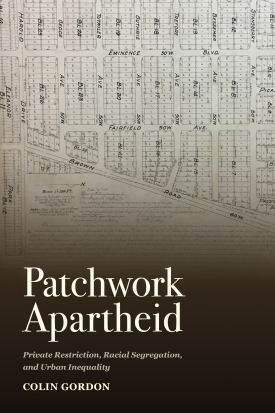
For the first half of the twentieth century, private agreements to impose racial restrictions on who could occupy property decisively shaped the development of American cities and the distribution of people within them. Racial restrictions on the right to buy, sell, or occupy property also effectively truncated the political, social, and economic citizenship of those targeted for exclusion. In Patchwork Apartheid, historian Colin Gordon examines the history of such restrictions and how their consequences reverberate today. Drawing on a unique record of property restrictions excavated from local property records in five Midwestern counties, Gordon documents the prevalence of private property restriction in the era before zoning and building codes were widely employed and before federal redlining sanctioned the segregation of American cities and suburbs. This record of private restriction—documented and mapped to the parcel level in Greater Minneapolis, Greater St. Louis, and two Iowa counties—reveals the racial segregation process both on the ground, in the strategic deployment of restrictions throughout transitional central city neighborhoods and suburbs, and in the broader social and legal construction of racial categories and racial boundaries.
Gordon also explores the role of other policies and practices in sustaining segregation. Enforcement of private racial restrictions was held unconstitutional in 1948, and such agreements were prohibited outright in 1968. But their premises and assumptions, and the segregation they had accomplished, were carried forward by an array of private and public policies. Explicit racial restrictions were accompanied and sustained by the discriminatory business practices of real estate agents and developers, who characterized certain neighborhoods as white and desirable and others as black and undesirable, thereby hiding segregation behind the promotion of sound property investments, safe neighborhoods, and good schools. These practices were accompanied and sustained by local zoning, which systematically protected white neighborhoods while targeting “blighted” black neighborhoods for commercial and industrial redevelopment, and by a tangle of federal policies that reliably deferred to local and private interests with deep investments in local segregation. Private race restriction was thus a key element in the original segregation of American cities and a source of durable inequalities in housing wealth, housing opportunity, and economic mobility.
Patchwork Apartheid exhaustively documents the history of private restriction in urban settings and demonstrates its crucial role in the ideas and assumptions that have sustained racial segregation in the United States into the twenty-first century.
COLIN GORDON is a professor of history at the University of Iowa
***
Interactive maps, datasets, and codebooks
The datasets linked below show the spatial location of racial restrictions on property in the City of St. Louis and St. Louis County in Missouri, and in Black Hawk and Johnson Counties in Iowa. Each zipped file contains a Geographic Information System (GIS) shapefile, and a codebook (describing the shapefile attributes) in CSV format. The data for Hennepin County, Minnesota was collected by the Mapping Prejudice project.
St. Louis and St. Louis County
Title: Racial Restrictions in the City of St. Louis
Published Date: 2023
Author: Gordon, Colin
Author Contact: colin-gordon@uiowa.edu
Type: Dataset, Spatial Data
Description: This data was compiled by Colin Gordon. It shows the location of racial restrictions on property use recorded in the City of St. Louis between 1890 and 1955. The data for this project were sourced from historical property records (deeds, indentures, agreements, plat maps) held by the Recorder of the City of St. Louis. Restrictions were identified using a register of property restrictions maintained by the St. Louis Title and Abstract Company. Restricted parcels were matched to current parcels using plat maps and the legal descriptions in the current records. In cases where the original parcels have been subject to resubdivision or redevelopment, original plats were used to re-create the historical parcels.
Funding information: Project funding and in-kind support were provided by the National Endowment for the Humanities, the City of St. Louis, the University of Iowa Vice President for Research, the National Endowment for the Humanities, the Commonwealth Fund (Harvard), Legal Services of Eastern Missouri, the Metropolitan St. Louis Equal Housing and Opportunity Council, and the St. Louis Association of Realtors.
Citation: Racial Restrictions in the City of St. Louis, Missouri [Dataset]
Title: Racial Restrictions in St. Louis County
Published Date 2023
Author: Gordon, Colin
Author Contact: colin-gordon@uiowa.edu
Type: Dataset, Spatial Data
Description: These data were compiled by Colin Gordon and show the location of racial restrictions on property use recorded in St. Louis County between 1890 and 1955. The data for this project were sourced from historical property records (deeds, indentures, agreements, plat maps) held by the Recorder of St. Louis County. Restrictions were identified using plat maps and a card file of property restrictions maintained by the St. Louis County Recorder. Restricted parcels were matched to current parcels using plat maps and the legal descriptions in the current records. In cases where the original parcels have been subject to resubdivision or redevelopment, original plats were used to re-create the historical parcels.
Funding information: Project funding and in-kind support were provided by the National Endowment for the Humanities, the St. Louis County Recorder, the University of Iowa Vice President for Research, the National Endowment for the Humanities, the Commonwealth Fund (Harvard), Legal Services of Eastern Missouri, the Metropolitan St. Louis Equal Housing and Opportunity Council, and the St. Louis Association of Realtors.
Citation: Racial Restrictions in the County of St. Louis, Missouri [Dataset]
Hennepin County, Minneapolis
The data for Hennepin County, Minnesota was collected by the Mapping Prejudice project [Dataset]
Black Hawk County, Iowa
Title: Racial Restrictions in Black Hawk County, Iowa
Published Date 2023
Author: Gordon, Colin
Author Contact: colin-gordon@uiowa.edu
Type: Dataset, Spatial Data
Description: These data were compiled by Colin Gordon, with the assistance of Brayden Adcock, Matt Bartholomew, Kate Dennis, Tyler Dolinar, Carson Frazee, Cori Hoffman, Emily Kehoe, Cassidy Kengott, Christopher Marriott, Charlotte Stevens, Daniel Welsh, and Hannah Wegner. The dataset shows the location of racial restrictions on property use recorded in Black Hawk County between 1910 and 1955. The data for this project were sourced from historical property records (deeds, indentures, agreements, plat maps) held by the Black Hawk County Recorder. Restrictions were identified by searching plat maps, deed books, and deed book indexes. Restricted parcels were matched to current parcels using plat maps and the legal descriptions in the current records. In cases where the original parcels have been subject to resubdivision or redevelopment, original plats were used to re-create the historical parcels.
Funding information: Project funding and in-kind support were provided by the University of Iowa and the Black Hawk County Recorders Office.
Citation: Racial Restrictions in Black Hawk County, Iowa [Dataset]
Johnson County, Iowa
Title: Racial Restrictions in Johnson County, Iowa
Published Date 2023-#-#
Author: Gordon, Colin
Author Contact: colin-gordon@uiowa.edu
Type: Dataset, Spatial Data
Description: These data were compiled by Colin Gordon, with the assistance of Gabe Bacille, Dune Carter, Colton Herrick, Daniel Langholz, Jack Lauer, and Keiran Reynolds. The dataset shows the location of racial restrictions on property use recorded in Johnson County between 1890 and 1955. The data for this project were sourced from historical property records (deeds, indentures, agreements, plat maps) held by the Johnson County Recorder. Restrictions were identified using optical character recognition (OCR) searches of the county’s digitized deed books. Restricted parcels were matched to current parcels using plat maps and the legal descriptions in the current records. In cases where the original parcels have been subject to resubdivision or redevelopment, original plats were used to re-create the historical parcels.
Funding information: Project funding and in-kind support were provided by the University of Iowa and the Johnson County Recorder.
Citation: Racial Restrictions in Johnson County, Iowa [Dataset]