"Brint and Schroedel's two volume series is, quite simply, an outstanding exploration of America's conservative Protestants and their interaction with democratic politics .... The essays tackle a wide range of issues: social movement theory, survey data on values and voting, historical development, the implications of partisan involvement, race, and much more .... There may not be a more informative 700 pages on the historical sociology of American evangelicals for many years to come."
-CANADIAN JOURNAL OF SOCIOLOGY
"With all the smoke that has been blown on the subject matter of this book, it is especially gratifying to read the careful, patient, well-researched, and perceptive material offered here. The sociologists and political scientists assembled for this project are first rate; what they write may be, collectively, the wisest words yet published on the character of 'the new Christian right' and much else besides."
-MARK A. NOLL, Francis Al McAnaney Professor of History, University of Notre Dame
"From the first wave of the Moral Majority to the shifting tide of values voters, a generation of Evangelical engagement in American public life is now ready for reassessment. Cogent and careful, the critical conversation of these two volumes cuts through the trumpet calls and tinny clichés of culture wars with an orchestral account of manifold ideals and institutions in counterpoint. It lifts up underlying changes that run deep in the American grain of revival and reform, moral protest and populist politics, social mobility, and cultural assimilation into an ongoing argument over the public good. Bravo!"
-STEVEN M. TIPTON, Charles Howard Candler Professor of Sociology of Religion, Emory University
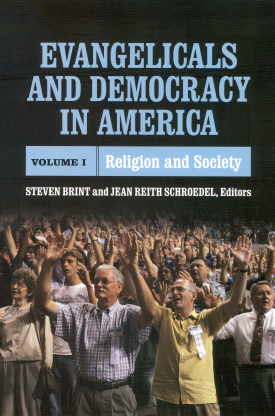
By the end of the nineteenth century, the vast majority of U.S. churches were evangelical in outlook and practice. America’s turn toward modernism and embrace of science in the early twentieth century threatened evangelicalism’s cultural prominence. But as confidence in modern secularism wavered in the 1960s and 1970s, evangelicalism had another great awakening. The two volumes of Evangelicals and Democracy in America trace the development and current role of evangelicalism in American social and political life. Volume I focuses on who evangelicals are today, how they relate to other groups, and what role they play in U.S. social institutions.
Part I of Religion and Society examines evangelicals’ identity and activism. Contributor Robert Wuthnow explores the identity built around the centrality of Jesus, church and community service, and the born-again experience. Philip Gorski explores the features of American evangelicalism and society that explain the recurring mobilization of conservative Protestants in American history. Part II looks at how evangelicals relate to other key groups in American society. Individual chapters delve into evangelicals’ relationship to other conservative religious groups, women and gays, African Americans, and mainline Protestants. These chapters show sources of both solidarity and dissension within the “traditionalist alliance” and the hidden strengths of mainline Protestants’ moral discourse. Part III examines religious conservatives’ influence on American social institutions outside of politics. W. Bradford Wilcox, David Sikkink, Gabriel Rossman, and Rogers Smith investigate evangelicals’ influence on families, schools, popular culture, and the courts, respectively. What emerges is a picture of American society as a consumer marketplace with a secular legal structure and an arena of pluralistic competition interpreting what constitutes the public good. These chapters show that religious conservatives have been shaped by these realities more than they have been able to shape them.
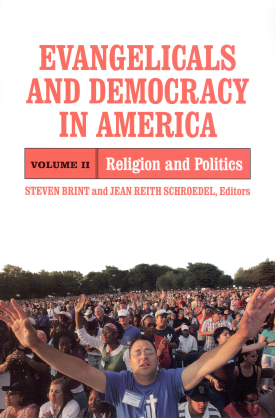
Evangelicals and Democracy in America, Volume I is one of the most comprehensive examinations ever of this important current in American life and serves as a corrective to erroneous popular representations. These meticulously balanced studies not only clarify the religious and social origins of evangelical mobilization, but also detail both the scope and limits of evangelicals’ influence in our society. This volume is the perfect complement to its companion in this landmark series, Evangelicals and Democracy in America, Volume II: Religion and Politics.
STEVEN BRINT is professor of sociology at the University of California, Riverside, director of the Colleges & Universities 2000 study, and associate dean of the College of Humanities, Arts, and Social Sciences.
JEAN REITH SCHROEDEL is dean of the School of Politics and Policy at Claremont Graduate University.
CONTRIBUTORS: Steven Brint, Jean Reith Schroedel, Nancy T. Ammerman, Prudence L. Carter, John H. Evans, John C. Green, Philip S. Gorski, Michèle Lamont, Paul Lichterman, Jennifer Merolla, Gabriel Rossman, David Sikkink, Rogers M. Smith, Scott Waller, W. Bradford Wilcox, Robert Wuthnow.