"It is uncontested that cooperation varies with the ambient level of trust. What is less widely appreciated is that a great deal of cooperation is explained not by the generalized level of trust but by the bilateral efforts of the parties to a contract who perceive that their mutual interests will be served by crafting cost-effective mechanisms in support of ongoing relations. Such intentional efforts to support cooperation are referred to as 'credible commitments' by economists and as an 'encapsulated interest in trust' by the authors of this book. Because, moreover, these supports are provided in cost-effective degree, they will vary predictably among transactions, depending on the needs. Karen S. Cook, Russell Hardin, and Margaret Levi demonstrate that such an approach to cooperation deepens our understanding of ongoing relations across a wide variety of social science phenomena. This book should be, and I am confident will be, widely read."
-OLIVER E. WILLIAMSON, Professor of the Graduate School and Edgar F. Kaiser Professor Emeritus of Business, Economics, and Law, Walter A. Haas School of Business, University of California, Berkeley
"Over the last decade, Professors Cook, Levi, and Hardin have masterminded one of the most productive collective scholarly endeavors in recent decades, exploring the contours and consequences of trust and trustworthiness in our collective lives. In this magisterial volume, they synthesize these contributions into a coherent and comprehensive account of this central concept. All subsequent investigations of trust will need to come to grips with this work, and all of us are in their debt."
-ROBERT D. PUTNAM, professor of public policy, Harvard University
"Is trust the central pillar of social order? Karen S. Cook, Russell Hardin, and Margaret Levi respond in the negative. They argue that effective and reliable institutions are the essential foundations of contemporary complex societies rather than interpersonal trust. Their analysis is worth a careful reading by all scholars and citizens concerned with the sustainability of modern societies."
-ELINOR OSTROM, Arthur F. Bentley Professor of Government, Indiana University
"Cooperation Without Trust? makes the provocative case that 'trust' is overrated. Working from a well-articulated definition of trust as a property of interpersonal relations, the authors challenge the notion that coordinating activities within complex societies requires high levels of trust and, indeed, suggest that, under certain circumstances, interpersonal trust can hinder large-scale coordination. They illustrate their points across a range of empirical settings, describing many modes of informal and institutional coordination that, they argue, make interpersonal trust increasingly expendable. This is a book of great clarity, imagination, and scope, speaking to scholars in fields as diverse as institutional economics, political organization, and social control. It belongs on a small shelf of essential readings on the classic question of social order in complex societies."
-PAUL DIMAGGIO, professor of sociology, Princeton University
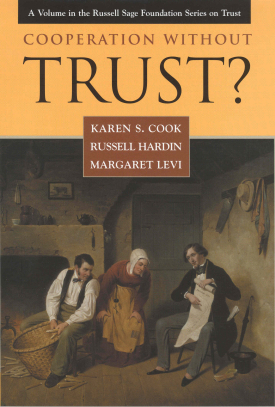
Some social theorists claim that trust is necessary for the smooth functioning of a democratic society. Yet many recent surveys suggest that trust is on the wane in the United States. Does this foreshadow trouble for the nation? In Cooperation Without Trust? Karen Cook, Russell Hardin, and Margaret Levi argue that a society can function well in the absence of trust. Though trust is a useful element in many kinds of relationships, they contend that mutually beneficial cooperative relationships can take place without it.
Cooperation Without Trust? employs a wide range of examples illustrating how parties use mechanisms other than trust to secure cooperation. Concerns about one’s reputation, for example, could keep a person in a small community from breaching agreements. State enforcement of contracts ensures that business partners need not trust one another in order to trade. Similarly, monitoring worker behavior permits an employer to vest great responsibility in an employee without necessarily trusting that person. Cook, Hardin, and Levi discuss other mechanisms for facilitating cooperation absent trust, such as the self-regulation of professional societies, management compensation schemes, and social capital networks. In fact, the authors argue that a lack of trust—or even outright distrust—may in many circumstances be more beneficial in creating cooperation. Lack of trust motivates people to reduce risks and establish institutions that promote cooperation. A stout distrust of government prompted America’s founding fathers to establish a system in which leaders are highly accountable to their constituents, and in which checks and balances keep the behavior of government officials in line with the public will. Such institutional mechanisms are generally more dependable in securing cooperation than simple faith in the trustworthiness of others.
Cooperation Without Trust? suggests that trust may be a complement to governing institutions, not a substitute for them. Whether or not the decline in trust documented by social surveys actually indicates an erosion of trust in everyday situations, this book argues that society is not in peril. Even if we were a less trusting society, that would not mean we are a less functional one.
KAREN S. COOK is the Ray Lyman Wilbur Professor of Sociology and senior associate dean of social sciences at Stanford University.
RUSSELL HARDIN is professor of politics at New York University.
MARGARET LEVI is Jere L. Bacharach Professor of International Studies in the Department of Political Science, University of Washington, Seattle.
A Volume in the Russell Sage Foundation Series on Trust