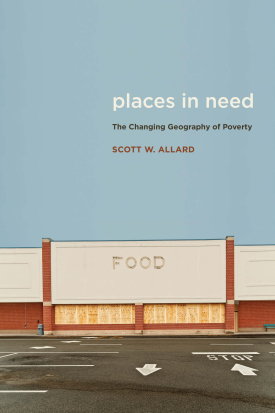
Cover image of the book Places in Need
Books

Places in Need

The Changing Geography of Poverty
Author
Scott W. Allard
Paperback
$32.50
Add to Cart
Publication Date
6 in. × 9 in. 308 pages
ISBN
978-0-87154-519-0
Also Available From

About This Book

“Scott W. Allard is one of the nation’s foremost experts on poverty, and Places in Need is a tour de force. This carefully-researched book offers more than innovative economic analysis and important lessons for social policy. It represents a deeply moral call to update our thinking about vulnerable people across America and rethink outdated assumptions about how to assist them. Places in Need must become required reading for anyone who seeks to understand modern American poverty, let alone begin to combat it.”

—Arthur Brooks, president, American Enterprise Institute

Places in Need tells the story of how poverty has grown dramatically in suburban America due to displacement, immigration, and job loss and how the existing social safety net is ill-equipped to address this new challenge. Scott W. Allard’s analysis expertly marshals both quantitative and qualitative data to give a nuanced account of the difficulties of meeting social needs in suburban locales. His insights and policy recommendations should be carefully studied by policymakers and social service providers as they come to grips with this new reality.”

—Paul Jargowsky, Professor of Public Policy, Rutgers University, Camden

“An exceptionally rich book that astutely focuses on key current issues related to the geography of poverty in the United States and trends therein. Scott W. Allard’s analysis is impressive in both its breadth and depth. His insights regarding the implications of geographic location for anti-poverty policy—how best to support low-income individuals and families in urban, suburban, and rural areas—make Places in Need essential reading for scholars, policymakers, and policy practitioners alike.”

Lawrence M. Berger, Vilas Distinguished Achievement Professor of Social Work and director, Institute for Research on Poverty, University of Wisconsin

Americans think of suburbs as prosperous areas that are relatively free from poverty and unemployment. Yet, today more poor people live in the suburbs than in cities themselves. In Places in Need, social policy expert Scott W. Allard tracks how the number of poor people living in suburbs has more than doubled over the last 25 years, with little attention from either academics or policymakers. Rising suburban poverty has not coincided with a decrease in urban poverty, meaning that solutions for reducing poverty must work in both cities and suburbs. Allard notes that because the suburban social safety net is less developed than the urban safety net, a better understanding of suburban communities is critical for understanding and alleviating poverty in metropolitan areas.

Using census data, administrative data from safety net programs, and interviews with nonprofit leaders in the Chicago, Los Angeles, and Washington, D.C. metropolitan areas, Allard shows that poor suburban households resemble their urban counterparts in terms of labor force participation, family structure, and educational attainment. In the last few decades, suburbs have seen increases in single-parent households, decreases in the number of college graduates, and higher unemployment rates. As a result, suburban demand for safety net assistance has increased. Concerning is evidence suburban social service providers—which serve clients spread out over large geographical areas, and often lack the political and philanthropic support that urban nonprofit organizations can command—do not have sufficient resources to meet the demand.

To strengthen local safety nets, Allard argues for expanding funding and eligibility to federal programs such as SNAP and the Earned Income Tax Credit, which have proven effective in urban and suburban communities alike. He also proposes to increase the capabilities of community-based service providers through a mix of new funding and capacity-building efforts.

Places in Need demonstrates why researchers, policymakers, and nonprofit leaders should focus more on the shared fate of poor urban and suburban communities. This account of suburban vulnerability amidst persistent urban poverty provides a valuable foundation for developing more effective antipoverty strategies.

SCOTT W. ALLARD is professor of public policy at the University of Washington’s Daniel J. Evans School of Public Policy and Governance.
RSF Journal
View Book Series
Sign Up For Our Mailing List
Apply For Funding
Cover image of the book Unequal City
Books

Unequal City

Race, Schools, and Perceptions of Injustice
Author
Carla Shedd
Paperback
$35.00
Add to Cart
Publication Date
6 in. × 9 in. 244 pages
ISBN
978-0-87154-796-5
Also Available From

About This Book

Winner of the 2016 C. Wright Mills Award from the Society for the Study of Social Problems

Winner of the 2016 Distinguished Contribution to Scholarship Book Award Presented by the American Sociological Association's Section on Race, Gender, and Class 

Honorable Mention, 2017 Outstanding Book Award from the Inequality, Poverty, and Mobility Section of the American Sociological Association

Unequal City is a revelatory study that shows and tells how inner city young people struggle to acquire a decent education. It powerfully describes the everyday challenges these students face—illuminating how they navigate school and their local communities and the way they confront what too often holds them back. This book should be required reading for anyone who wants to understand the relationship between inequality and urban education.”

—Elijah Anderson, William K. Lanman, Jr. Professor of Sociology, Yale University

“Carla Shedd has written an important book about how race and place shape the experiences of young people in Chicago. Unequal City stands out for many reasons, but most importantly for its empirical richness. Shedd has amassed amazing data and uses both quantitative and qualitative methods to amplify the voices of young people. If you want to understand what young people think about such topics as the police, schools, and in-equality, you should read this book. It is a timely and insightful book.”

–Cathy Cohen, David and Mary Winton Green Professor of Political Science, University of Chicago

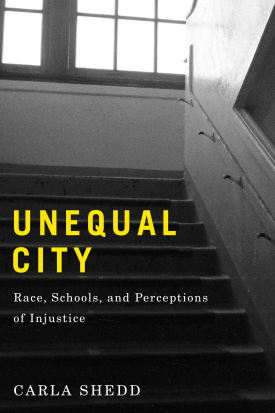
Chicago has long struggled with racial residential segregation, high rates of poverty, and deepening class stratification, and it can be a challenging place for adolescents to grow up. Unequal City examines the ways in which Chicago’s most vulnerable residents navigate their neighborhoods, life opportunities, and encounters with the law. In this pioneering analysis of the intersection of race, place, and opportunity, sociologist and criminal justice expert Carla Shedd illuminates how schools either reinforce or ameliorate the social inequalities that shape the worlds of these adolescents.

Shedd draws from an array of data and in-depth interviews with Chicago youth to offer new insight into this understudied group. Focusing on four public high schools with differing student bodies, Shedd reveals how the predominantly low-income African American students at one school encounter obstacles their more affluent, white counterparts on the other side of the city do not face. Teens often travel long distances to attend school which, due to Chicago’s segregated and highly unequal neighborhoods, can involve crossing class, race, and gang lines. As Shedd explains, the disadvantaged teens who traverse these boundaries daily develop a keen “perception of injustice,” or the recognition that their economic and educational opportunities are restricted by their place in the social hierarchy.

Adolescents’ worldviews are also influenced by encounters with law enforcement while traveling to school and during school hours. Shedd tracks the rise of metal detectors, surveillance cameras, and pat-downs at certain Chicago schools. Along with police procedures like stop-and-frisk, these prison-like practices lead to distrust of authority and feelings of powerlessness among the adolescents who experience mistreatment either firsthand or vicariously. Shedd finds that the racial composition of the student body profoundly shapes students’ perceptions of injustice. The more diverse a school is, the more likely its students of color will recognize whether they are subject to discriminatory treatment. By contrast, African American and Hispanic youth whose schools and neighborhoods are both highly segregated and highly policed are less likely to understand their individual and group disadvantage due to their lack of exposure to youth of differing backgrounds.

CARLA SHEDD is assistant professor of sociology and African American studies at Columbia University.

RSF Journal
View Book Series
Sign Up For Our Mailing List
Apply For Funding
Cover image of the book Women in the Bookbinding Trade
Books

Women in the Bookbinding Trade

Author
Mary Van Kleeck
Ebook
Publication Date
326 pages

About This Book

This book, published in 1913, describes the results of the first investigation made by the Committee on Women's Work of the Russell Sage Foundation, part of a series of studies of the condition of women's work in important trades in New York City that demonstrate similar conditions throughout the United States. The bookbinding trade, one of the most important trades for women in the city at the time, is examined in detail. These findings were relevant to many other industries because it presented most of the important problems which confronted women wage-earners at the time.

MARY VAN KLEECK was secretary of the Committee on Women's Work at the Russell Sage Foundation.

RSF Journal
View Book Series
Sign Up For Our Mailing List
Apply For Funding
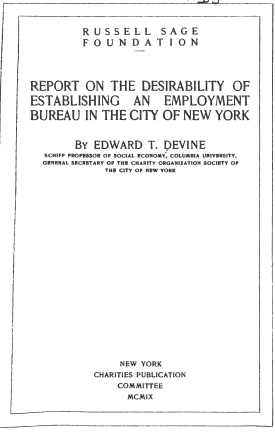
Cover image of the book Report on the Desirability of Establishing an Employment Bureau in the City of New York
Books

Report on the Desirability of Establishing an Employment Bureau in the City of New York

Author
Edward T. Devine
Ebook
Publication Date
254 pages

About This Book

Based on Jacob H. Schiff's 1908 argument for the establishment of an unofficial employment bureau for the City of New York for the benefit of the unemployed, this 1909 report, funded by the Russell Sage Foundation, is an examination of the need for such a bureau and an inquiry into the reasons for the discontinuance of other similar labor bureaus that attempted to deal with the same problem.

EDWARD T. DEVINE was Schiff Professor of Social Economy at Columbia University and general secretary of the Charity Organization Society of the City of New York.

RSF Journal
View Book Series
Sign Up For Our Mailing List
Apply For Funding
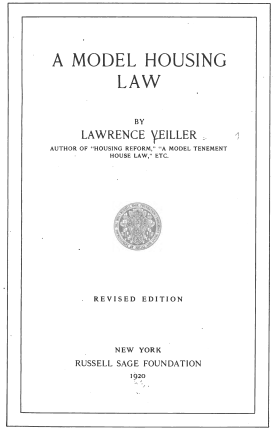
Cover image of the book A Model Housing Law
Books

A Model Housing Law

Author
Lawrence Veiller
Ebook
Publication Date
456 pages

About This Book

A pioneering exploration of housing legislation published in 1914, this book examined the little housing laws in the country at the time, tenement house laws in New York City. It proposed a model housing law which later influenced a number of state and city legislators throughout the country to adapt the proposal into their own laws. An updated and expanded edition was published in 1920.

LAWRENCE VEILLER was secretary of the New York State Tenement House Commission, and First Deputy Tenement Commissioner of the Tenement Department of New York City.

RSF Journal
View Book Series
Sign Up For Our Mailing List
Apply For Funding
Cover image of the book Studying Your Community
Books

Studying Your Community

Author
Roland L. Warren
Ebook
Publication Date
385 pages

About This Book

This book, published in 1955, is a successor to Joanna C. Colcord's Your Community: Its Provision for Health, Education, Safety, and Welfare, published by the Russell Sage Foundation in 1939. It is designed as a broadly conceived working manual of community study aimed at not just social workers, like its predecessor, but a more varied group of citizens. It details procedures for conducting the survey, both in its organizational and methodological aspects.

ROLAND L. WARREN was professor of sociology at Alfred University.

RSF Journal
View Book Series
Sign Up For Our Mailing List
Apply For Funding
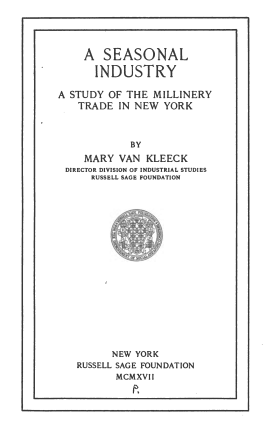
Cover image of the book A Seasonal Industry
Books

A Seasonal Industry

A Study of the Millinery Trade in New York
Author
Mary Van Kleeck
Ebook
Publication Date
320 pages

About This Book

This 1917 report on the conditions of the millinery industry, or the trade of making women's hats, functions as a general study of problems more or less common to all industries characterized by seasonal fluctuations in employment. Two separate but often overlapping inquiries were conducted to secure the data presented in this book, involving the study of wages, education, and the particular conditions surrounding a seasonal occupation.

MARY VAN KLEECK was director of the Division of Industrial Studies of the Russell Sage Foundation.

RSF Journal
View Book Series
Sign Up For Our Mailing List
Apply For Funding
Cover image of the book Wider Use of the School Plant
Books

Wider Use of the School Plant

Author
Clarence Arthur Perry
Ebook
Publication Date
423 pages

About This Book

A report of the findings of a study into the utilization of school property after day-class hours, carried out by the Department of Child Hygiene of the Russell Sage Foundation in 1910.

CLARENCE ARTHUR PERRY, Department of Child Hygiene, Russell Sage Foundation

RSF Journal
View Book Series
Sign Up For Our Mailing List
Apply For Funding
Cover image of the book The Real Snag in Social Center Extension
Books

The Real Snag in Social Center Extension

Author
Clarence Arthur Perry
Ebook
Publication Date
8 pages

About This Book

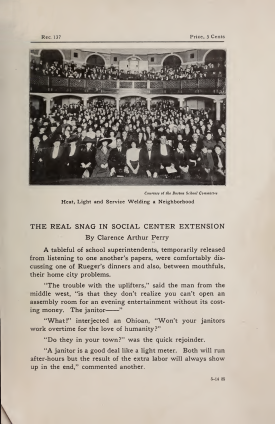
Published in 1920, this paper attempts to explain why school officials and voluntary organizations were not pulling together to expand the school's use as a social center—uncertainty as to the people's will. It proposes that asking the community to decide what uses a social center should have will help in the creating of such an agency.

CLARENCE ARTHUR PERRY, Department of Child Hygiene, Russell Sage Foundation

RSF Journal
View Book Series
Sign Up For Our Mailing List
Apply For Funding
Cover image of the book The School as a Factor in Neighborhood Development
Books

The School as a Factor in Neighborhood Development

Author
Clarence Arthur Perry
Ebook
Publication Date
14 pages

About This Book

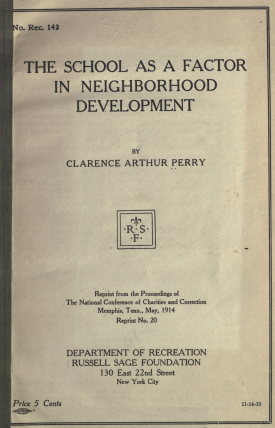
A paper delivered at the National Conference of Charities and Correction, in 1914.

CLARENCE ARTHUR PERRY, Department of Child Hygiene, Russell Sage Foundation

RSF Journal
View Book Series
Sign Up For Our Mailing List
Apply For Funding