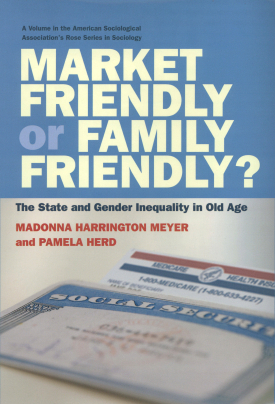
Market Friendly or Family Friendly?
About This Book
A Volume in the American Sociological Association’s Rose Series in Sociology
Winner of the 2008 Richard Kalish Publication Award from the Genontological Society of America
"Market Friendly or Family Friendly? is a welcome addition to the burgeon ing debate over America's fraying social contract. With the knowledge and care of social scientists and the passion and vision of public intellectuals, Harrington Meyer and Herd show that older women continue to be gravely disadvantaged by a framework of old-age security that has been under assault for more than two decades. To their great credit, they also lay out a set of reasonable reforms that would go a long way toward making American social policy more 'family friendly.'"
-JACOB S. HACKER, professor of political science, Yale University
"In this beautifully written and carefully argued book, Madonna Harrington Meyer and Pamela Herd challenge advocates of pro-market policies who seek to privatize Social Security and Medicare and force families to pay more out-of-pocket for health care. Using a rich array of evidence, they convincingly demonstrate that the protection afforded by the welfare state is needed even more now than in the past, especially for women and minori ties. This should be required for anyone seeking to understand the distribu tional effects of social programs and for members of Congress."
-JILL QUADAGNO, Mildred and Claude Pepper Eminent Scholar in Social Gerontology, Florida State University
Poverty among the elderly is sharply gendered—women over sixty-five are twice as likely as men to live below the poverty line. Older women receive smaller Social Security payments and are less likely to have private pensions. They are twice as likely as men to need a caregiver and twice as likely as men to be a caregiver. Recent efforts of some in Washington to reduce and privatize social welfare programs threaten to exacerbate existing gender disparities among older Americans. They also threaten to exacerbate inequality among women by race, class, and marital status. Madonna Harrington Meyer and Pamela Herd explain these disparities and assess how proposed policy reforms would affect inequality among the aged.
Market Friendly or Family Friendly? documents the cumulative disadvantages that make it so difficult for women to achieve economic and health security when they retire. Wage discrimination and occupational segregation reduce women’s lifetime earnings, depressing their savings and Social Security benefits. While more women are employed today than a generation ago, they continue to shoulder a greater share of the care burden for children, the disabled, and the elderly. Moreover, as marriage rates have declined, more working mothers are raising children single-handedly. Women face higher rates of health problems due to their lower earnings and the high demands associated with unpaid care work. There are also financial consequences to these family and work patterns.
Harrington Meyer and Herd contrast the impact of market friendly programs that maximize individual choice, risk, and responsibility with family friendly programs aimed at redistributing risks and resources. They evaluate popular policies on the current agenda, considering the implications for inequality. But they also evaluate less discussed policy proposals. In particular, minimum benefits for Social Security, as well as credits for raising children, would improve economic security for all, regardless of marital status. National health insurance would also reduce inequality, as would reforms to Medicare, particularly increased coverage of long term care. Just as important are policies such as universal preschool and paid family leave aimed at reducing the disadvantages women face during their working years.
The gender gaps that women experience during their work and family lives culminate in income and health disparities between men and women during retirement, but the problem has received scant attention. Market Friendly or Family Friendly? is a comprehensive introduction to this issue, and a significant contribution to the debate over the future of America’s entitlement programs.
MADONNA HARRINGTON MEYER is professor of sociology, director of the Gerontology Center, and senior research associate at the Center for Policy Research at Syracuse University.
PAMELA HERD is assistant professor of public affairs and sociology and a research associate at the Institute for Research on Poverty at the University of Wisconsin, Madison.
An Institute for Research on Poverty Affiliated Book on Poverty and Public Policy