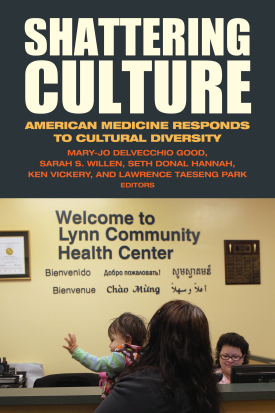
Cover image of the book Shattering Culture
Books

Shattering Culture

American Medicine Responds to Cultural Diversity
Editors
Mary-Jo Delvecchio Good
Sarah S. Willen
Seth Donal Hannah
Ken Vickery
Lawrence Taeseng Park
Paperback
$47.50
Add to Cart
Publication Date
260 pages
ISBN
978-0-87154-060-7
Also Available From

About This Book

“Shattering Culture is a fine book, organized around a tightly constructed theme but taking advantage of the authors’ widely varying perspectives and professions. It carefully examines the mantra of ‘cultural competence.’ While valuing different cultural frameworks and emphasizing the need to understand patients from their own perspective, the authors show how some elements of respect for diversity must be rethought in the face of hard realities of running a health care system. The message is sensitive, sensible, and energizingly bold.”
—JENNIFER L. HOCHSCHILD, Harvard University

“Shattering Culture humanizes the struggle to provide culturally-grounded health care to a patient population that refuses to fit neatly into our tidy conceptual boxes. Drawing from their own insider and outsider perspectives, the editors and authors deliver an unusually empathic yet critical analysis of the various players and practices that interact to shape patient care—for better and for worse. Beautifully written, and brimming with rich, ethnographic details, this volume explodes static formulations of cultural competence, and shows us just how much more work we have to do. A remarkable achievement.”
—DORIS F. CHANG, New School for Social Research

“This volume shines a fresh and brilliant light on contemporary culture and American healthcare. Shattering Culture is essential reading for the social and medical sciences and particularly for the fields of global health, medical anthropology/sociology, internal medicine, psychiatry, psychology, and public health. The immediacy of the problems tackled here (precisely how does culture ‘count’?) is demonstrated with compelling qualitative materials that empirically display intimate clinician-patient encounters under the press of ‘checkbox medicine/psychiatry.’ This book takes an utterly fearless look into the chasm of cultural complexity and provides the foundation for innovation in the provision of healthcare.”
—JANIS H. JENKINS, University of California, San Diego

"Culture counts" has long been a rallying cry among health advocates and policymakers concerned with racial disparities in health care. A generation ago, the women’s health movement led to a host of changes that also benefited racial minorities, including more culturally aware medical staff, enhanced health education, and the mandated inclusion of women and minorities in federally funded research. Many health professionals would now agree that cultural competence is important in clinical settings, but in what ways? Shattering Culture provides an insightful view of medicine and psychiatry as they are practiced in today’s culturally diverse clinical settings. The book offers a compelling account of the many ways culture shapes how doctors conduct their practices and how patients feel about the care they receive.

Based on interviews with clinicians, health care staff, and patients, Shattering Culture shows the human face of health care in America. Building on over a decade of research led by Mary-Jo Good, the book delves into the cultural backgrounds of patients and their health care providers, as well as the institutional cultures of clinical settings, to illuminate how these many cultures interact and shape the quality of patient care. Sarah Willen explores the controversial practice of matching doctors and patients based on a shared race, ethnicity, or language and finds a spectrum of arguments challenging its usefulness, including patients who may fear being judged negatively by providers from the same culture. Seth Hannah introduces the concept of cultural environments of hyperdiversity describing complex cultural identities. Antonio Bullon and Mary-Jo Good demonstrate how regulations meant to standardize the caregiving process—such as the use of templates and check boxes instead of narrative notes—have steadily limited clinician flexibility, autonomy, and the time they can dedicate to caring for patients. Elizabeth Carpenter-Song looks at positive doctor-patient relationships in mental health care settings and finds that the most successful of these are based on mutual “recognition”—patients who can express their concerns and clinicians who validate them. In the book’s final essay, Hannah, Good, and Park show how navigating the maze of insurance regulations, financial arrangements, and paperwork compromises the effectiveness of mental health professionals seeking to provide quality care to minority and poor patients.

Rapidly increasing diversity on one hand and bureaucratic regulations on the other are two realities that have made providing culturally sensitive care even more challenging for doctors. Few opportunities exist to go inside the world of medical and mental health clinics and see how these realities are influencing patient care. Shattering Culture provides a rare look at the day-to-day experiences of psychiatrists and other clinicians and offers multiple perspectives on what culture means to doctors, staff, and patients and how it shapes the practice of medicine and psychiatry.

MARY-JO DELVECCHIO GOODis professor of social medicine at Harvard Medical School and teaches in the Department of Sociology at Harvard University, in addition to being a faculty affiliate of the Asia Center, the Center for Middle Eastern Studies, and the Weatherhead Center for International Affairs.

SARAH S. WILLEN is assistant professor of anthropology at the University of Connecticut.

SETH DONAL HANNAH is lecturer on sociology at Harvard University.

KEN VICKERY is director of external fellowships at the University of Illinois, Urbana-Champaign.

LAWRENCE TAESENG PARK assistant professor of psychiatry at Massachusetts General Hospital.

CONTRIBUTORS: Antonio Bullon, Joseph D. Calabrese,  Elizabeth Carpenter-Song,  Sadeq Rahimi, Lisa Stevenson, Marina Yaroshenko.  
RSF Journal
View Book Series
Sign Up For Our Mailing List
Apply For Funding
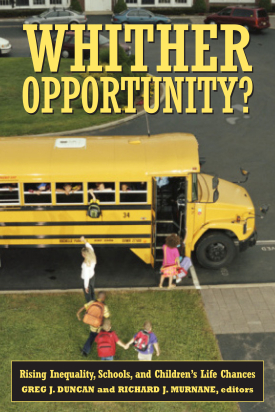
Cover image of the book Whither Opportunity?
Books

Whither Opportunity?

Rising Inequality, Schools, and Children's Life Chances
Editors
Greg J. Duncan
Richard J. Murnane
Paperback
$59.95
Add to Cart
Publication Date
6.63 in. × 9.25 in. 572 pages
ISBN
978-0-87154-372-1
Also Available From

About This Book

"One does not often apply the term 'landmark' to an edited volume, but this volume is a major exception to the rule. Whither Opportunity? is one of the most important compendia we have, for it examines in detail and from all conceivable angles the power of class to determine the developmental fate of America's children. From this volume, we learn that children in communities experiencing unemployment do worse in school even if their own families are safe from its reach; that test score gaps by income are larger and growing faster than the gaps between black and white; that expenditures by high-income families on enrichment of all kinds are vastly larger than what low-income families can afford. All of this adds up to a new and troubling examination of the ways in which income inequality is pressing the nation's children, youth, neighborhoods, schools, and families. I don't often use the overworked phrase, 'must read,' but it most definitely applies to this book."
-KATHERINE S. NEWMAN, James B. Knapp Dean of Arts and Sciences and professor of sociology, Johns Hopkins University

"Almost all Americans state that they are in favor of equal opportunity for the next generation. But the lip service stops there. Whither Opportunity? systematically and forcefully follows low- and high-income children through the life course from birth through their labor-market outcomes. The authors suggest that at every stage in the life course low-income children have worse outcomes than do higher-income children, leading to a highly polarized future society. The myriad of studies summarized here offer compelling evidence that if we as a nation really believe in equality of opportunity, we must intervene early and often in low- income children's lives and in the schools they attend, while also addressing the rising inequality that is ultimately giving well-to-do children every advantage possible and harming low-income children. This book will be a reference source on child development, inequality, and schools for years to come. I urge you to read it and then become active in social change to better the situation of low-income children in America."
-TIMOTHY M. SMEEDING, director, Institute for Research on Poverty, and Distinguished Professor of Public Affairs and Economics, University of Wisconsin, Madison

As the incomes of affluent and poor families have diverged over the past three decades, so too has the educational performance of their children. But how exactly do the forces of rising inequality affect the educational attainment and life chances of low-income children? In Whither Opportunity? a distinguished team of economists, sociologists, and experts in social and education policy examines the corrosive effects of unequal family resources, disadvantaged neighborhoods, insecure labor markets, and worsening school conditions on K-12 education. This groundbreaking book illuminates the ways rising inequality is undermining one of the most important goals of public education—the ability of schools to provide children with an equal chance at academic and economic success.

The most ambitious study of educational inequality to date, Whither Opportunity? analyzes how social and economic conditions surrounding schools affect school performance and children’s educational achievement. The book shows that from earliest childhood, parental investments in children’s learning affect reading, math, and other attainments later in life. Contributor Meredith Phillip finds that between birth and age six, wealthier children will have spent as many as 1,300 more hours than poor children on child enrichment activities such as music lessons, travel, and summer camp. Greg Duncan, George Farkas, and Katherine Magnuson demonstrate that a child from a poor family is two to four times as likely as a child from an affluent family to have classmates with low skills and behavior problems – attributes which have a negative effect on the learning of their fellow students. As a result of such disparities, contributor Sean Reardon finds that the gap between rich and poor children’s math and reading achievement scores is now much larger than it was fifty years ago. And such income-based gaps persist across the school years, as Martha Bailey and Sue Dynarski document in their chapter on the growing income-based gap in college completion.

Whither Opportunity? also reveals the profound impact of environmental factors on children’s educational progress and schools’ functioning. Elizabeth Ananat, Anna Gassman-Pines, and Christina Gibson-Davis show that local job losses such as those caused by plant closings can lower the test scores of students with low socioeconomic status, even students whose parents have not lost their jobs. They find that community-wide stress is most likely the culprit. Analyzing the math achievement of elementary school children, Stephen Raudenbush, Marshall Jean, and Emily Art find that students learn less if they attend schools with high student turnover during the school year – a common occurrence in poor schools. And David Kirk and Robert Sampson show that teacher commitment, parental involvement, and student achievement in schools in high-crime neighborhoods all tend to be low.

For generations of Americans, public education provided the springboard to upward mobility. This pioneering volume casts a stark light on the ways rising inequality may now be compromising schools’ functioning, and with it the promise of equal opportunity in America.

GREG J. DUNCAN is distinguished professor in the Department of Education at the University of California, Irvine.

RICHARD J. MURNANE is Thompson Professor of Education and Society at the Harvard Graduate School of Education.

CONTRIBUTORS:  Joseph G. Altonji, Elizabeth O. Ananat,  Emily Art,  Martha J. Bailey,  Don Boyd,  Harry Brighouse,  Julia Burdick-Will,  Vilsa E. Curto,  Susan M. Dynarski,  George Farkas,  Roland G. Fryer Jr.,  Frank F. Furstenberg,  Anna Gassman-Pines,  Lisa Gannetian,  Christina M. Gibson-Davis,  David Harding, Michael Hout,  Meghan L. Howerd,  Brian A. Jacob,  Alexander Janus,  Marshall Jean,  Neeraj Kaushal,  David S. Kirk, Jeffrey Kling,  Hamp Lankford,  Phillip B. Levine, Tamara Wilder Linkow,  Susanna Loeb,  Jens Ludwig,  Katherine Magnuson,  Richard K. Mansfield,  Charles A. Nelson III, Meredith Phillips, Stephen W. Raudenbush,  Sean F. Reardon,  Matthew Ronfeldt,  Brian Rowan,  Robert J. Sampson, Amy Ellen Schwartz,  Patrick Sharkey,  Margaret A. Sheridan,  Leanna Stiefel,  Megan M. Sweeney,  Jacob L. Vigdor,  Jane Waldfogel,  Christopher Winship,  Jim Wyckoff. 

RSF Journal
View Book Series
Sign Up For Our Mailing List
Apply For Funding
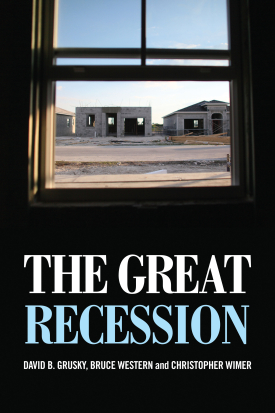
Cover image of the book The Great Recession
Books

The Great Recession

Editors
David B. Grusky
Bruce Western
Christopher Wimer
Paperback
$47.50
Add to Cart
Publication Date
6 in. × 9 in. 344 pages
ISBN
978-0-87154-421-6
Also Available From

About This Book

"This is the first systematic, scholarly analysis of the initial effects of the Great Recession on the well-being of American workers and families. The authors analyze historical and recent data and document who lost their jobs, their homes, their financial assets; how the Federal stimulus bill enhanced the safety net for the poor and unemployed; and how individuals, families, and institutions responded to the economic shocks. Taken together, the chapters present a gloomy forecast. Job losses have been greater and the recovery slower than in other recessions and the 'deficit mania' that prevents new Federal stimulus and encourages state and local government layoffs means that unemployment and poverty will remain high for at least the next five years."
—Sheldon H. Danziger, H. J. Meyer Distinguished University Professor of Public Policy, University of Michigan

"This is a collection of basic studies of the economic, social, cultural, and political consequences of the economic downturn of 2008-2009. A first-rate team of social scientists contributes an impressively thorough set of analyses that go well beyond journalistic accounts, which tend to overemphasize the dramatic, the short-term, and the anecdotal. Yet The Great Recession is timely, important, and novel-essential reading about the broad implications of the great economic crisis of our time."
—Robert D. Mare, Distinguished Professor of Sociology and Statistics, UCLA

Officially over in 2009, the Great Recession is now generally acknowledged to be the most devastating global economic crisis since the Great Depression. As a result of the crisis, the United States lost more than 7.5 million jobs, and the unemployment rate doubled—peaking at more than 10 percent. The collapse of the housing market and subsequent equity market fluctuations delivered a one-two punch that destroyed trillions of dollars in personal wealth and made many Americans far less financially secure. Still reeling from these early shocks, the U.S. economy will undoubtedly take years to recover. Less clear, however, are the social effects of such economic hardship on a U.S. population accustomed to long periods of prosperity. How are Americans responding to these hard times? The Great Recession is the first authoritative assessment of how the aftershocks of the recession are affecting individuals and families, jobs, earnings and poverty, political and social attitudes, lifestyle and consumption practices, and charitable giving.

Focused on individual-level effects rather than institutional causes, The Great Recession turns to leading experts to examine whether the economic aftermath caused by the recession is transforming how Americans live their lives, what they believe in, and the institutions they rely on. Contributors Michael Hout, Asaf Levanon, and Erin Cumberworth show how job loss during the recession—the worst since the 1980s—hit less-educated workers, men, immigrants, and factory and construction workers the hardest. Millions of lost industrial jobs are likely never to be recovered and where new jobs are appearing, they tend to be either high-skill positions or low-wage employment—offering few opportunities for the middle-class. Edward Wolff, Lindsay Owens, and Esra Burak examine the effects of the recession on housing and wealth for the very poor and the very rich. They find that while the richest Americans experienced the greatest absolute wealth loss, their resources enabled them to weather the crisis better than the young families, African Americans, and the middle class, who experienced the most disproportionate loss—including mortgage delinquencies, home foreclosures, and personal bankruptcies. Lane Kenworthy and Lindsay Owens ask whether this recession is producing enduring shifts in public opinion akin to those that followed the Great Depression. Surprisingly, they find no evidence of recession-induced attitude changes toward corporations, the government, perceptions of social justice, or policies aimed at aiding the poor. Similarly, Philip Morgan, Erin Cumberworth, and Christopher Wimer find no major recession effects on marriage, divorce, or cohabitation rates. They do find a decline in fertility rates, as well as increasing numbers of adult children returning home to the family nest—evidence that suggests deep pessimism about recovery.

This protracted slump—marked by steep unemployment, profound destruction of wealth, and sluggish consumer activity—will likely continue for years to come, and more pronounced effects may surface down the road. The contributors note that, to date, this crisis has not yet generated broad shifts in lifestyle and attitudes. But by clarifying how the recession’s early impacts have—and have not—influenced our current economic and social landscape, The Great Recession establishes an important benchmark against which to measure future change.

DAVID B. GRUSKY is professor of sociology at Stanford University.

BRUCE WESTERN is professor of sociology at Harvard University.

CHRISTOPHER WIMER is associate director of the Collaboration for Poverty Research and senior editor of Pathways at the Stanford Center for the Study of Poverty and Inequality.

RSF Journal
View Book Series
Sign Up For Our Mailing List
Apply For Funding
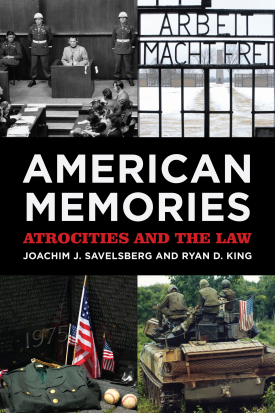
Cover image of the book American Memories
Books

American Memories

Atrocities and the Law
Authors
Joachim J. Savelsberg
Ryan D. King
Paperback
$39.95
Add to Cart
Publication Date
6 in. × 9 in. 264 pages
ISBN
978-0-87154-737-8
Also Available From

About This Book

A Volume in the American Sociological Association’s Rose Series in Sociology

Winner of the 2012 Outstanding Book Award of the Theory Section of the Society for the Study of Social Problems (SSSP)

In the long history of warfare and cultural and ethnic violence, the twentieth century was exceptional for producing institutions charged with seeking accountability or redress for violent offenses and human rights abuses across the globe, often forcing nations to confront the consequences of past atrocities. The Holocaust ended with trials at Nuremberg, apartheid in South Africa concluded with the Truth and Reconciliation Commission, and the Gacaca courts continue to strive for closure in the wake of the Rwandan genocide. Despite this global trend toward accountability, American collective memory appears distinct in that it tends to glorify the nation’s past, celebrating triumphs while eliding darker episodes in its history. In American Memories, sociologists Joachim Savelsberg and Ryan King rigorously examine how the United States remembers its own and others’ atrocities and how institutional responses to such crimes, including trials and tribunals, may help shape memories and perhaps impede future violence.

American Memories uses historical and media accounts, court records, and survey research to examine a number of atrocities from the nation’s past, including the massacres of civilians by U.S. military in My Lai, Vietnam, and Haditha, Iraq. The book shows that when states initiate responses to such violence—via criminal trials, tribunals, or reconciliation hearings—they lay important groundwork for how such atrocities are viewed in the future. Trials can serve to delegitimize violence—even by a nation’s military— by creating a public record of grave offenses. But the law is filtered by and must also compete with other institutions, such as the media and historical texts, in shaping American memory. Savelsberg and King show, for example, how the My Lai slayings of women, children, and elderly men by U.S. soldiers have been largely eliminated from or misrepresented in American textbooks, and the army’s reputation survived the episode untarnished. The American media nevertheless evoked the killings at My Lai in response to the murder of twenty-four civilian Iraqis in Haditha, during the war in Iraq. Since only one conviction was obtained for the My Lai massacre, and convictions for the killings in Haditha seem increasingly unlikely, Savelsberg and King argue that Haditha in the near past is now bound inextricably to My Lai in the distant past. With virtually no criminal convictions, and none of higher ranks for either massacre, both events will continue to be misrepresented in American memory. In contrast, the book examines American representations of atrocities committed by foreign powers during the Balkan wars, which entailed the prosecution of ranking military and political leaders. The authors analyze news accounts of the war’s events and show how articles based on diplomatic sources initially cast Serbian President Slobodan Milosevic in a less negative light, but court-based accounts increasingly portrayed Milosevic as a criminal, solidifying his image for the public record.

American Memories provocatively suggests that a nation’s memories don’t just develop as a rejoinder to events—they are largely shaped by institutions. In the wake of atrocities, how a state responds has an enduring effect and provides a moral framework for whether and how we remember violent transgressions. Savelsberg and King deftly show that such responses can be instructive for how to deal with large-scale violence in the future, and hopefully how to deter it.

JOACHIM J. SAVELSBERG is professor of sociology at the University of Minnesota.

RYAN D. KING is associate professor of sociology at the University at Albany, State University of New York.

RSF Journal
View Book Series
Sign Up For Our Mailing List
Apply For Funding
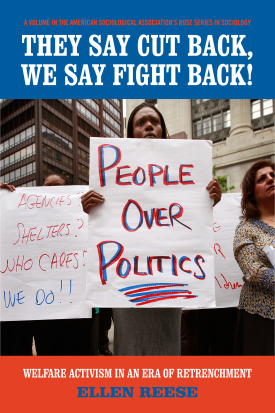
Cover image of the book They Say Cut Back, We Say Fight Back!
Books

They Say Cut Back, We Say Fight Back!

Welfare Activism in an Era of Retrenchment
Author
Ellen Reese
Paperback
$39.95
Add to Cart
Publication Date
6 in. × 9 in. 312 pages
ISBN
978-0-87154-715-6
Also Available From

About This Book

To purchase this title on Amazon, please click here.

A Volume in the American Sociological Association’s Rose Series in Sociology

In 1996, President Bill Clinton hailed the “end of welfare as we know it” when he signed the Personal Responsibility and Work Opportunity Act. The law effectively transformed the nation’s welfare system from an entitlement to a work-based one, instituting new time limits on welfare payments and restrictions on public assistance for legal immigrants. In They Say Cutback, We Say Fight Back, Ellen Reese offers a timely review of welfare reform and its controversial design, now sorely tested in the aftermath of the Great Recession. The book also chronicles the largely untold story of a new grassroots coalition that opposed the law and continues to challenge and reshape its legacy.

While most accounts of welfare policy highlight themes of race, class and gender, They Say Cutback examines how welfare recipients and their allies contested welfare reform from the bottom-up. Using in-depth case studies of campaigns in Wisconsin and California, Reese argues that a crucial phase in policymaking unfolded after the bill’s passage. As counties and states set out to redesign their welfare programs, activists scored significant victories by lobbying officials at different levels of American government through media outreach, protests and organizing. Such efforts tended to enjoy more success when based on broad coalitions that cut across race and class, drawing together a shifting alliance of immigrants, public sector unions, feminists, and the poor. The book tracks the tensions and strategies of this unwieldy group brought together inadvertently by their opposition to four major aspects of welfare reform: immigrants’ benefits, welfare-to-work policies, privatization of welfare agencies, and child care services. Success in scoring reversals was uneven and subject to local demographic, political and institutional factors. In California, for example, workfare policies created a large and concentrated pool of new workers that public sector unions could organize in campaigns to change policies. In Wisconsin, by contrast, such workers were scattered and largely placed in private sector jobs, leaving unions at a disadvantage. Large Latino and Asian immigrant populations in California successfully lobbied to restore access to public assistance programs, while mobilization in Wisconsin remained more limited. On the other hand, the unionization of child care providers succeeded in Wisconsin – but failed in California – because of contrasting gubernatorial politics. With vivid descriptions of the new players and alliances in each of these campaigns, Reese paints a nuanced and complex portrait of the modern American welfare state.

At a time when more than 40 million Americans live in poverty, They Say Cutback offers a sobering assessment of the nation’s safety net. As policymakers confront budget deficits and a new era of austerity, this book provides an authoritative guide for both scholars and activists looking for lessons to direct future efforts to change welfare policy.

ELLEN REESE is associate professor of sociology at the University of California, Riverside.

RSF Journal
View Book Series
Sign Up For Our Mailing List
Apply For Funding
Thomas Kochan
Massachusetts Institute of Technology
Alicia Munnell
Boston College
Wendy Rahn
University of Minnesota
Nancy Bermeo
University of Oxford
Larry M. Bartels
Princeton University