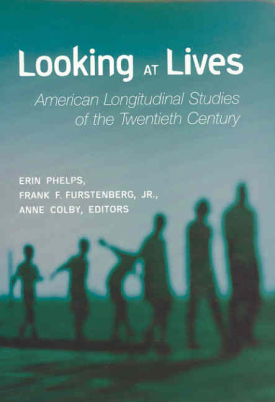
Looking at Lives
About This Book
"To study the life course is a life-long commitment. Where do the ideas that motivate longitudinal research come from? How do indefatigable investigators find the energy and resources to sustain longitudinal studies? The chapters in Looking at Lives reveal the genius, passion, and dedication that lie behind some of the most important longitudinal studies of human development ever conducted."
-Avshalom Caspi, Institute of Psychiatry, London, and University of Wisconsin, Madison
"This book is a watershed event in the scientific study of human development. It demonstrates in singularly compelling ways the precise methodological details that are required to conduct exemplary longitudinal research and that are involved in exploiting for new purposes existing longitudinal data archives."
-Richard M. Lerner, Tufts University
"Looking at Lives is a must-read for all of us involved in landmark longitudinal studies of the twentieth century. Some of the real pioneers in the long-term developmental study of humans are here as authors, describing the important details of their personal involvement in their work as well as the substance of their studies. Among other things, this volume could easily provide core reading for courses in research methods for longitudinal studies."
-Lewis Lipsitt, Brown University
The impact of long-term longitudinal studies on the landscape of 20th century social and behavioral science cannot be overstated. The field of life course studies has grown exponentially since its inception in the 1950s, and now influences methodologies as well as expectations for all academic research. Looking at Lives offers an unprecedented "insider's view" into the intentions, methods, and findings of researchers engaged in some of the twentieth century's landmark studies. In this volume, eminent American scholars—many of them pioneers in longitudinal studies—provide frank and illuminating insights into the difficulties and the unique scientific benefits of mounting studies that track people's lives over a long period of time.
Looking at Lives includes studies from a range of disciplines, including psychology, sociology, and education, which together cover a span of more than fifty years. The contributors pay particular attention to the changing historical, cultural, and scientific context of their work, as well as the theoretical and methodological changes that have occurred in their fields over decades. What emerges is a clear indication of the often unexpected effects these studies have had on public policies and public opinion—especially as they relate to such issues as the connection between poverty and criminal behavior, or the consequences of teen-age pregnancy and drug use for inner-city youth. For example, David Weikart reveals how his long-term research on preschool intervention projects, begun in 1959, permitted him to show how surprisingly effective preschool education can be in improving the lives of disadvantaged children. In another study, John Laub and Robert Sampson build on findings from a groundbreaking study begun by Sheldon and Eleanor Glueck in the 1950s to reveal the myriad ways in which juvenile delinquency can predict criminal behavior in adults. And Arland Thornton, Ronald Freedman, and William Axinn employ an intergenerational study of women and their children begun in 1962 to examine the substantial relaxation of social mores for family and individual behavior in the latter decades of the 20th century.
Looking at Lives is full of striking testimony to the importance of long-term, longitudinal studies. As a unique chronicle of the origins and development of longitudinal studies in America, this collection will be an invaluable aid to 21st century investigators who seek to build on the successes and the experiences of the pioneers in life-course studies.
ERIN PHELPS is associate director, Murray Research Center, Radcliffe Institute for Advanced Study, Harvard University.
FRANK F. FURSTENBERG, JR. is the Zellerbach Family Professor of Sociology, University of Pennsylvania.
ANNE COLBY is senior scholar, Carnegie Foundation for the Advancement of Teaching.
CONTRIBUTORS: Karl L. Alexander, William G. Axinn, Ann F. Brunswick, Beverly D. Cairns, Robert B. Cairns, Greg J. Duncan, Glen H. Elder Jr., Doris Entwisle, Ronald Freedman, Janet Zollinger Giele, John H. Laub, John Modell, Frank L. Mott, Linda Steffel Olson, Robert J. Sampson, Arland Thornton, George E. Vaillant, David P. Weikart, Emmy E. Werner.