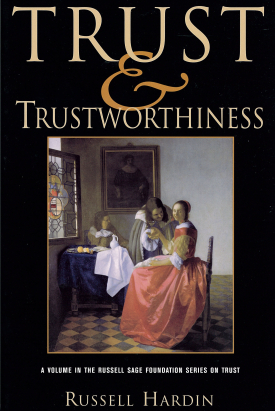
Trust and Trustworthiness
About This Book
"Of the dozens of important works on trust that have appeared in recent years, Trust and Trustworthiness is the single most valuable. Russell Hardin thinks with clarity and writes with vigor. Anyone concerned with understanding the logic of trust needs to begin here."
-ROBERT D. PUTNAM, Malkin Professor of Public Policy, Kennedy School of Government, Harvard University
"Beyond any doubt one of the most important and illuminating works ever written on this fundamental but protean and little understood form of social interaction. Russell Hardin's landmark reformulation of trust as mutually encapsulated interest grounded in ongoing relationships subsumes nearly all important previous accounts. As compelling for its theoretical elegance and power as for the broad range of ordinary trust experiences addressed, it is now the definitive text on the subject."
ORLANDO PATTERSON, John Cowles Professor of Sociology, Harvard University
"Russell Hardin's Trust and Trustworthiness is a breathtaking scholarly achievement. With compelling examples and elegant logic, Hardin advances an important and much-needed original perspective on the fundamental nature of trust and distrust in contemporary society. His provocative analysis of trust as encapsulated interest is crisp and clear-headed, and will help trust scholars move past many of the conceptual confusions and misunderstandings that have plagued the trust literature over the past decade. This book will very quickly and rightfully assume a position of intellectual leadership in this field."
-RODERICK M. KRAMER, William R. Kimball Professor of Organizational Behavior, Graduate School of Business, Stanford University
"At a time when social scientists are rediscovering the importance of trust in social life, in institutions, and in exchange relationships, and when there is a rush to measure all sorts of variables that appear to be defining characteristics of trust (and often are not), Russell Hardin offers a systematic and coherent analysis of the phenomenon. What trust is not and what it is are clearly defined and examined. The book will appeal to everyone interested in the subject not only because it is written in the felicitous prose we have come to expect from Hardin but because the role of trust in various relationships is clearly spelled out. Those who hold to the view that trust is not consistent with rational behavior will be challenged in a special way by Hardin's superb analysis."
-ALBERT BRETON, Professor Emeritus, Department of Economics, University of Toronto
What does it mean to "trust?" What makes us feel secure enough to place our confidence—even at times our welfare—in the hands of other people? Is it possible to "trust" an institution? What exactly do people mean when they claim to "distrust" their governments? As difficult as it may be to define, trust is essential to the formation and maintenance of a civil society. In Trust and Trustworthiness political scientist Russell Hardin addresses the standard theories of trust and articulates his own new and compelling idea: that much of what we call trust can be best described as "encapsulated interest."
Research into the roles of trust in our society has offered a broad range of often conflicting theories. Some theorists maintain that trust is a social virtue that cannot be reduced to strategic self-interest; others claim that trusting another person is ultimately a rational calculation based on information about that person and his or her incentives and motivations. Hardin argues that we place our trust in persons whom we believe to have strong reasons to act in our best interests. He claims that we are correct when we assume that the main incentive of those whom we trust is to maintain a relationship with us—whether it be for reasons of economic benefit or for love and friendship. Hardin articulates his theory using examples from a broad array of personal and social relationships, paying particular attention to explanations of the development of trusting relationships. He also examines trustworthiness and seeks to understand why people may behave in ways that violate their own self-interest in order to honor commitments they have made to others. The book also draws important distinctions between vernacular uses of "trust" and "trustworthiness," contrasting, for example, the type of trust (or distrust) we place in individuals with the trust we place in institutions
Trust and Trustworthiness represents the culmination of important new research into the roles of trust in our society; it offers a challenging new voice in the current discourse about the origins of cooperative behavior and its consequences for social and civic life.
RUSSELL HARDIN is professor of politics at New York University and professor of political science at Stanford University.
A Volume in the Russell Sage Foundation Series on Trust