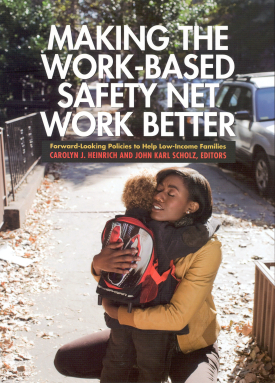
Making the Work-Based Safety Net Work Better
About This Book
"Making the Work-Based Safety Net Work Better presents a clear picture of the challenges that low- income workers and their families face after welfare reform, and of potential policy changes that could improve their economic prospects. The team of authors is terrific-all are widely known and highly respected in their fields. And the papers are all valuable, whether they simply review previous work or break new empirical ground."
-HARRY J. HOLZER,professor of public policy, Georgetown University
"Making the Work-Based Safety Net Work Better is the first book by accomplished scholars based on the controversial assumption that encouraging and rewarding work is the foundation of the nation's social policy for the poor. Given the prestige of the editors and authors, the quality of writing, and the originality of thought and proposals, anyone interested in the next generation of policies to help the poor should start with this seminal volume."
-RON HASKINS, senior fellow and codirector, Center on Children and Families, The Brookings Institution
"More than fifteen years have passed since welfare reform and the expansion of the Earned Income Tax Credit dramatically changed the safety net for low-income families with children. The United States has largely made a transition to a work-based safety net-where public assistance is targeted to working (rather than nonworking) families. In Making the Work-Based Safety Net Work Better, a highly-qualified group of authors provides wide-ranging analyses and discussion that is evidence based, forward looking, and outward looking. They explore topics such as the consequences of a work-based safety net for adults and children and the identification of groups left behind by the work-based safety net. The result is a highly readable, relevant, and exceedingly important book for anyone interested in U.S. domestic policy."
-HILARY HOYNES, professor of economics, University of California, Davis
Work first. That is the core idea behind the 1996 welfare reform legislation. It sounds appealing, but according to Making the Work-Based Safety Net Work Better, it collides with an exceptionally difficult reality. The degree to which work provides a way out of poverty depends greatly on the ability of low-skilled people to maintain stable employment and make progress toward an income that provides an adequate standard of living. This forward-looking volume examines eight areas of the safety net where families are falling through and describes how current policies and institutions could evolve to enhance the self-sufficiency of low-income families.
David Neumark analyzes a range of labor market policies and finds overwhelming evidence that the minimum wage is ineffective in promoting self-sufficiency. Neumark suggests the Earned Income Tax Credit is a much more promising policy to boost employment among single mothers and family incomes. Greg Duncan, Lisa Gennetian, and Pamela Morris find no evidence that encouraging parents to work leads to better parenting, improved psychological health, or more positive role models for children. Instead, the connection between parental work and child achievement is linked to parents’ improved access to quality child care. Rebecca Blank and Brian Kovak document an alarming increase in the number of single mothers who receive neither wages nor public assistance and who are significantly more likely to suffer from medical problems of their own or of a child. Time caps and work hour requirements embedded in benefits policies leave some mothers unable to work and ineligible for cash benefits.
Marcia Meyers and Janet Gornick identify another gap: low-income families tend to lose financial support and health coverage long before they earn enough to access employer-based benefits and tax provisions. They propose building “institutional bridges” that minimize discontinuities associated with changes in employment, earnings, or family structure. Steven Raphael addresses a particularly troubling weakness of the work-based safety net—its inadequate provision for the large number of individuals who are or were incarcerated in the United States. He offers tractable suggestions for policy changes that could ease their transition back into non-institutionalized society and the labor market.
Making the Work-Based Safety Net Work Better shows that the “work first” approach alone isn’t working and suggests specific ways the social welfare system might be modified to produce greater gains for vulnerable families.
CAROLYN J. HEINRICH is director of the La Follette School of Public Affairs, professor of public affairs and affiliated professor of economics, and associate director of research and training at the Institute for Research on Poverty at the University of Wisconsin-Madison.
JOHN KARL SCHOLZ is professor of economics at the University of Wisconsin-Madison.
CONTRIBUTORS: Jayanta Bhattacharya, Rebecca M. Blank, Greg J. Duncan, David N. Figlio, Lisa Gennetian, Janet C. Gornick, Brian K. Kovak, Marcia K. Meyers, Pamela Morris, David Neumark, Steven Raphael, Peter Richmond, R. Kent Weaver.
An Institute for Research on Poverty Affiliated Book on Poverty and Public Policy