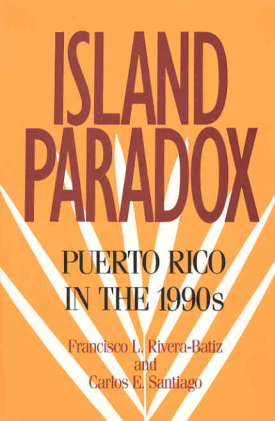
Cover image of the book Island Paradox
Books

Island Paradox

Puerto Rico in the 1990s
Authors
Carlos E. Santiago
Francisco L. Rivera-Batiz
Paperback
$26.95
Add to Cart
Publication Date
6 in. × 9 in. 212 pages
ISBN
978-0-87154-751-4
Also Available From

About This Book

"One of the year's best books on Puerto Rico." —El Nuevo Dia, San Juan

"[The authors] are highly regarded labor economists who have written extensively and intelligently in the past, and again in this volume, on Puerto Rican migration and labor markets... There isabundant statistical data and careful analysis, some of which challenges the conventional wisdom. Highly recommended." —Choice

Island Paradox is the first comprehensive, census-based portrait of social and economic life in Puerto Rico. During its nearly fiftyyears as a U.S. commonwealth, the relationship between Puerto Rico's small, developing economy and the vastly larger, more industrialized United States has triggered profound changes in the island's industry and labor force. Puerto Rico has been deeply affected by the constant flow of its people to and from the mainland, and by the influx of immigrant workers from other nations. Distinguished economists Francisco Rivera-Batiz and Carlos Santiago provide the latest data on the socioeconomic status of Puerto Rico today, and examine current conditions within the context of the major trends of the past two decades.

Island Paradox describes many improvements in Puerto Rico's standard of living, including rising per-capita income, longer life expectancies, greater educational attainment, and increased job prospects for women. But it also discusses the devastating surge in unemployment. Rapid urbanization and a vanishing agricultural sector have led to severe inequality, as family income has become increasingly dependent on education and geographic location. Although Puerto Rico's close ties to the United States were the major source of the island's economic growth prior to 1970, they have also been at the root of recent hardships. Puerto Rico's trade andbusiness transactions remain predominantly with the United States, but changes in federal tax, social, and budgetary policies, along with international agreements such as NAFTA, now threaten to alter the economic ties between the island and the mainland.

Island Paradox reveals the social and family changes that have occurred among Puerto Ricans on the island and the mainland. The significant decline in the island's population growth is traced in part to women's increased pursuit of educational and employment opportunities before marrying. More children are being raised by singleparents, but this stems from a higher divorce rate and not a rise in teenage pregnancy. The widespread circular migration to and from the United States has had strong repercussions for the island's labor markets and social balance, leading to concerns about an island brain drain. The Puerto Rican population in the United States hasbecome increasingly diverse, less regionally concentrated and not, as some have claimed, in danger of becoming an underclass.

Within a single generation Puerto Rico has experienced social and economic shifts of an unprecedented magnitude. Island Paradox charts Puerto Rico's economic fortunes, summarizes the major demographic trends, and identifies the issues that will have the strongest bearings on Puerto Rico's prospects for a successful future.

FRANCISCO L. RIVERA-BATIZ is director of the Program in Economic Policy Management and associate professor in the Economics Department and the Latino Studies Program at Columbia University. He is also associate professor of international studies at Teachers College, Columbia University.

CARLOS E. SANTIAGO is professor in the Department of Latin American and Caribbean Studies and in the Department of Economics and associate vice president for academic affairs at the State University of New York, Albany.
 

A Volume in the RSF Census Series

RSF Journal
View Book Series
Sign Up For Our Mailing List
Apply For Funding
Cover image of the book Aging and Society, Volume 3
Books

Aging and Society, Volume 3

A Sociology of Age Stratification
Editors
Matilda White Riley
Marilyn Johnson
Anne Foner
Hardcover
Add to Cart
Publication Date
6 in. × 9 in. 672 pages
ISBN
978-0-87154-720-0
Also Available From

About This Book

Represents the first integrated effort to deal with age as a crucial variable in the social system. Of special interest to sociologists for whom the sociology of age seems destined to become a special field.

MATILDA WHITE RILEY, MARILYN JOHNSON, and ANNE FONER are in the Department of Sociology at Rutgers University.

CONTRIBUTORS: John A. Clausen, Richard Cohn, Anne Foner, Beth Hess, Marilyn Johnson, Robert K. Merton, Edward E. Nelson, Talcott Parsons, Gerald Platt, Matilda White Riley, Norman B. Ryder, Harris Schrank, Bernice C. Starr, and Harriet Zuckerman
 

RSF Journal
View Book Series
Sign Up For Our Mailing List
Apply For Funding
Cover image of the book Aging and Society, Volume 2
Books

Aging and Society, Volume 2

Aging and the Professions
Editors
Matilda White Riley
John W. Riley, Jr.
Marilyn E. Johnson
Hardcover
Add to Cart
Publication Date
6 in. × 9 in. 432 pages
ISBN
978-0-87154-719-4
Also Available From

About This Book

Interprets the research findings on aging for professionals concerned with the prevention and treatment of problems associated with aging. Each chapter, written by an expert, deals with the field within the broad context of aging in contemporary society.

MATILDA WHITE RILEY and MARILYN E. JOHNSON, Department of Sociology, Rutgers University.

JOHN W. RILEY, JR. is vice president and director of Social Research for the Equitable Life Assurance Society of the United States.

CONTRIBUTORS: Faye G. Abdellah, Reubin Andres, Walter M. Beattie Jr., Merton C. Bernstein, Glenn H. Beyer, Herman B. Brotman, Esther Lucille Brown, W. Phillips Davison, Lowell Eklund, Ellen Fahy, Robert L. Geddes, Andrew M. Greeley, James M. Gustafson, Phillip E. Hammond, Huson Jackson, Marilyn E. Johnson, Juanita M. Kreps, Louis Lasaga, Frances Cook Macgregor, John Madge, Geneva Mathiasen, Ernest E. McMahon, Walter J. McNamara, Robert Morris, Charles E. Odell, Margery T. Overholser, Arthur J. Patek Jr., Ollie A. Randall, Max Rheinstein, John W. Riley Jr., Matilda White Riley, Sverre Roang, George Rosen, Doris R. Schwartz, Alvin L. Schorr, Wilbur Schramm, Harold L. Sheppard, DeWitt Stetten Jr., Mervyn Susser, Manfred H. Vogel, Thurman White, and Frederick D. Zeman
 

RSF Journal
View Book Series
Sign Up For Our Mailing List
Apply For Funding
Cover image of the book Aging and Society, Volume 1
Books

Aging and Society, Volume 1

An Inventory of Research Findings
Editors
Matilda White Riley
Anne Foner
Hardcover
Add to Cart
Publication Date
10 in. × 7.25 in. 648 pages
ISBN
978-0-87154-718-7
Also Available From

About This Book

Aging and Society summarizes the results of social science research on middle-aged and older people and interprets this knowledge in terms of sociological theory and professional practice. Its three volumes are addressed to social scientists and teachers engaged in research and education on the aging practice and to practitioners concerned with prevention and treatment of problems associated with aging. Volume one summarizes research findings on this topic. It selects, condenses, and organizes social science findings on human beings in their middle and later years. It is a reference work to be used as a tool for advancing theoretical understanding and enhancing professional practice.

MATILDA WHITE RILEY and ANNE FONER are members of the Department of Sociology at Rutgers University.

CONTRIBUTORS: Anne Foner, Beth Hess, Marilyn E. Johnson, Mary E. Moore, Matilda White Riley, Barbara K. Roth, and Virginia E. Schein
 

RSF Journal
View Book Series
Sign Up For Our Mailing List
Apply For Funding
Cover image of the book Social Diagnosis
Books

Social Diagnosis

Author
Mary E. Richmond
Hardcover
$59.95
Add to Cart
Publication Date
6 in. × 9 in. 512 pages
ISBN
978-0-87154-703-3
Also Available From

About This Book

Social Diagnosis is the classic in social work literature. In it Miss Richmond first established a technique of social casework. She discusses the nature and uses of social evidence, its tests and their practical application, and summarizes the lessons to be learned from history, science, and the law. While other aids in diagnosis have been added to the caseworker's equipment, the assembling of social evidence is still an important discipline of the profession, to which this volume continues to make a significant contribution. No revision of the book has ever been made nor does any later book take its place.

MARY RICHMOND was the director of the Charity Organization Department at the Russell Sage Foundation.

RSF Journal
View Book Series
Sign Up For Our Mailing List
Apply For Funding
Cover image of the book Networks and Markets
Books

Networks and Markets

Editors
James E. Rauch
Alessandra Casella
Hardcover
Add to Cart
Publication Date
6 in. × 9 in. 276 pages
ISBN
978-0-87154-700-2
Also Available From

About This Book

"Though economists claim that dollar bills will not be left 'lying in the street,' the profits from sharply focused exchange between sociologists and economists are rarely taken. This sparkling volume is a welcome exception. Prominent practitioners of both arts present important work on networks and markets, and critique one another in concise and fruitful ways. An invaluable resource for those who follow these exciting new developments in social theory."
- MARK GRANOVETTER, Stanford University

"A pioneering collaboration between economists and sociologists. The contributors compete and cooperate with each other, combining the best traditions of the two fields, to elucidate the organization of industrial economies in East Asia, fish markets in Marseille, banking in renaissance Florence, ethnic business networks in New York, and much else."
- DANI RODRIK, Harvard University

"After a century of separation, economics and other social sciences are reestablishing mutually beneficial links. These studies of the interaction between social networks and markets are an excellent case in point. Here, a dozen sociologists and economists bring together their skills in case studies and theoretical modeling to create a rich and fascinating collection that will inspire much further research."
-AVINASH K. DIXIT, Princeton University

Networks and Markets argues that economists' knowledge of markets and sociologists' rich understanding of networks can and should be combined. Together they can help us achieve a more coherent view of economic life, where transactions follow both the logic of economic incentives and the established channels of personal relationships.

Market exchange is impersonal, episodic, and carried out at arm's length. All that matters is how much the seller is asking, and how much the buyer is offering. An economic network, by contrast, is based upon more personalized and enduring relationships between people tied together by more than just price. Networks and Markets focuses on how the two concepts relate to each other: Are social networks an essential precondition for successful markets, or do networks arise naturally out of markets, as faceless traders build reputations and gain confidence in each other?

The book includes contributions by both sociologists and economists, applying the concepts of markets and networks to concrete empirical phenomena. Among the topics analyzed, the book explains how, in Taiwan, South Korea, and Japan, firms combine into tightly-knit business blocs, how wholesalers in a Marseille fish market earn the loyalty of customers, and how ethnic retailers in the U.S. share valuable market information with other shopkeepers from their ethnic group. A response to each chapter discusses the issue from the standpoint of the other discipline. Sociologists are challenged to go beyond small-scale economic exchange and to integrate their concept of networks into a broader understanding of the economic system as a whole, while economists are challenged to consider the economic implications of network ties, which can be strong or weak, unconditional or highly contingent.

This book proves that both economics and sociology provide stronger insights when they study markets and networks as parallel forms of exchange. But it also clarifies the healthy division of labor that remains between the two disciplines. Sociologists are adept at showing how markets are framed by social institutions; economists specialize in explaining how markets perform, taking the social context as a given. Networks and Markets showcases what each discipline does best and reveals where each discipline would do better by borrowing from the other.

JAMES E. RAUCH is professor of economics at the University of California, San Diego.

ALESSANDRA CASELLA is professor of economics at Columbia University.

CONTRIBUTORS: Ronald. S Burt, Gregory Basharov, Robert C. Feenstra, Neil Fligstein, Avner Greif, Gary C. Hamilton, Deng-Shing Huang, Alan Kirman, John F. Padgett, Rebeca Raijman, Joel Sobel, Marta Tienda.

RSF Journal
View Book Series
Sign Up For Our Mailing List
Apply For Funding
Cover image of the book The Missing Links
Books

The Missing Links

Formation and Decay of Economic Networks
Editor
James E. Rauch
Hardcover
Add to Cart
Publication Date
6 in. × 9 in. 256 pages
ISBN
978-0-87154-709-5
Also Available From

About This Book

"In an instance of supreme irony, economists and sociologists studying networks have traditionally conducted their researches in largely unconnected components, each with its own questions, methods, and citation clusters. The Missing Links indeed provides the missing links between the two literatures. In the jargon of the subject, it bridges a structural hole. Much intellectual traffic will flow across this bridge in the future."
-AVINASH DIXIT, John J. F. Sherrerd '52 University Professor of Economics, Princeton University

"The contemporary study of social networks represents one of the most exciting endeavors in social science and constitutes a remarkable integration of ideas from economics and sociology. The Missing Links brings together many of the most important thinkers on social networks to produce a valuable overview of the state of the field. This book will be of great value to students as well as researchers. Editor James Rauch, who has made a number of seminal contributions to social network research, deserves congratulations for assembling such a fine collection of essays."
-STEVEN N. DURLAUF, Kenneth J. Arrow Professor of Economics, University of Wisconsin, Madison

Half of all workers are hired through personal referrals, and networks of social connections channel the flows of capital, technology, and international trade. Sociologists and economists alike recognize that economic exchange is shaped by social networks, which propagate information and facilitate trust, but each discipline brings a distinct theoretical perspective to the study of networks. Sociologists have focused on how networks shape individual behavior, economists on how individual choices shape networks. The Missing Links is a bold effort by an interdisciplinary group of scholars to synthesize sociological and economic theories of how economic networks emerge and evolve.

Interweaving sophisticated theoretical models and concrete case studies, The Missing Links is both an introduction to the study of economic networks and a catalyst for further research. Economists Rachel Kranton and Deborah Minehart illustrate their field’s approach to modeling network formation, showing how manufacturers form networks of suppliers in ways that maximize profits. Exemplifying the sociological approach, Ronald Burt analyzes patterns of cooperation and peer evaluations among colleagues at a financial organization. He finds that dense connections of shared acquaintances lead to more stable reputations.  In the latter half of the book, contributors combine the insights of sociology and economics to explore a series of case studies. Ray Reagans, Ezra Zuckerman, and Bill McEvily investigate an R & D firm in which employees participate in overlapping collaborative teams, allowing the authors to disentangle the effects of network structure and individual human capital on team performance. Kaivan Munshi and Mark Rosenzweig examine how economic development and rising inequality in India are reshaping caste-based networks of mutual insurance and job referrals. Their study shows that people’s economic decisions today are shaped both by the legacy of the caste hierarchies and by the particular incentives and constraints that each individual faces in an evolving labor market.

Economic globalization is forging new connections between people in distant corners of the world, while unsettling long-standing social relations. Anyone interested in understanding the opportunities and challenges of this era of rapid change will find a highly informative guide in The Missing Links.

JAMES E. RAUCH is professor of economics at the University of California, San Diego, and a research associate at the National Bureau of Economic Research.

CONTRIBUTORS: Ronald S. Burt, Gregory Besharov, Robert C. Feenstra, Neil Fligstein, Avner Greif, Gary G. Hamilton, Deng-Shing Huang, Alan Kirman, John F. Padgett, Rebeca Raijman, Joel Sobel, Marta Tienda.

RSF Journal
View Book Series
Sign Up For Our Mailing List
Apply For Funding
Cover image of the book Do Prisons Make Us Safer?
Books

Do Prisons Make Us Safer?

The Benefits and Costs of the Prison Boom
Editors
Steven Raphael
Michael A. Stoll
Hardcover
$49.95
Add to Cart
Publication Date
6 in. × 9 in. 364 pages
ISBN
978-0-87154-860-3
Also Available From

About This Book

"Do Prisons Make Us Safer? is an important volume. Steven Raphael and Michael A. Stoll have brought together some of the best researchers in the country to address a crucial question: Does the marginal crime reduction benefit of increased incarceration outweigh its social and economic costs to society? The compelling findings are extremely thought provoking and the policy implications are profound. I very strongly recommend this timely publication."
-William Julius Wilson, Lewis P. and Linda L. Geyser University Professor. Harvard University

"This ambitious book tackles one of the most far-reaching phenomena of the modern American era, the relentless growth of our nation's prison population. Each chapter is a gem, shedding new light on the complex interactions between our prisons and our society. In the future, no serious assessment of our incarceration policies will be complete without reference to this ground-breaking scholarship."
-Jeremy Travis, president, John Jay College of Criminal Justice, The City University of New York

The number of people incarcerated in U.S. prisons and jails more than quadrupled between 1975 and 2005, reaching the unprecedented level of over two million inmates today. Annual corrections spending now exceeds 64 billion dollars, and many of the social and economic burdens resulting from mass incarceration fall disproportionately on minority communities. Yet crime rates across the country have also dropped considerably during this time period. In Do Prisons Make Us Safer? leading experts systematically examine the complex repercussions of the massive surge in our nation’s prison system.

Do Prisons Make Us Safer? asks whether it makes sense to maintain such a large and costly prison system. The contributors expand the scope of previous analyses to include a number of underexplored dimensions, such as the fiscal impact on states, effects on children, and employment prospects for former inmates. Steven Raphael and Michael Stoll assess the reasons behind the explosion in incarceration rates and find that criminal behavior itself accounts for only a small fraction of the prison boom. Eighty-five percent of the trend can be attributed to “get tough on crime” policies that have increased both the likelihood of a prison sentence and the length of time served. Shawn Bushway shows that while prison time effectively deters and incapacitates criminals in the short term, long-term benefits such as overall crime reduction or individual rehabilitation are less clear cut. Amy Lerman conducts a novel investigation into the effects of imprisonment on criminal psychology and uncovers striking evidence that placement in a high security penitentiary leads to increased rates of violence and anger—particularly in the case of first time or minor offenders. Rucker Johnson documents the spill-over effects of parental incarceration—children who have had a parent serve prison time exhibit more behavioral problems than their peers. Policies to enhance the well-being of these children are essential to breaking a devastating cycle of poverty, unemployment, and crime. John Donohue’s economic calculations suggest that alternative social welfare policies such as education and employment programs for at-risk youth may lower crime just as effectively as prisons, but at a much lower human cost. The cost of hiring a new teacher is roughly equal to the cost of incarcerating an additional inmate.

The United States currently imprisons a greater proportion of its citizens than any other nation in the world. Until now, however, we’ve lacked systematic and comprehensive data on how this prison boom has affected families, communities, and our nation as a whole. Do Prisons Make Us Safer? provides a highly nuanced and deeply engaging account of one of the most dramatic policy developments in recent U.S. history.

STEVEN RAPHAEL is professor of public policy at the University of California, Berkeley.

MICHAEL A. STOLL is professor and chair of public policy in the School of Public Affairs, University of California, Los Angeles.

CONTRIBUTORS: Shawn D. Bushway, John J. Donohue III, John W. Ellwood, Joshua Guetzkow, Harry J. Holzer, Rucker C. Johnson, Amy E. Lerman, Raymond Paternoster, Steven Raphael, Michael A. Stoll, David F. Weiman, and Christopher Weiss

RSF Journal
View Book Series
Sign Up For Our Mailing List
Apply For Funding
Cover image of the book Civic Hopes and Political Realities
Books

Civic Hopes and Political Realities

Immigrants, Community Organizations, and Political Engagement
Editors
S. Karthick Ramakrishnan
Irene Bloemraad
Paperback
$37.50
Add to Cart
Publication Date
6 in. × 9 in. 408 pages
ISBN
978-0-87154-778-1
Also Available From

About This Book

"Civic Hopes and Political Realities represents a conjunction of important forces: rising as well as established scholars across several disciplines; recognition of the urgency of bringing immigrants into politics and civic activism; and the insights attainable by comparing across ethnic groups, countries, and local settings. Together these forces have generated a book that vividly illuminates how immigrants do-and do not-get incorporated into their new homes. Beneath the scholarly exterior lies tragedy as well as triumph, and these authors adeptly show both."
-JENNIFER L. HOCHSCHILD, Henry LaBarre Jayne Professor of Government, professor of African and African American Studies, and Harvard College Professor, Harvard University

"Civic Hopes and Political Realities constitutes a superb addition to the rapidly growing scholarly literature on immigrant political incorporation! By commissioning an excellent set of case studies on immigrant civic engagement, and by tying them together in a well-done and innovative conceptual and theoretical introduction, Karthick Ramakrishnan and Irene Bloemraad importantly document the often unconventional and invisible ways through which immigrants organize themselves and generate participation in civic activities, driving home in the process the crucial necessity of coming to better policy and theoretical understandings of the multiple interdependencies between immigrant political and other kinds of integration."
-FRANK D. BEAN, director, Center for Research on Immigration, Population and Public Policy, and Chancellor's Professor of Sociology, University of California, Irvine

For many Americans, participation in community organizations lays the groundwork for future political engagement. But how does this traditional model of civic life relate to the experiences of today’s immigrants? Do community organizations help immigrants gain political influence in their neighborhoods and cities? In Civic Hopes and Political Realities, experts from a wide range of disciplines explore the way civic groups across the country and around the world are shaping immigrants’ quest for political effectiveness.

Civic Hopes and Political Realities shows that while immigrant organizations play an important role in the lives of members, their impact is often compromised by political marginalization and a severe lack of resources.  S. Karthick Ramakrishnan and Irene Bloemraad examine community organizations in six cities in California and find that even in areas with high rates of immigrant organizing, policymakers remain unaware of local ethnic organizations. Looking at new immigrant destinations, Kristi Andersen finds that community organizations often serve as the primary vehicle for political incorporation—a role once played by the major political parties. Floris Vermeulen and Maria Berger show how policies in two European cities lead to very different outcomes for ethnic organizations. Amsterdam’s more welcoming multicultural policies help immigrant community groups attain a level of political clout that similar organizations in Berlin lack. Janelle Wong, Kathy Rim, and Haven Perez report on a study of Latino and Asian American evangelical churches. While the church shapes members’ political views on issues such as abortion and same-sex marriage, church members may also question the evangelical movement’s position on such issues as civil rights and immigration. Els de Graauw finds that many non-profit organizations without explicitly political agendas nonetheless play a crucial role in advancing the political interests of their immigrant members. Recent cuts in funding for such organizations, she argues, block not only the provision of key social services, but also an important avenue for political voice. Looking at community organizing in a suburban community, Sofya Aptekar finds that even when immigrant organizations have considerable resources and highly educated members, they tend to be excluded from town politics.

Some observers worry that America’s increasing diversity is detrimental to civic life and political engagement. Civic Hopes and Political Realities boldly advances an alternative understanding of the ways in which immigrants are enriching America’s civic and political realms—even in the face of often challenging circumstances.

S. KARTHICK RAMAKRISHNAN is associate professor of political science at the University of California, Riverside.

IRENE BLOEMRAAD is assistant professor of sociology at the University of California, Berkeley.

CONTRIBUTORS: Kristi Andersen, Sofya Aptekar, Maria Berger, Irene Bloemraad, Caroline B. Brettell, Els de Graauw, Shannon Gleeson, Rebecca Hamlin, Rahsaan Maxwell, Haven Perez, S. Karthick Ramakrishnan, Deborah Reed-Danahay, Kathy Rim, Laurencio Sanguino, Floris Vermeulen, Celia Viramontes, and Janelle Wong.

RSF Journal
View Book Series
Sign Up For Our Mailing List
Apply For Funding
Cover image of the book Poor Kids in a Rich Country
Books

Poor Kids in a Rich Country

America's Children in Comparative Perspective
Authors
Lee Rainwater
Timothy M. Smeeding
Paperback
$29.95
Add to Cart
Publication Date
6 in. × 9 in. 280 pages
ISBN
978-0-87154-705-7
Also Available From

About This Book

"For twenty years, Lee Rainwater and Timothy Smeeding have developed and enhanced the Luxembourg Income Study to provide comparable data on living standards in industrialized economies. In Poor Kids in a Rich Country, they document that the relative rate of child poverty depends more on how a government regulates the labor market and provides social benefits to those who fare badly in the market than on that country's overall standard of living. They show, that even though average real income in the United States is well-above that of most countries, low-income American children have fewer material resources than their counterparts in ten of fourteen comparison countries. Poor Kids in a Rich Country is the best source for detailed information on variations in living standards across industrialized countries; it should be read by anyone interested in understanding how income poverty is measured and how differences can be interpreted."
-SHELDON DANZIGER, Henry J. Meyer Collegiate Professor of Public Policy, Gerald R. Ford School of Public Policy, University of Michigan

"Poor Kids in a Rich Country easily reaffirms Lee Rainwater's and Timothy Smeeding's reputation as the leading international poverty researchers. With unrelenting scientific rigor, they tackle a great paradox of our times, namely that the world's richest nation produces more child poverty than any other advanced country. The mass of evidence they assemble points to one set of overwhelming and, alas, bleak conclusions. The United States performs badly indeed, with one-fifth of its children living in poverty, and the situation is actually worsening. Equally worrisome is the finding that American children are less likely to escape from poverty. Upon reading this book one begins to wonder whether a country with so many underprivileged children can sustain its economic leadership much further into the future."
-GØSTA ESPING-ANDERSEN, professor of sociology and university dean, Universitat Pompeu Fabra, Barcelona

"Lee Rainwater and Timothy Smeeding have given us a wonderful gift. Poor Kids in a Rich Country is smart, readable, and attentive to the important questions. Researchers and students of child poverty will long be in their debt."
-SARA MCLANAHAN, professor of sociology and public affairs and director of the Bendheim-Thoman Center for Research on Child Wellbeing, Princeton University

In Poor Kids in a Rich Country, Lee Rainwater and Timothy Smeeding ask what it means to be poor in a prosperous nation - especially for any country's most vulnerable citizens, its children. In comparing the situation of American children in low-income families with their counterparts in fourteen other countries—including Western Europe, Australia, and Canada—they provide a powerful perspective on the dynamics of child poverty in the United States.

Based on the rich data available from the transnational Luxembourg Income Study (LIS), Poor Kids in a Rich Country puts child poverty in the United States in an international context. Rainwater and Smeeding find that while the child poverty rate in most countries has been relatively stable over the past 30 years, child poverty has increased markedly in the United States and Britain—two of the world's wealthiest countries. The book delves into the underlying reasons for this difference, examining the mix of earnings and government transfers, such as child allowances, sickness and maternity benefits, unemployment insurance, and other social assistance programs that go into the income packages available to both single- and dual-parent families in each country. Rainwater and Smeeding call for policies to make it easier for working parents to earn a decent living while raising their children—policies such as parental leave, childcare support, increased income supports for working poor families, and a more socially oriented education policy. They make a convincing argument that our definition of poverty should not be based solely on the official poverty line—that is, the minimum income needed to provide a certain level of consumption—but on the social and economic resources necessary for full participation in society.

Combining a wealth of empirical data on international poverty levels with a thoughtful new analysis of how best to use that data, Poor Kids in a Rich Country will provide an essential tool for researchers and policymakers who make decisions about child and family policy.

LEE RAINWATER is professor emeritus of sociology at Harvard University and research director of the Luxembourg Income Study.

TIMOTHY M. SMEEDING is Maxwell Professor of Public Policy, professor of economics and public administration, and director of the Center for Policy Research at Syracuse University. He is also the director of the Luxembourg Income Study.


An Institute for Research on Poverty Affiliated Book on Poverty and Public Policy


RSF Journal
View Book Series
Sign Up For Our Mailing List
Apply For Funding