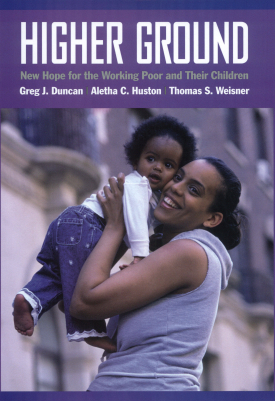
Higher Ground
About This Book
Winner of the 2007 Richard A. Lester Prize for Outstanding Book in Labor Economics and Industrial Relations
"[Higher Ground] is valuable for what it tells us not only about strategies to fight poverty, but also about how to generate evidence on strategies to fight poverty."
-INDUSTRIAL & LABOR RELATIONS REVIEW
"Higher Ground describes the results from the New Hope demonstration project in Milwaukee, one of the most creative social experiments of the past twenty- five years. It tells how New Hope was designed to help participants move into jobs, retain health insurance, and find effective child care. While not all the results of the program were positive, they do show that good policies can make a difference in providing economic stability to low-income families. The les sons from New Hope, described in this book, should be part the current public discussion. This is a book that students, researchers, and policy analysts will all find useful."
-REBECCA M. BLANK, Joan and Sanford Weill Dean of Public Policy, Gerald R. Ford School of Public Policy, University of Michigan
"New Hope was an ambitious experiment in helping the poor and near-poor. Higher Ground brings out its full significance and potential, especially by showing the effects on families and children. Greg J. Duncan, Aletha C. Huston, and Thomas S. Weisner make visible what rebuilding the welfare state around employment might mean."
-LAWRENCE M. MEAD, professor of politics, New York University
"Higher Ground puts the word 'hope' back into the debate about poverty, offering compelling evidence that government can make a difference in the lives of the poor. While others sought to 'end welfare as we know it,' the architects of New Hope had a grander vision, to end poverty as we know it. New Hope restored dignity and rewarded work, and its impact extended to the next generation."
-KATHRYN EDIN, visiting professor of public policy, John F. Kennedy School of Government, Harvard University
During the 1990s, growing demands to end chronic welfare dependency culminated in the 1996 federal “welfare-to-work” reforms. But regardless of welfare reform, the United States has always been home to a large population of working poor—people who remain poor even when they work and do not receive welfare. In a concentrated effort to address the problems of the working poor, a coalition of community activists and business leaders in Milwaukee, Wisconsin, launched New Hope, an experimental program that boosted employment among the city’s poor while reducing poverty and improving children’s lives. In Higher Ground, Greg Duncan, Aletha Huston, and Thomas Weisner provide a compelling look at how New Hope can serve as a model for national anti-poverty policies.
New Hope was a social contract—not a welfare program—in which participants were required to work a minimum of thirty hours a week in order to be eligible for earnings supplements and health and child care subsidies. All participants had access to career counseling and temporary community service jobs. Drawing on evidence from surveys, public records of employment and earnings, in-depth interviews, and ethnographic observation, Higher Ground tells the story of this ambitious three-year social experiment and evaluates how participants fared relative to a control group. The results were highly encouraging. Poverty rates declined among families that participated in the program. Employment and earnings increased among participants who were not initially working full-time, relative to their counterparts in a control group. For those who had faced just one significant barrier to employment (such as a lack of access to child care or a spotty employment history), these gains lasted years after the program ended. Increased income, combined with New Hope’s subsidies for child care and health care, brought marked improvements to the well-being and development of participants’ children. Enrollment in child care centers increased, and fewer medical needs went unmet. Children performed better in school and exhibited fewer behavioral problems, and gains were particularly dramatic for boys, who are at the greatest risk for poor academic performance and behavioral disorders.
As America takes stock of the successes and shortcomings of the Clinton-era welfare reforms, the authors convincingly demonstrate why New Hope could be a model for state and national policies to assist the working poor. Evidence based and insightfully written, Higher Ground illuminates how policymakers can make work pay for families struggling to escape poverty.
GREG J. DUNCAN is the Edwina S. Tarry Professor of Education and Social Policy at Northwestern University and a faculty fellow at the Institute for Policy Research.
ALETHA C. HUSTON is the Priscilla Pond Flawn Regents Professor of Child Development in the department of human ecology at the University of Texas, Austin and associate director of the Population Research Center.
THOMAS S. WEISNER is professor of anthropology at the University of California, Los Angeles.