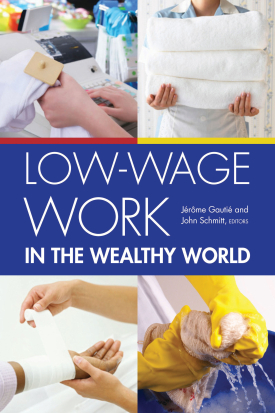
Cover image of the book Low-Wage Work in the Wealthy World
Books

Low-Wage Work in the Wealthy World

Editors
Jérôme Gautié
John Schmitt
Hardcover
$55.00
Add to Cart
Publication Date
6.63 in. × 9.25 in. 508 pages
ISBN
978-0-87154-061-4
Also Available From

About This Book

As global flows of goods, capital, information, and people accelerate competitive pressure on businesses throughout the industrialized world, firms have responded by reorganizing work in a variety of efforts to improve efficiency and cut costs. In the United States, where minimum wages are low, unions are weak, and immigrants are numerous, this has often lead to declining wages, increased job insecurity, and deteriorating working conditions for workers with little bargaining power in the lower tiers of the labor market. Low-Wage Work in the Wealthy World builds on an earlier Russell Sage Foundation study (Low-Wage America) to compare the plight of low-wage workers in the United States to five European countries—Denmark, France, Germany, the Netherlands, and the United Kingdom—where wage supports, worker protections, and social benefits have generally been stronger. By examining low-wage jobs in systematic case studies across five industries, this groundbreaking international study goes well beyond standard statistics to reveal national differences in the quality of low-wage work and the well being of low-wage workers.

The United States has a high percentage of low-wage workers—nearly three times more than Denmark and twice more than France. Since the early 1990s, however, the United Kingdom, the Netherlands, and Germany have all seen substantial increases in low-wage jobs. While these jobs often entail much the same drudgery in Europe and the United States, quality of life for low-wage workers varies substantially across countries. The authors focus their analysis on the “inclusiveness” of each country’s industrial relations system, including national collective bargaining agreements and minimum-wage laws, and the generosity of social benefits such as health insurance, pensions, family leave, and paid vacation time—which together sustain a significantly higher quality of life for low-wage workers in some countries.

Investigating conditions in retail sales, hospitals, food processing, hotels, and call centers, the book’s industry case studies shed new light on how national institutions influence the way employers organize work and shape the quality of low-wage jobs. A telling example: in the United States and several European nations, wages and working conditions of front-line workers in meat processing plants are deteriorating as large retailers put severe pressure on prices, and firms respond by employing low-wage immigrant labor. But in Denmark, where unions are strong, and, to a lesser extent, in France, where the statutory minimum wage is high, the low-wage path is blocked, and firms have opted instead to invest more heavily in automation to raise productivity, improve product quality, and sustain higher wages. However, as Low-Wage Work in the Wealthy World also shows, the European nations’ higher level of inclusiveness is increasingly at risk. “Exit options,” both formal and informal, have emerged to give employers ways around national wage supports and collectively bargained agreements. For some jobs, such as room cleaners in hotels, stronger labor relations systems in Europe have not had much impact on the quality of work.

Low-Wage Work in the Wealthy World offers an analysis of low-wage work in Europe and the United States based on concrete, detailed, and systematic contrasts. Its revealing case studies not only provide a human context but also vividly remind us that the quality and incidence of low-wage work is more a matter of national choice than economic necessity and that government policies and business practices have inevitable consequences for the quality of workers’ lives.

JÉRÔME GAUTIÉ is professor of economics at the University of Paris 1 Panthéon-Sorbonne.

JOHN SCHMITT is senior economist with the Center for Economic and Policy Research in Washington, D.C.

CONTRIBUTORS: Eileen Appelbaum, Rosemary Batt, Peter Berg, Annette Bernhardt, Gerhard Bosch, Francoise Carre, Laura Dresser, Jacob Eskildsen, Damian Grimshaw, Klaus G. Grunert, Karen Jaehrling, Susan James, Caroline Lloyd, Geoff Mason, Ken Mayhew, Philippe Mehaut, Philip Moss,  Wiemer Salverda, Chris Tillly, Marc Van Der Meer, Maarten Van Klaveren, Achim Vanselow, Dorothea Voss-Dahm, Chris Warhurst, Claudia Weinkopf, Niels Westergaard-Nielsen.

A Volume in the RSF Case Studies of Job Quality in Advanced Economies
RSF Journal
View Book Series
Sign Up For Our Mailing List
Apply For Funding
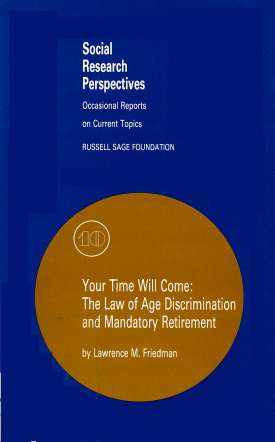
Cover image of the book Your Time Will Come
Books

Your Time Will Come

The Law of Age Discrimination and Retirement
Author
Lawrence M. Friedman
Paperback
$21.95
Add to Cart
Publication Date
6 in. × 9 in. 160 pages
ISBN
978-0-87154-295-3
Also Available From

About This Book

Age discrimination and its corollary, mandatory retirement, are modern legal issues, barely a generation old. In this concise and readable report, Lawrence Friedman explores the apparently sudden emergence of a field of law that pertains mainly to the elderly and middle-aged.

Friedman traces the brief but fascinating social, legislative, and judicial history of age discrimination law and of the laws addressing mandatory retirement. Both histories contain paradoxes and contradictions; both seem simultaneously to make an issue of "age" and to demand a kind of age neutrality, reflecting broad recent changes in American culture. Both histories are intricately bound up with other legal issues—age discrimination with race and sex discrimination; mandatory retirement with the development of pension plans and other social insurance systems. Friedman speculates on the impact of these new laws, illuminating through his analysis the complex phenomenon of "legalization," or the penetration of legal norms into ever more areas of life.

Finally, Friedman offers a provocative conclusion in which he suggests that laws on age discrimination and retirement—laws that appear to have a less extensive social background than one would expect—may in fact be "stand-in" laws for vague but powerful social norms not yet recognized in the legal system.

Your Time Will Come is the first new volume in a special paperback series entitled Social Research Perspectives: Occasional Reports on Current Topics. These Perspectives represent a revival of the Social Science Frontiers series published by the Foundation from 1969 to 1977 and will again offer short, timely, and accessible reports on various aspects of social science research.

LAWRENCE M. FRIEDMAN is Marion Rice Kirkwood Professor of Law at Stanford University.

A Volume in the the Russell Sage Foundation's Social Science Perspectives Series

RSF Journal
View Book Series
Sign Up For Our Mailing List
Apply For Funding
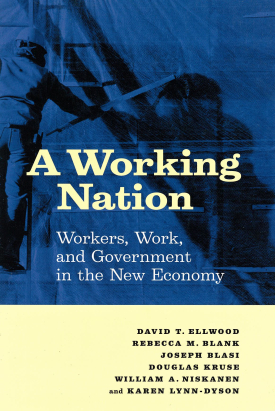
Cover image of the book A Working Nation
Books

A Working Nation

Workers, Work, and Government in the New Economy
Authors
Rebecca M. Blank
Joseph Blasi
Douglas Kruse
Karen Lynn-Dyson
William A. Niskane
David T. Ellwood
Paperback
Add to Cart
Publication Date
6 in. × 9 in. 168 pages
ISBN
978-0-87154-247-2
Also Available From

About This Book

The nature of work in the United States is changing dramatically, as new technologies, a global economy, and more demanding investors combine to create a far more competitive marketplace. Corporate efforts to respond to these new challenges have yielded mixed results. Headlines about instant millionaires and innovative e-businesses mingle with coverage of increasing job insecurity and record wage gaps between upper management and hourly workers. A Working Nation tracks the profound implications the changing workplace has had for all workers and shows who the real economic winners and losers have been in the past twenty-five years.

A Working Nation sorts fact from fiction about the new relationship between workers and firms, and addresses several critical issues: Who are the real winners and losers in this new economy? Has the relationship between workers and firms really been transformed? How have employees become more integrated into or disconnected from corporate strategies and performance? Should government step into this new economic reality and how should it intervene?

Among the topics investigated, David T. Ellwood explores and explains the apparent paradox between the steady rise in per capita national income and the stagnant wages of middle- and working-class workers. Douglas Kruse and Joseph Blasi study relative changes in long-term vs. temporary work, and evaluate the introduction of profit-sharing schemes and high performance workplace programs. William A. Niskanen and Rebecca M. Blank, both former members of the president's Council of Economic Advisers, offer their perspectives on what direction government might take to make this a working nation for everyone. Though Niskanen and Blank take alternative approaches, they both conclude that the primary policy emphasis ought to be on the problems of the least skilled more than on inequality per se, and that a focus on childhood education and tax supports for low-income working families should be of primary concern.

A Working Nation paints a compelling and surprisingly consistent picture of today's workplace. While the booming economy has created millions of new jobs, it has also lead to an alarmingly unbalanced system of rewards that puts less-skilled, and many middle-class, workers at risk. This book is essential reading for those seeking the most efficient answers to the challenges and opportunities of the evolving economy.

DAVID T. ELLWOOD is Lucius N. Littauer Professor of Political Economy at the John F. Kennedy School of Government, Harvard University. He is also director of the Aspen Domestic Strategy Group.

REBECCA M. BLANK was a member of the Council of Economic Advisers under President Clinton. She is Henry Carter Adams Collegiate Professor of Public Policy, dean of the Gerald R. Ford School of Public Policy, and professor of economics at the University of Michigan.

JOSEPH BLASI is professor of sociology at the School of Management and Labor Relations, Rutgers University.

DOUGLAS KRUSE is professor of economics at the School of Management and Labor Relations, Rutgers University. He is also research associate  of the National Bureau of Economic Research.

WILLIAM A. NISKANEN was a member of the Council of Economic Advisers under President Reagan and is chairman of the Cato Institute.

KAREN LYNN-DYSON is associate director of the Aspen Institute’s Domestic Strategy Group.

RSF Journal
View Book Series
Sign Up For Our Mailing List
Apply For Funding
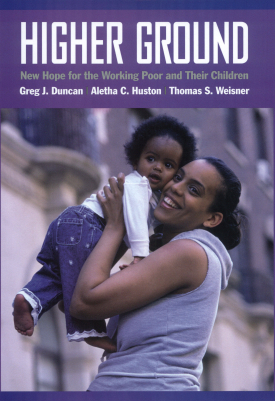
Cover image of the book Higher Ground
Books

Higher Ground

New Hope for the Working Poor and Their Children
Authors
Greg J. Duncan
Aletha C. Huston
Thomas S. Weisner
Paperback
$34.95
Add to Cart
Publication Date
6 in. × 9 in. 184 pages
ISBN
978-0-87154-167-3
Also Available From

About This Book

Winner of the 2007 Richard A. Lester Prize for Outstanding Book in Labor Economics and Industrial Relations

During the 1990s, growing demands to end chronic welfare dependency culminated in the 1996 federal “welfare-to-work” reforms. But regardless of welfare reform, the United States has always been home to a large population of working poor—people who remain poor even when they work and do not receive welfare. In a concentrated effort to address the problems of the working poor, a coalition of community activists and business leaders in Milwaukee, Wisconsin, launched New Hope, an experimental program that boosted employment among the city’s poor while reducing poverty and improving children’s lives. In Higher Ground, Greg Duncan, Aletha Huston, and Thomas Weisner provide a compelling look at how New Hope can serve as a model for national anti-poverty policies.

New Hope was a social contract—not a welfare program—in which participants were required to work a minimum of thirty hours a week in order to be eligible for earnings supplements and health and child care subsidies. All participants had access to career counseling and temporary community service jobs. Drawing on evidence from surveys, public records of employment and earnings, in-depth interviews, and ethnographic observation, Higher Ground tells the story of this ambitious three-year social experiment and evaluates how participants fared relative to a control group. The results were highly encouraging. Poverty rates declined among families that participated in the program. Employment and earnings increased among participants who were not initially working full-time, relative to their counterparts in a control group. For those who had faced just one significant barrier to employment (such as a lack of access to child care or a spotty employment history), these gains lasted years after the program ended. Increased income, combined with New Hope’s subsidies for child care and health care, brought marked improvements to the well-being and development of participants’ children. Enrollment in child care centers increased, and fewer medical needs went unmet. Children performed better in school and exhibited fewer behavioral problems, and gains were particularly dramatic for boys, who are at the greatest risk for poor academic performance and behavioral disorders.

As America takes stock of the successes and shortcomings of the Clinton-era welfare reforms, the authors convincingly demonstrate why New Hope could be a model for state and national policies to assist the working poor. Evidence based and insightfully written, Higher Ground illuminates how policymakers can make work pay for families struggling to escape poverty.

GREG J. DUNCAN is the Edwina S. Tarry Professor of Education and Social Policy at Northwestern University and a faculty fellow at the Institute for Policy Research.

ALETHA C. HUSTON is the Priscilla Pond Flawn Regents Professor of Child Development in the department of human ecology at the University of Texas, Austin and associate director of the Population Research Center.

THOMAS S. WEISNER is professor of anthropology at the University of California, Los Angeles.

RSF Journal
View Book Series
Sign Up For Our Mailing List
Apply For Funding
Cover image of the book The Company Doctor
Books

The Company Doctor

Risk, Responsibility, and Corporate Professionalism
Author
Elaine Draper
Paperback
Add to Cart
Publication Date
6 in. × 9 in. 412 pages
ISBN
978-0-87154-290-8
Also Available From

About This Book

To limit the skyrocketing costs of their employees' health insurance, companies such as Dow, Chevron, and IBM, as well as many large HMOs, have increasingly hired physicians to supervise the medical care they provide. As Elaine Draper argues in The Company Doctor, company doctors are bound by two conflicting ideals: serving the medical needs of their patients while protecting the company's bottom line. Draper analyzes the advent of the corporate physician both as an independent phenomenon, and as an index of contemporary culture, reaching startling conclusions about the intersection of corporate culture with professional autonomy.

Drawing on over 100 interviews with company physicians, scientists, and government and labor officials, as well as historical, legal, and statistical sources and medical trade association data, Draper presents an illuminating overview of the social context and meaning of professional work in corporations. Draper finds that while medical journals, speeches, and ethical codes proclaim the independent professional judgment of corporate physicians, the company doctors she interviewed often expressed anguish over the tightrope they must walk between their patients' health and the corporate oversight they face at every turn. Draper dissects the complex position occupied by company doctors to explore broad themes of doctor-patient trust, employee loyalty, privacy issues, and the future direction of medicine. She addresses such controversial topics as drug screening and the difficult position of company doctors when employees sue companies for health hazards in the workplace.

Company doctors are but one example of professionals who have at times ceded their autonomy to corporate management. Physicians provide the prototypical professional case for exploring this phenomenon, due to their traditional independence, extensive training, and high levels of prestige. But Draper expands the scope of the book—tracing parallel developments in the law, science, and technology—to draw insightful conclusions about changing conditions in the professional workplace, as corporate cultures everywhere adapt to the new realities of the global economy. The Company Doctor provides a compelling examination of the corporatization of American medicine with far-reaching implications for professionals in many other fields.

ELAINE DRAPER is a visiting scholar at the Institute for the Study of Social Change, University of California, Berkeley, and assistant professor of sociology at California State University, Los Angeles.

RSF Journal
View Book Series
Sign Up For Our Mailing List
Apply For Funding
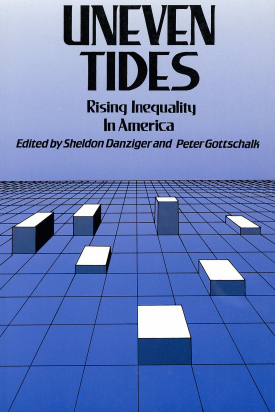
Cover image of the book Uneven Tides
Books

Uneven Tides

Rising Inequality in America
Editors
Sheldon Danziger
Peter Gottschalk
Paperback
$28.95
Add to Cart
Publication Date
6 in. × 9 in. 300 pages
ISBN
978-0-87154-227-4
Also Available From

About This Book

Inequality has been on the rise in America for more than two decades. This socially divisive trend began in the economic doldrums of the 1970s and continued through the booming 1980s, when surging economic tides clearly failed to lift all ships. Instead, escalating inequality in both individual earnings and family income widened the gulf between rich and poor and led to the much-publicized decline of the middle class. Uneven Tides brings together a distinguished group of economists to confront the crucial questions about this unprecedented rise in inequality. Just how large and pervasive was it? What were its principal causes? And why did it continue in the 1980s, when previous periods of national economic growth have generally reduced inequality?

Reviewing the best current evidence, the essays in Uneven Tides show that rising inequality is a complex phenomenon, the result of a web of circumstances inherent in the nation's current industrial, social, and political situation. Once attributed to the rising supply of inexperienced workers—as baby boomers, new immigrants, and women entered the labor market—the growing inequality in individual earnings is revealed in Uneven Tides to be the direct result of the economy's increasing demand for skilled workers. The authors explore many of the possible causes of this trend, including the employment shift from manufacturing to the service sector, the heightened importance of technology in the workplace, the decline of unionization, and the intensified efforts to compete in a global marketplace. Uneven Tides also examines the equally dramatic growth in the inequality of family income, and reviews the effects of family size, the age and education of household heads, and the transition to both two-earner and single-parent families. Although these demographic shifts played a role, what emerges most clearly is an understanding of the powerful influence of public policy, as increasingly regressive taxes, declining welfare benefits, and a stagnant minimum wage continue to amplify the effects of market forces on income.

With the rise in inequality now much in the headlines, it is clear that our nation's ability to reverse these shifting currents requires deeper understanding of their causes and consequences. Uneven Tides is the first book to get beyond the news stories to a clear analysis of the changing fortunes of America's families. It should be required reading for anyone with a serious interest in the economic underpinnings of the country's social problems.

SHELDON DANZIGER is professor of social work and public policy and faculty associate in population studies at the University of Michigan.

PETER GOTTSCHALK is professor of economics at Boston College, and research affiliate at the Institute for Research on Poverty at the University of Wisconsin.

RSF Journal
View Book Series
Sign Up For Our Mailing List
Apply For Funding
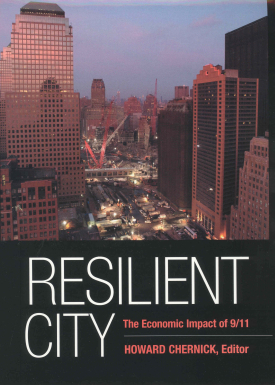
Cover image of the book Resilient City
Books

Resilient City

The Economic Impact of 9/11
Editor
Howard Chernick
Paperback
$34.95
Add to Cart
Publication Date
6 in. × 9 in. 352 pages
ISBN
978-0-87154-170-3
Also Available From

About This Book

The strike against the World Trade Center on September 11, 2001, was a violent blow against the United States and a symbolic attack on capitalism and commerce. It shut down one of the world’s busiest commercial centers for weeks, destroyed or damaged billions of dollars worth of property, and forced many New York City employers to slash their payrolls or move jobs to other areas. The immediate economic effect was substantial, but how badly did 9/11 affect New York City’s economy in the longer term? In Resilient City, Howard Chernick and a team of economic experts examine the city’s economic recovery in the three years following the destruction of the Twin Towers.

Assessing multiple facets of the New York City economy in the years after 9/11, Resilient City discerns many hopeful signs among persistent troubles. Analysis by economist Sanders Korenman indicates that the value of New York–based companies did not fall relative to other firms, indicating that investors still believe that there are business advantages to operating in New York despite higher rates of terrorism insurance and concerns about future attacks. Cordelia Reimers separates the economic effect of 9/11 from the effects of the 2001 recession by comparing employment and wage trends for disadvantaged workers in New York with those in five major U.S. cities. She finds that New Yorkers fared at least as well as people in other cities, suggesting that the decline in earnings and employment for low-income New York workers in 2002 was due more to the recession than to the effects of 9/11. Still, troubles remain for New York City. Howard Chernick considers the substantial fiscal implications of the terrorist attacks on New York City, estimating that the attack cost the city about $3 billion in the first two years alone; a sum that the city now must make up through large tax increases, spending cuts, and substantial additional borrowing, which will inevitably be a burden on future budgets.

The terrorist attacks of September 11 dealt a severe blow to the economy of New York City, but it was far from a knock-out punch. Resilient City shows that New York’s dynamic, flexible economy has absorbed the hardships inflicted by the attacks, and provides a thorough, authoritative assessment of what, so far, has been a strong recovery.


HOWARD CHERNICK is professor of economics at Hunter College of the City University of New York.

CONTRIBUTORS:  Joshua Chang,  Oliver D. Cooke,  Franz Fuerst,  Andrew F. Haughwout,  Edward W. Hill,  Sanders Korenman,  Iryna Lendel,  James A. Parrott,  Cordelia W. Reimers,  Jonathan A. Schwabish. 

A September 11 Initiative Volume

RSF Journal
View Book Series
Sign Up For Our Mailing List
Apply For Funding
Cover image of the book Putting Children First
Books

Putting Children First

How Low-Wage Working Mothers Manage Child Care
Author
Ajay Chaudry
Paperback
$29.95
Add to Cart
Publication Date
6 in. × 9 in. 368 pages
ISBN
978-0-87154-172-7
Also Available From

About This Book

Semi-Finalist for the Robert F. Kennedy Memorial Book Award

In the five years following the passage of federal welfare reform law, the labor force participation of low-income, single mothers with young children climbed by more than 25 percent. With significantly more hours spent outside the home, single working mothers face a serious childcare crunch—how can they provide quality care for their children? In Putting Children First, Ajay Chaudry follows forty-two low-income families in New York City over three years to illuminate the plight of these mothers and the ways in which they respond to the difficult challenge of providing for their children’s material and developmental needs with limited resources.

Using the words of the women themselves, Chaudry tells a startling story. Scarce subsidies, complicated bureaucracies, inflexible work schedules, and limited choices force families to piece together care arrangements that are often unstable, unreliable, inconvenient, and of limited quality. Because their wages are so low, these women are forced to rely on inexpensive caregivers who are often under-qualified to serve the developmental needs of their children. Even when these mothers find good, affordable care, it rarely lasts long because their volatile employment situations throw their needs into constant flux. The average woman in Chaudry’s sample had to find five different primary caregivers in her child’s first four years, while over a quarter of them needed seven or more in that time.

This book lets single, low-income mothers describe the childcare arrangements they desire and the ways that options available to them fail to meet even their most basic needs. As Chaudry tracks these women through erratic childcare spells, he reveals the strategies they employ, the tremendous costs they incur and the anxiety they face when trying to ensure that their children are given proper care.

Honest, powerful, and alarming, Putting Children First gives a fresh perspective on work and family for the disadvantaged. It infuses a human voice into the ongoing debate about the effectiveness of welfare reform, showing the flaws of a social policy based solely on personal responsibility without concurrent societal responsibility, and suggesting a better path for the future.

AJAY CHAUDRY is a writer on social policy issues and a faculty and senior research fellow in urban policy and management at New School University.

RSF Journal
View Book Series
Sign Up For Our Mailing List
Apply For Funding
Cover image of the book Women in Academe
Books

Women in Academe

Progress and Prospects
Editor
Mariam K. Chamberlain
Paperback
$26.95
Add to Cart
Publication Date
6 in. × 9 in. 448 pages
ISBN
978-0-87154-218-2
Also Available From

About This Book

The role of women in higher education, as in many other settings, has undergone dramatic changes during the past two decades. This significant period of progress and transition is definitively assessed in the landmark volume, Women in Academe.

Crowded out by returning veterans and pressed by social expectations to marry early and raise children, women in the 1940s and 1950s lost many of the educational gains they had made in previous decades. In the 1960s women began to catch up, and by the 1970s women were taking rapid strides in academic life. As documented in this comprehensive study, the combined impact of the women’s movement and increased legislative attention to issues of equality enabled women to make significant advances as students and, to a lesser extent, in teaching and academic administration. Women in Academe traces the phenomenal growth of women’s studies programs, the notable gains of women in non-traditional fields, the emergence of campus women’s centers and research institutes, and the increasing presence of minority and re-entry women. Also examined are the uncertain future of women’s colleges and the disappointingly slow movement of women into faculty and administrative positions.

This authoritative volume provides more current and extensive data on its subject than any other study now available. Clearly and objectively, it tells an impressive story of progress achieved—and of important work still to be done.

MARIAM K. CHAMBERLAIN is founding president of the National Council for Research on Women.

CONTRIBUTORS: Helen S. Astin,  Jean W. Campbell, Mary Ellen S. Capek,  Maren Lockwood Carden,  Mariam K. Chamberlain,  Carol Frances,  Jane Gould,  Lilli S. Hornig,  Florence Howe,  Marjorie Lightman,  Virginia Davis Nordin,  Patricia Ann Palmieri, Bernice R. Sandler,  Cynthia Secor,  Donna Shavlik,  Margaret C. Simms.

RSF Journal
View Book Series
Sign Up For Our Mailing List
Apply For Funding
Cover image of the book Fringe Banking
Books

Fringe Banking

Check-Cashing Outlets, Pawnshops, and the Poor
Author
John P. Caskey
Paperback
$26.95
Add to Cart
Publication Date
6 in. × 9 in. 184 pages
ISBN
978-0-87154-180-2
Also Available From

About This Book

"Cogently argued, fills an important gap in the literature, and is accessible to undergraduates." —Choice

"Dismantles the mythology surrounding pawnshops and check-cashing outlets, and demonstrates that they are no longer on the fringe of our financial system but integral to it."—San Francisco Bay Guardian

In today's world of electronic cash transfers, automated teller machines, and credit cards, the image of the musty, junk-laden pawnshop seems a relic of the past. But it is not. The 1980s witnessed a tremendous boom in pawnbroking. There are now more pawnshops thanever before in U.S. history, and they are found not only in large cities but in towns and suburbs throughout the nation. As John Caskey demonstrates in Fringe Banking, the increased public patronage of both pawnshops and commercial check-cashing outlets signals the growing number of American households now living on a cash-only basis, with no connection to any mainstream credit facilities or banking services.

Fringe Banking is the first comprehensive study of pawnshops and check-cashing outlets, profiling their operations, customers, and recent growth from family-owned shops to such successful outlet chains as Cash American and ACE America's Cash Express. It explains why, despite interest rates and fees substantially higher than those of banks, their use has so dramatically increased. According to Caskey, declining family earnings, changing family structures, a growing immigrant population, and lack of household budgeting skills has greatly reduced the demand for bank deposit services among millions of Americans. In addition, banks responded to 1980s regulatory changes by increasing fees on deposit accounts with small balances and closing branches in many poor urban areas.

These factors combined to leave many low- and moderate-income families without access to checking privileges, credit services, and bank loans. Pawnshops and check-cashing outlets provide such families with essential financial services thay cannot obtain elsewhere. Caskey notes that fringe banks, particularly check-cashing outlets, are also utilized by families who could participate in the formal banking system, but are willing to pay more for convenience and quick access to cash. Caskey argues that, contrary to their historical reputation as predators milking the poor and desperate, pawnshops and check-cashing outlets play a key financial role for disadvantaged groups. Citing the inconsistent and often unenforced state laws currently governing the industry, Fringe Banking challenges policy makers to design regulations that will allow fringe banks to remain profitable without exploiting the customers who depend on them.

JOHN P. CASKEY is associate professor of economics at Swarthmore College.

RSF Journal
View Book Series
Sign Up For Our Mailing List
Apply For Funding