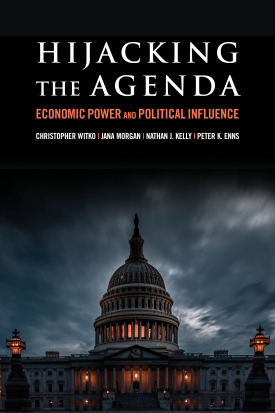
Cover image of the book Hijacking the Agenda
Books

Hijacking the Agenda

Economic Power and Political Influence
Authors
Christopher Witko
Jana Morgan
Nathan J. Kelly
Peter K. Enns
Paperback
$35.00
Add to Cart
Publication Date
6 in. × 9 in. 416 pages
ISBN
978-0-87154-573-2
Also Available From

About This Book

Winner of the 2022 Gladys M. Kammerer Award from the American Political Science Association

Hijacking the Agenda should have a big impact on how we think about Congress, policymaking, and political inequality. It provides an ambitious and creative analysis of an often-overlooked dimension of political power—the outsized role of the wealthy and well-organized in determining whose problems get addressed and whose get ignored.”
Larry M. Bartels, May Werthan Shayne Chair of Public Policy and Social Science, Vanderbilt University

“To know who governs, we must know who controls the governing agenda. In this innovative book, four top political scientists show that the congressional agenda is disproportionately shaped by economic elites and the politicians most friendly to and funded by them. Combining sophisticated quantitative analysis and compelling case studies, Hijacking the Agenda sets a new standard for research on inequality and American democracy—and sounds a loud warning that all scholars and citizens should hear.”
Jacob Hacker, Stanley Resor Professor of Political Science, Yale University

Why are the economic concerns of lower- and middle-class Americans so often ignored by Congress, while the economic goals of the wealthiest are prioritized, often resulting in policies promoting their interests? In Hijacking the Agenda, political scientists Christopher Witko, Jana Morgan, Nathan J. Kelly, and Peter K. Enns examine why Congress privileges the concerns of businesses and the wealthy over those of average Americans. They go beyond demonstrating this bias to document how and why economic policy is skewed in favor of the rich.

The authors analyze over 20 years of floor speeches by thousands of members of Congress to examine how campaign contributions and independent expenditures on behalf of candidates help set the national economic agenda. They find that legislators receiving more support from business and other wealthy interests were more likely to discuss the deficit and other upper-class priorities, while those receiving more assistance from unions were more likely to discuss issues important to the lower and middle class, such as economic inequality and wages. This attention imbalance matters because when members of Congress talk about certain issues, their speech is often followed by legislative action. While unions use their resources to push back against wealthy interests, spending by the wealthy dwarfs that of unions, often giving the upper class the upper hand.

The authors use case studies analyzing financial regulation and the minimum wage to demonstrate how the economic power of the wealthy enables them to advance their agenda. In each case, the authors examine structural power, or the power that comes from a group’s economic position, and kinetic power, the power that comes from the ability to mobilize organizational and financial resources in the policy process. They show how business uses its structural power and resources to effect policy change in Congress, as when the financial industry in the late 1990s promoted passage of a bill that eviscerated financial regulations put in place after the Great Depression. Likewise, when business wants to preserve the status quo, it uses its power to keep issues off of the legislative agenda, as when inflation erodes the value of the minimum wage and its declining purchasing power leaves minimum-wage workers in poverty. Although groups representing lower- and middle-class interests, particularly unions, are sometimes able to shape policy if conditions are right, they lack structural power and have limited financial resources. As a result, the wealthy have considerable advantages in the policy process, advantages that only intensify as their economic power becomes more concentrated and policymakers continue to see policies beneficial to business as beneficial for all.

Hijacking the Agenda is an illuminating account of the way economic power influences the congressional agenda and policy process to privilege the wealthy and marks a major step forward in understanding the politics of inequality.

CHRISTOPHER WITKO is professor of public policy and political science and associate director of the School of Public Policy at Pennsylvania State University.

JANA MORGAN is professor of political science at the University of Tennessee.

NATHAN J. KELLY is professor of political science at the University of Tennessee.

PETER K. ENNS is professor of government at Cornell University and executive director of the Roper Center for Public Opinion Research.

RSF Journal
View Book Series
Sign Up For Our Mailing List
Apply For Funding
Cover image of the book The WPA and Federal Relief Policy
Books

The WPA and Federal Relief Policy

Author
Donald S. Howard
Ebook
Publication Date
881 pages

About This Book

This book examines the Work Projects Administration, previously known as the Work Progress Administration, as well as other national relief policies. The WPA was the name applied to the federally operated and financed program inaugurated in the summer of 1935 in which as many as fifty federal agencies cooperated in providing jobs for workers meeting prescribed conditions of eligibility.

Donald S. Howard was assistant director of the Charity Organization Department of the Russell Sage Foundation.

RSF Journal
View Book Series
Sign Up For Our Mailing List
Apply For Funding
Cover image of the book The Work of the Little Theatres
Books

The Work of the Little Theatres

The Groups They Include, the Plays They Produce, Their Tournaments, and the Handbooks They Use
Author
Clarence Arthur Perry
Ebook
Publication Date
228 pages

About This Book

A survey of amateur and community theatrical productions and activity in the early twentieth century, in particular dramatics for children through public and private schools, playground and community centers, and various voluntary organizations. With a selected bibliography for amateur workers in drama.

Clarence Arthur Perry was the author of Wider Use of the School Plant, Housing for the Machine Age, and The Rebuilding of Blighted Areas.

RSF Journal
View Book Series
Sign Up For Our Mailing List
Apply For Funding
Cover image of the book Volunteer Attorneys and Legal Services for the Poor
Books

Volunteer Attorneys and Legal Services for the Poor

New York’s CLO Program
Authors
Douglas E. Rosenthal
Robert A. Kagan
Debra Quatrone
Ebook
Publication Date
245 pages

About This Book

This report is about the Community Law Offices (CLO), which operated two neighborhood law offices in Manhattan—in East and Central Harlem—that provided free legal services to individuals and groups who could not afford private attorneys. CLO relied primarily on attorneys in private practice who volunteered part of their time to handle the cases brought to the two offices. Formation and growth, an overview of its operations, and an evaluation of volunteer performance are discussed.

Douglas E. Rosenthal was chief of the Foreign Commerce Section of the Antitrust Division of the Department of Justice. Robert A. Kagan is professor of political science and law at the University of California, Berkeley.

RSF Journal
View Book Series
Sign Up For Our Mailing List
Apply For Funding
Cover image of the book Training Schools for Delinquent Girls
Books

Training Schools for Delinquent Girls

Author
Margaret Reeves
Ebook
Publication Date
455 pages

About This Book

The Department of Child Helping of the Russell Sage Foundation completed a detailed study of 151 public institutions for delinquent youth in the United States in 1924, including a few private institutions supported chiefly by public funds. The work of such schools is unique, technical, and vitally important, but up to the time that this study was undertaken no complete and detailed information regarding these institutions was available. The department undertook the study with the goal of informing the public and awakening its interest in these schools, and of assisting trustees and superintendents to improve the methods, standards, and conditions of their work. This book examines academics, physical care, and parole for delinquent girls, as well as building conditions, salaries in training schools, record-keeping, and community aspects of institutional life.

Margaret Reeves was field agent of the Russell Sage Foundation and director of the State Bureau of Child Welfare, Santa Fe, New Mexico.

RSF Journal
View Book Series
Sign Up For Our Mailing List
Apply For Funding
Cover image of the book Ten Thousand Small Loans
Books

Ten Thousand Small Loans

Facts about Borrowers in 109 Cities in 17 States
Authors
Louis N. Robinson
Maude E. Stearns
Ebook
Publication Date
159 pages

About This Book

This 1930 report of a statistical study of 10,000 small loans is part of the Small Loans Series, a general survey of small loans prepared for the Russell Sage Foundation by the Department of Remedial Loans. Topics include the development of the small loan business and the social, economic, and living conditions of borrowers.

Louis N. Robinson was professor of economics at Swarthmore College.

RSF Journal
View Book Series
Sign Up For Our Mailing List
Apply For Funding
Cover image of the book A Study of Company-Sponsored Foundations
Books

A Study of Company-Sponsored Foundations

Author
Frank M. Andrews
Ebook
Publication Date
88 pages

About This Book

A survey of the role of company-sponsored foundations and the philanthropic contributions of American corporations. History and growth, financial operations, goals and objectives, and the causes company foundations support are discussed.

RSF Journal
View Book Series
Sign Up For Our Mailing List
Apply For Funding
Cover image of the book Statistical Procedure of Public Employment Offices
Books

Statistical Procedure of Public Employment Offices

Authors
Anabel M. Stewart
Bryce M. Stewart
Ebook
Publication Date
327 pages

About This Book

An analysis of the practice, scope, and methods of recording facts in the daily work of public employment in various countries and a plan for standard procedure in the United States made for the Committee on Governmental Labor Statistics of the American Statistical Association.

Anabel M. Stewart and Bryce M. Stewart, Committee on Governmental Labor Statistics

RSF Journal
View Book Series
Sign Up For Our Mailing List
Apply For Funding
Cover image of the book Small Loan Legislation
Books

Small Loan Legislation

A History of the Regulation of the Business of Lending Small Sums
Authors
David J. Gallert
Walter S. Hilborn
Geoffrey May
Ebook
Publication Date
255 pages

About This Book

This survey of small loan legislation is part of a general survey of small loans prepared for the Russell Sage Foundation under the direction of Dr. Louis N. Robinson. It is issued as one of the Small Loan Series of the Department of Remedial Loans. Chapter VIII of this volume on the Constitutionality of Small Loan Legislation, by Frank R. Hubachek, was printed in 1931 as a pamphlet under the same title.

David J. Gallert, New York Bar; Walter S. Hilborn, New York Bar, Geoffrey may, Inner Temple, London

RSF Journal
View Book Series
Sign Up For Our Mailing List
Apply For Funding
Cover image of the book Sharing Management with the Workers
Books

Sharing Management with the Workers

A Study of the Partnership Plan of the Dutchess Bleachery, Wappingers Falls, New York
Author
Ben M. Selekman
Ebook
Publication Date
156 pages

About This Book

Part of the Industrial Relations Series, a series by the Department of Industrial Studies of the Russell Sage Foundation investigating early twentieth-century experiments in the organization of relations between employers and employees in industrial enterprises in the United States. It examines the plan for employee representation of a mill in Wappingers Falls, New York, and the relationship between workers and management.

Ben M. Selekman, Department of Industrial Studies, Russell Sage Foundation

RSF Journal
View Book Series
Sign Up For Our Mailing List
Apply For Funding