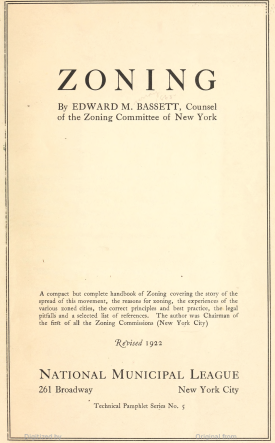
Cover image of the book Zoning
Books

Zoning

Author
Edward M. Bassett
Ebook
Publication Date
41 pages

About This Book

A compact but complete handbook of zoning covering the story of the spread of this movement, the reasons for zoning, the experiences of various zoned cities, the correct principles and best practice, the legal pitfalls and a selected list of reference.

EDWARD M. BASSETT was chairman of the Zoning Committee of New York.

RSF Journal
View Book Series
Sign Up For Our Mailing List
Apply For Funding
Beyond Deaths of Despair
Books

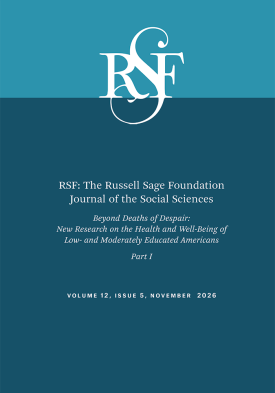
RSF: Beyond Deaths of Despair

New Research on the Health and Well-Being of Low- and Moderately Educated Americans
Authors
Anne Case
Andrew J. Cherlin
Angus Deaton
Paperback
$29.95
Add to Cart
Publication Date
7 in. × 10 in. 160 pages
ISBN
978-0-87154-029-4

About This Book

The term “deaths of despair” was coined in 2015 by economists Anne Case and Angus Deaton to describe the increasing mortality rate for White Americans without college degrees due to drug over-doses, suicide, and alcoholic liver disease. These deaths were attributed to the despondency experienced by the White working class, who were left behind by changes in the American economy. However, the mortality picture has changed since then. Mortality rates are now rising among both Black and White Americans without a college degree. Nearly all major causes of death are increasing more, or decreasing less, for people without college degrees. The educational gap in mortality has become so severe that, in 2021, adult life expectancy was more than eight years higher among college graduates. In this double issue of RSF, Case, Deaton, sociologist Andrew J. Cherlin, and an interdisciplinary group of contributors move beyond the concept of “deaths of despair” to explore the widening educational gap in mortality. 

Issue 5 provides new perspectives on the education gap in mortality as well as new viewpoints on the non-college population. Christopher L. Foote and colleagues show that much of the educational gap in mortality may be due to smoking. One of the most popular explanations for the growing mortality gap is that college unlocks better job opportunities. However, Sam Arenberg and Sam Stripling find that what may matter for longer life expectancy is not so much having a “good” job as having a job at all, as high school dropouts with jobs have lower mortality rates than college graduates without them. Victor Tan Chen and colleagues reveal that people with opioid use disorders experience “precarity chains”: overlapping, connected hazards that combine to put people at increased risk of substance abuse.

Issue 6 also gives new viewpoints on the non-college population and examines geographic and international variation in mortality. Grace Landrum-Hall and colleagues discover that men with health issues repeatedly enter and exit the formal labor force—referred to as “churning”—owing to inflexible employer policies and insufficient income support program policies. Jennifer Karas Montez and col-leagues show that rural areas and small cities have seen increases in mortality, while large urban areas have seen decreases. Iliya Gutin and colleagues find that the educational gap in health and well-being is typically larger in the US than in Britain. This may be because education in the US—and the resulting higher salaries—allows for more access to health-promoting resources.

This double issue of RSF provides fascinating insights into the stark and alarming mortality gap between those with and without a college degree in the US.

About the Author

ANNE CASE is Alexander Stewart 1886 Professor of Economics and Public Affairs, Emeritus, Princeton University 

ANDREW J. CHERLIN is Benjamin H. Griswold III Professor Emeritus of Public Policy, Johns Hopkins University 

ANGUS DEATON is Dwight D. Eisen- hower Professor of International Affairs, Emeritus and Professor of Economics and International Affairs, Emeritus, Princeton University 

CONTRIBUTORS: Emily Q. Ahonen, Sarah B. Andrea, Sam Arenberg, Charis Bridger Staatz, Victor Tan Chen, HwaJung Choi, Jennifer Beam Dowd, Paula Fomby, Christopher L. Foote, Lauren Gaydosh, Marjory L. Givens, Iliya Gutin, Sarah Halpern-Meekin, Katrina Hamilton, Ilana M. Horwitz, V. Joseph Hotz, Grace Landrum-Hall, Meiying Li, Kaylee T. Matheny, Ellen Meara, Shannon M. Monnat, Jennifer Karas Montez, Kelly Musick, Kaitlin N. Piper, George Ploubidis, Megan M. Reynolds, Robert F. Schoeni, Judith A. Seltzer, Jonathan Skinner, Luke R. Stewart, Sam Stripling, Adam Talkington, Andrea Tilstra, Erin C. Tucker, Emily E. Wiemers, Megan R. Winkler, Douglas A. Wolf 6 | RSF JOURNAL
RSF Journal
View Book Series
Sign Up For Our Mailing List
Apply For Funding

While many believe that schooling and education can deter crime, voters often express polarized sentiments towards increasing investment in public schools. State school finance reforms (SFRs), triggered by judicial and legislative decisions in 27 states are non-criminal justice interventions with the potential to impact public safety. A growing literature examines how SFRs affect individual and social economic outcomes, but less is known about how they affect community-level safety and violent crime exposure.

Police-led behavioral health crisis response can result in arrest, use of force, or entry into jail for behaviors that are a result of untreated or inadequately treated mental illness. This dynamic contributes to the criminalization of behavioral health conditions. In response, policymakers have increasingly invested in mobile crisis services—teams of behavioral health professionals who respond directly in the community to individuals experiencing acute crises. These services are intended to provide stabilization, de-escalation, and linkage to treatment without resorting to arrest.

Farm labor shortages have become a salient feature of agricultural production in the U.S. Immigrant workers, particularly immigrants from Mexico, play an important role in the agricultural labor force. However, over the past twenty years, there has been a marked decline in new immigrant arrivals from Mexico, suggesting a link between falling Mexican immigration and agricultural labor shortages. Economists Ashish Shenoy and Julián Arteaga will examine the impacts of changes in immigrant labor supply on wages, farm production, and domestic food prices.

While unions played a central role in reducing inequality and shaping political life throughout the twentieth century, they historically drew sharp boundaries between insiders and outsiders – frequently excluding immigrants, Black workers, and women. Economist Carlo Medici will examine how demographic shifts shaped unions’ inclusion of diverse workers and how unions, in turn, impacted immigrant and Black workers’ access to economic and political opportunity. He will analyze archival records and census and electoral data for his project.

In 2021, in response to historic migration across the U.S.-Mexico border, Texas enacted Operation Lone Star, an initiative that transported more than 100,000 migrants from border communities to Washington, D.C., New York City, Chicago, Denver, Philadelphia, and Los Angeles. These transfers were politically driven, largely unanticipated by receiving jurisdictions, and unrelated to local economic conditions. Economists Jose Bucheli and Rhet Smith will examine how these sudden inflows of migrants affected local crime, policing, and public order.

The California Dream Act and CADAA opened access to state Cal Grants for undocumented students who cannot receive federal aid. Using the universe of CADAA applications, this study employs a regression discontinuity design around annual Cal Grant offer cutoffs to estimate intention-to-treat effects of scoring above the threshold on educational outcomes. A fuzzy RDD uses score-relative-to-cutoff as an instrument for actual grant receipt to estimate local average treatment effects.