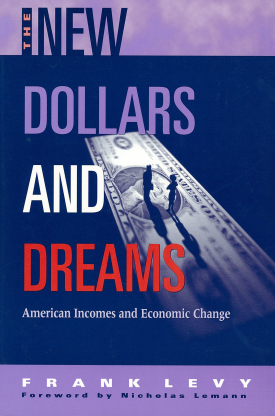
Cover image of the book The New Dollars and Dreams
Books

The New Dollars and Dreams

American Incomes and Economic Change
Author
Frank Levy
Paperback
$26.95
Add to Cart
Publication Date
6 in. × 9 in. 264 pages
ISBN
978-0-87154-515-2
Also Available From

About This Book

Foreword by Nicholas Lemann

"A brilliant book that both clarifies and explains the seemingly contradictory trends of a booming economy, wage stagnation, and growing income inequality." —Thomas B. Edsall, author, The New Politics of Inequality and political reporter at The Washington Post

More than a decade ago, Frank Levy's classic Dollars and Dreams offered an incisive analysis of the dramatic changes then taking place in the American standard of living. As wage stagnation and rising income inequality in the 1970s and early 80s began to undermine Americans' traditional economic optimism, Levy's book provided the first diagnosis of what he called the quiet depression. Since then, the U.S. economy has made a dramatic comeback, but economic insecurity remains widespread. New technologies, increased immigration, and global competition have opened up a new economic playing field, one with new rules and new winners and losers. The New Dollars and Dreams explores this puzzling economic landscape, in which low unemployment goes hand in hand with sluggish wage growth and high income inequality. This completely revised and expanded version of Levy's original book offers an invaluable guide to the sweeping economic, social, and political changes that have remade life in the United States over the past twenty-five years.

Levy tells a fascinating and insightful story about what happened to American incomes and jobs. His plot resists the simple truths of everyday journalism, and explains the economic and political twists and turns that have shaped the current American economy—including the oil and food price inflations of the 1970s, the market deregulations and corporate downsizings of the 1980s, the emergence of women as sole breadwinners in many families, the migration of jobs to the suburbs, and the computerization of work. The New Dollars and Dreams illuminates the key sources of inequality, with chapters that examine the disparate employment progress of whites, minorities, men, and women, and it carefully investigates the claim that the concentration of very high incomes is the result of a winner-take-all economy. Although the growth of the service economy is often blamed for inequality, Levy locates a more fundamental cause in the rising educational and skill demands brought about by restructuring of work in all sectors of the economy. An important part of the story also involves the transformation of the American family from extended and two-parent households to those headed by single mothers and lone individuals. By making sense of these complex trends, The New Dollars and Dreams offers crucial insights into why, despite a thriving economy, many Americans no longer feel secure in their financial futures.

FRANK LEVY is Daniel Rose Professor of Urban Economics at the Massachusetts Institute of Technology.

A Volume in the RSF Census Series

RSF Journal
View Book Series
Sign Up For Our Mailing List
Apply For Funding
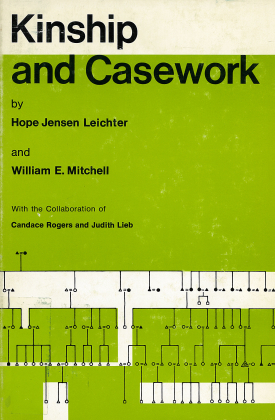
Cover image of the book Kinship and Casework
Books

Kinship and Casework

Authors
Hope Jensen Leichter
William E. Mitchell
Hardcover
Add to Cart
Publication Date
6 in. × 9 in. 372 pages
ISBN
978-0-87154-522-0
Also Available From

About This Book

Reaffirms the importance of the larger kinship network through analysis of extensive data on the clients of one social agency. The authors show that the less kinship-oriented caseworkers often attempt to change clients' kin relationships in the direction of less involvement, raising questions about value differences in therapeutic practice. The book also points to the importance of concepts, such as those dealing with family kinship, that will enable the caseworker to appraise the client's social relationships more fully. The authors emphasize the benefits to be derived from a closer liaison between social work and social science.

HOPE JENSEN LEICHTER is associate professor at Columbia University's Teacher's College.

WILLIAM E. MITCHELL is research associate in anthropology in the Department of Psychiatry at the Vermont College of Medicine.

RSF Journal
View Book Series
Sign Up For Our Mailing List
Apply For Funding
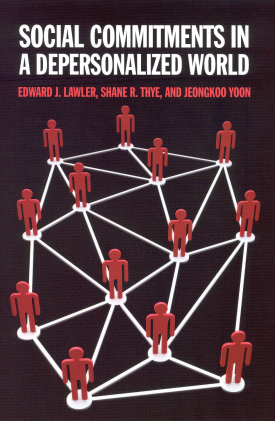
Cover image of the book Social Commitments in a Depersonalized World
Books

Social Commitments in a Depersonalized World

Authors
Edward J. Lawler
Shane R. Thye
Jeongkoo Yoon
Paperback
$33.95
Add to Cart
Publication Date
6 in. × 9 in. 264 pages
ISBN
978-0-87154-508-4
Also Available From

About This Book

Winner of the 2010 Best Book Award from the Rationality and Society Section of the American Sociological Association

As individuals’ ties to community organizations and the companies they work for weaken, many analysts worry that the fabric of our society is deteriorating. But others counter that new social networks, especially those forming online, create important and possibly even stronger social bonds than those of the past. In Social Commitments in a Depersonalized World, Edward Lawler, Shane Thye, and Jeongkoo Yoon examine interpersonal and group ties and propose a new theory of social commitments, showing that multiple interactions, group activities and, particularly, emotional attachment, are essential for creating and sustaining alignments between individuals and groups.

Lawler, Thye, and Yoon acknowledge that long-term social attachments have proven fragile in a volatile economy where people increasingly form transactional associations—based not on collective interest but on what will yield the most personal advantage in a society shaped by market logic. Although person-to-group bonds may have become harder to sustain, they continue to play a vital role in maintaining healthy interactions in larger social groups from companies to communities. Drawing on classical and contemporary sociology, organizational psychology, and behavioral economics, Social Commitments in a Depersonalized World shows how affiliations—particularly those that involve a profound emotional component—can transcend merely instrumental or transactional ties and can even transform these impersonal bonds into deeply personal ones.

The authors study the structures of small groups, corporations, economic transactions, and modern nation-states to determine how hierarchies, task allocation, and social identities help or hinder a group’s vitality. They find that such conditions as equal status, interdependence, and overlapping affiliations figure significantly in creating and sustaining strong person-to-group bonds. Recurring collaboration with others to achieve common goals—along with shared responsibilities and equally valued importance within an organization—promote positive and enduring feelings that enlarge a person’s experience of a group and the significance of their place within it. Employees in organizations with strong person-to-group ties experience a more unified, collective identity. They tend to work more cost effectively, meet company expectations, and better regulate their own productivity and behavior.

The authors make clear that the principles of their theory have implications beyond business. With cultures pulling apart and crashing together like tectonic plates, much depends on our ability to work collectively across racial, cultural, and political divides. The new theory in Social Commitments in a Depersonalized World provides a way of thinking about how groups form and what it takes to sustain them in the modern world.

EDWARD J. LAWLER is Martin P. Catherwood Professor of Industrial and Labor Relations and professor of sociology at Cornell Univeristy.

SHANE R. THYE is professor of sociology at the University of South Carolina.

JEONGKOO YOON is professor of business administration at the Ewha University, South Korea.


RSF Journal
View Book Series
Sign Up For Our Mailing List
Apply For Funding
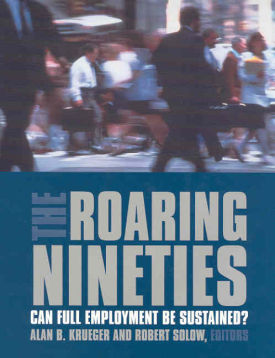
Cover image of the book The Roaring Nineties
Books

The Roaring Nineties

Can Full Employment Be Sustained?
Editors
Alan B. Krueger
Robert Solow
Hardcover
Add to Cart
Publication Date
6.63 in. × 9.25 in. 640 pages
ISBN
978-0-87154-817-7
Also Available From

About This Book

The positive social benefits of low unemployment are many—it helps to reduce poverty and crime and fosters more stable families and communities. Yet conventional wisdom—born of the stagflation of the 1970s—holds that sustained low unemployment rates run the risk of triggering inflation. The last five years of the 1990s—in which unemployment plummeted and inflation remained low—called this conventional wisdom into question. The Roaring Nineties provides a thorough review of the exceptional economic performance of the late 1990s and asks whether it was due to a lucky combination of economic circumstances or whether the new economy has somehow wrought a lasting change in the inflation-safe rate of unemployment.

Led by distinguished economists Alan Krueger and Robert Solow, a roster of twenty-six respected economic experts analyzes the micro- and macroeconomic factors that led to the unexpected coupling of low unemployment and low inflation. The more macroeconomically oriented chapters clearly point to a reduction in the inflation-safe rate of unemployment. Laurence Ball and Robert Moffitt see the slow adjustment of workers' wage aspirations in the wake of rising productivity as a key factor in keeping inflation at bay. And Alan Blinder and Janet Yellen credit sound monetary policy by the Federal Reserve Board with making the best of fortunate circumstances, such as lower energy costs, a strong dollar, and a booming stock market.

Other chapters in The Roaring Nineties examine how the interaction between macroeconomic and labor market conditions helped sustain high employment growth and low inflation. Giuseppe Bertola, Francine Blau, and Lawrence M. Kahn demonstrate how greater flexibility in the U.S. labor market generated more jobs in this country than in Europe, but at the expense of greater earnings inequality. David Ellwood examines the burgeoning shortage of skilled workers, and suggests policies—such as tax credits for businesses that provide on-the-job-training—to address the problem. And James Hines, Hilary Hoynes, and Alan Krueger elaborate the benefits of sustained low unemployment, including budget surpluses that can finance public infrastructure and social welfare benefits—a perspective often lost in the concern over higher inflation rates.

While none of these analyses promise that the good times of the 1990s will last forever, The Roaring Nineties provides a unique analysis of recent economic history, demonstrating how the nation capitalized on a lucky confluence of economic factors, helping to create the longest peacetime boom in American history.

ROBERT SOLOW is Institute Professor Emeritus, M.I.T., and a Nobel laureate in economics.

ALAN KRUEGER is professor of economics at Princeton University.

CONTRIBUTORS: Katharine G. Abraham, Laurence Ball, Giusepe Bertola, Rebecca M. Blank,  Francine D. Blau,  Alan S. Blinder,  Jessica Cohen,  William T. Dickens,  David T. Ellwood,  James R. Hines Jr., Hilary W. Hoynes,  George Johnson,  Lawrence M. Kahn,  Lisa M. Lynch, Robert Moffitt, Stephen J. Nickell,  Adam Posen,  Matthew D. Shapiro,  Robert Shimer,  Matthew J. Slaughter,  Douglas Staiger,  James H. Stock, Janet L. Yellen, Mark W. Watson.


Copublished with The Century Foundation

RSF Journal
View Book Series
Sign Up For Our Mailing List
Apply For Funding
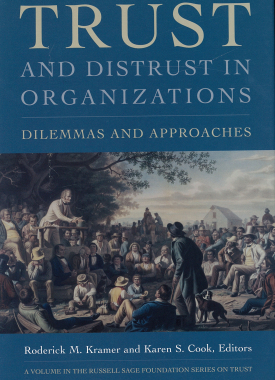
Cover image of the book Trust and Distrust in Organizations
Books

Trust and Distrust in Organizations

Editors
Roderick M. Kramer
Karen S. Cook
Paperback
$34.95
Add to Cart
Publication Date
6 in. × 9 in. 400 pages
ISBN
978-0-87154-486-5
Also Available From

About This Book

The effective functioning of a democratic society—including social, business, and political interactions—largely depends on trust. Yet trust remains a fragile and elusive resource in many of the organizations that make up society's building blocks. In their timely volume, Trust and Distrust in Organizations, editors Roderick M. Kramer and Karen S. Cook have compiled the most important research on trust in organizations, illuminating the complex nature of how trust develops, functions, and often is thwarted in organizational settings. With contributions from social psychologists, sociologists, political scientists, economists, and organizational theorists, the volume examines trust and distrust within a variety of settings—from employer-employee and doctor-patient relationships, to geographically dispersed work teams and virtual teams on the internet.

Trust and Distrust in Organizations opens with an in-depth examination of hierarchical relationships to determine how trust is established and maintained between people with unequal power. Kurt Dirks and Daniel Skarlicki find that trust between leaders and their followers is established when people perceive a shared background or identity and interact well with their leader. After trust is established, people are willing to assume greater risks and to work harder. In part II, the contributors focus on trust between people in teams and networks. Roxanne Zolin and Pamela Hinds discover that trust is more easily established in geographically dispersed teams when they are able to meet face-to-face initially. Trust and Distrust in Organizations moves on to an examination of how people create and foster trust and of the effects of power and betrayal on trust. Kimberly Elsbach reports that managers achieve trust by demonstrating concern, maintaining open communication, and behaving consistently. The final chapter by Roderick Kramer and Dana Gavrieli includes recently declassified data from secret conversations between President Lyndon Johnson and his advisors that provide a rich window into a leader’s struggles with problems of trust and distrust in his administration.

Broad in scope, Trust and Distrust in Organizations provides a captivating and insightful look at trust, power, and betrayal, and is essential reading for anyone wishing to understand the underpinnings of trust within a relationship or an organization.

RODERICK M. KRAMER is the William R. Kimball Professor of Organizational Behavior in the Graduate School of Business, Stanford University.

KAREN S. COOK is Ray Lyman Wilbur Professor of Sociology, Stanford University.

CONTRIBUTORS:  John Brehm, Robin M. Cooper, John M. Darley, Kurt T. Dirks, Amy C. Edmondson, Kimberly D. Elsbach, Scott Gates,  Dana A. Gavrieli, Pamela J. Hinds, Deepak Malhotra, Bill McEvily, Gary J. Miller, Stefanie Bailey Mollborn, J. Keith Murnighan, Helen Nissenbaum, Hakan Ozcelik, Sandra L. Robinson, Daniel P. Skarlicki, Irena Stepanikova, David H. Thom, J. Mark Weber, Akbar Zaheer, Rozanne Zolin. 


A Volume in the Russell Sage Foundation Series on Trust
RSF Journal
View Book Series
Sign Up For Our Mailing List
Apply For Funding
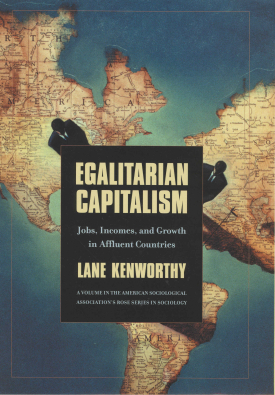
Cover image of the book Egalitarian Capitalism
Books

Egalitarian Capitalism

Jobs, Incomes, and Growth in Affluent Countries
Author
Lane Kenworthy
Publication Date

About This Book

A Volume in the American Sociological Association’s Rose Series in Sociology

Declining participation in labor unions, the movement toward a service-based economy, and increased globalization have cast doubt on the extent to which welfare states can continue to stem inequality in market economies over the long-term. Does the new economy render existing models of social assistance obsolete? Do traditional welfare states hamper economic and employment growth, thereby worsening the plight of the poor? Lane Kenworthy offers a rigorous empirical analysis of these questions in Egalitarian Capitalism. The book examines 16 industrialized countries in North America, Western Europe, and Scandinavia—each with different approaches to assisting the poor—to see how successful each has been in developing its economy and curbing inequality over the past twenty years.

Kenworthy finds that inequality grew in almost all of these countries, from the most progressive to the least. Using simple but powerful statistical tests, he assesses the theory that inequality is necessary to improve economic growth and reduce poverty. He finds no necessary trade-off between equality and economic growth but discovers some evidence that high minimum wages dampen employment growth in private sector services. Kenworthy suggests that without greater private sector employment, public supports may be unable to adequately sustain living standards for the poor. An equitable growth strategy necessitates a balance of policy options: Creating jobs is aided by loose employment regulation, low payroll taxes, and, in some cases, lower real wages for workers at the bottom of the income spectrum. However, high employment is also facilitated by a system that “makes work pay” with earnings subsidies, workplace flexibilities, financial support for those who are between jobs or unable to work, and universal health and child care coverage. Kenworthy suggests that these strategies, though generally presented as mutually exclusive, could be effectively combined to create a robust, fair economy.

Egalitarian Capitalism addresses fundamental questions of national policy with rigorous scholarship and a clarity that makes it accessible to any reader interested in the alleged trade-off between social equity and market efficiency. The book analyzes the viability of traditional welfare regimes and offers sustainable options that can promote egalitarian societies without hampering economic progress.

LANE KENWORTHY is assistant professor of sociology at Emory University.

RSF Journal
View Book Series
Sign Up For Our Mailing List
Apply For Funding
Cover image of the book Egalitarian Capitalism
Books

Egalitarian Capitalism

Jobs, Incomes, and Growth in Affluent Countries
Author
Lane Kenworthy
Paperback
Add to Cart
Publication Date
6 in. × 9 in. 240 pages
ISBN
978-0-87154-452-0
Also Available From

About This Book

A Volume in the American Sociological Association’s Rose Series in Sociology

Declining participation in labor unions, the movement toward a service-based economy, and increased globalization have cast doubt on the extent to which welfare states can continue to stem inequality in market economies over the long-term. Does the new economy render existing models of social assistance obsolete? Do traditional welfare states hamper economic and employment growth, thereby worsening the plight of the poor? Lane Kenworthy offers a rigorous empirical analysis of these questions in Egalitarian Capitalism. The book examines sixteen industrialized countries in North America, Western Europe, and Scandinavia—each with different approaches to assisting the poor—to see how successful each has been in developing its economy and curbing inequality over the past twenty years.

Kenworthy finds that inequality grew in almost all of these countries, from the most progressive to the least. Using simple but powerful statistical tests, he assesses the theory that inequality is necessary to improve economic growth and reduce poverty. He finds no necessary trade-off between equality and economic growth but discovers some evidence that high minimum wages dampen employment growth in private sector services. Kenworthy suggests that without greater private sector employment, public supports may be unable to adequately sustain living standards for the poor. An equitable growth strategy necessitates a balance of policy options: Creating jobs is aided by loose employment regulation, low payroll taxes, and, in some cases, lower real wages for workers at the bottom of the income spectrum. However, high employment is also facilitated by a system that “makes work pay” with earnings subsidies, workplace flexibilities, financial support for those who are between jobs or unable to work, and universal health and child care coverage. Kenworthy suggests that these strategies, though generally presented as mutually exclusive, could be effectively combined to create a robust, fair economy.

Egalitarian Capitalism addresses fundamental questions of national policy with rigorous scholarship and a clarity that makes it accessible to any reader interested in the alleged trade-off between social equity and market efficiency. The book analyzes the viability of traditional welfare regimes and offers sustainable options that can promote egalitarian societies without hampering economic progress.

LANE KENWORTHY is assistant professor of sociology at Emory University.

RSF Journal
View Book Series
Sign Up For Our Mailing List
Apply For Funding
Cover image of the book One Nation Divisible
Books

One Nation Divisible

What America Was and What It Is Becoming
Authors
Michael Katz
Mark Stern
Paperback
$34.95
Add to Cart
Publication Date
6 in. × 9 in. 368 pages
ISBN
978-0-87154-446-9
Also Available From

About This Book

American society today is hardly recognizable from what it was a century ago. Integrated schools, an information economy, and independently successful women are just a few of the remarkable changes that have occurred over just a few generations. Still, the country today is influenced by many of the same factors that revolutionized life in the late nineteenth century—immigration, globalization, technology, and shifting social norms—and is plagued by many of the same problems—economic, social, and racial inequality. One Nation Divisible, a sweeping history of twentieth-century American life by Michael B. Katz and Mark J. Stern, weaves together information from the latest census with a century’s worth of data to show how trends in American life have changed while inequality and diversity have endured.

One Nation Divisible examines all aspects of work, family, and social life to paint a broad picture of the American experience over the long arc of the twentieth century. Katz and Stern track the transformations of the U.S. workforce, from the farm to the factory to the office tower. Technological advances at the beginning and end of the twentieth century altered the demand for work, causing large population movements between regions. These labor market shifts fed both the explosive growth of cities at the dawn of the industrial age and the sprawling suburbanization of today. One Nation Divisible also discusses how the norms of growing up and growing old have shifted. Whereas the typical life course once involved early marriage and living with large, extended families, Americans today commonly take years before marrying or settling on a career path, and often live in non-traditional households. Katz and Stern examine the growing influence of government on trends in American life, showing how new laws have contributed to more diverse neighborhoods and schools, and increased opportunities for minorities, women, and the elderly. One Nation Divisible also explores the abiding economic paradox in American life: while many individuals are able to climb the financial ladder, inequality of income and wealth remains pervasive throughout society.

The last hundred years have been marked by incredible transformations in American society. Great advances in civil rights have been tempered significantly by rising economic inequality. One Nation Divisible provides a compelling new analysis of the issues that continue to divide this country and the powerful role of government in both mitigating and exacerbating them.

MICHAEL B. KATZ is Walter H. Annenberg Professor of History and research associate at the Population Studies Center at the University of Pennsylvania.

MARK J. STERN is professor of social welfare and history in the School of Social Work at the University of Pennsylvania.

A Volume in the RSF Census Series

RSF Journal
View Book Series
Sign Up For Our Mailing List
Apply For Funding
Cover image of the book Poverty and Place
Books

Poverty and Place

Ghettos, Barrios, and the American City
Author
Paul A. Jargowsky
Paperback
$27.95
Add to Cart
Publication Date
6 in. × 9 in. 304 pages
ISBN
978-0-87154-406-3
Also Available From

About This Book

Awarded Best Book in Urban Affairs Published in 1997 / 1998 by the Urban Affairs Association.

One of Choice magazine's Outstanding Academic Books of 1997

"[An] alarming report, a rigorous study packed with charts, tables, 1990 census data and [Jargowsky's] own extensive field work.... His careful analysis of enterprise zones, job-creation strategies, local economic development schemes and housing and tax policies rounds out an essential handbook for policy makers, a major contribution to public debate over ways to reverse indigence." —Publishers Weekly

"A data-rich description and a conceptually innovative explanation of the spread of neighborhood poverty in the United States between 1970 and 1990. Urban scholars and policymakers alike should find Jargowsky's compelling arguments thought-provoking."—Library Journal

"A powerful book that allows us to really understand how ghettos have been changing over time and the forces behind these changes. It should be required reading of anyone who cares about urban poverty." —David Ellwood, Malcolm Wiener Professor of Public Policy, John F. Kennedy School of Government, Harvard University

Poverty and Place documents the geographic spread of the nation's ghettos and shows how economic shifts have had a particularly devastating impact on certain regions, particularly in the rust-belt states of the Midwest. Author Paul Jargowsky's thoughtful analysis of the causes of ghetto formation clarifies the importance of widespread urban trends, particularly those changes in the labor and housing markets that have fostered income inequality and segregated the rich from the poor. Jargowsky also examines the sources of employment that do exist for ghetto dwellers, and describes how education and family structure further limit their prospects. Poverty and Place shows how the spread of high poverty neighborhoods has particularly trapped members of poor minorities, who account for nearly four out of five ghetto residents. Poverty and Place sets forth the facts necessary to inform the public understanding of the growth of concentrated poverty, and confronts essential questions about how the spiral of urban decay in our nation's cities can be reversed.

PAUL A. JARGOWSKY is associate professor of political economy in the School of Social Sciences at the University of Texas, Dallas.

RSF Journal
View Book Series
Sign Up For Our Mailing List
Apply For Funding
Cover image of the book Encountering American Faultlines
Books

Encountering American Faultlines

Race, Class, and the Dominican Experience in Providence
Author
José Itzigsohn
Paperback
$37.50
Add to Cart
Publication Date
6 in. × 9 in. 256 pages
ISBN
978-0-87154-462-9
Also Available From

About This Book

Winner of the 2009 Distinguished Contribution to Research Award from the Latino/a Section of the American Sociological Association


The descendents of twentieth-century southern and central European immigrants successfully assimilated into mainstream American culture and generally achieved economic parity with other Americans within several generations. So far, that is not the case with recent immigrants from Latin America and the Caribbean. A compelling case study of first- and second-generation Dominicans in Providence, Rhode Island, Encountering American Faultlines suggests that even as immigrants and their children increasingly participate in American life and culture, racialization and social polarization remain key obstacles to further progress.

Encountering American Faultlines uses occupational and socioeconomic data and in-depth interviews to address key questions about the challenges Dominicans encounter in American society. What is their position in the American socioeconomic structure? What occupations do first- and second-generation Dominicans hold as they enter the workforce? How do Dominican families fare economically? How do Dominicans identify themselves in the American racial and ethnic landscape?

The first generation works largely in what is left of Providence’s declining manufacturing industry. Second-generation Dominicans do better than their parents economically, but even as some are able to enter middle-class occupations, the majority remains in the service-sector working class. José Itzigsohn suggests that the third generation will likely continue this pattern of stratification, and he worries that the chances for further economic advancement in the next generation may be seriously in doubt.

While transnational involvement is important to first-generation Dominicans, the second generation concentrates more on life in the United States and empowering their local communities. Itzigsohn ties this to the second generation’s tendency to embrace panethnic identities. Panethnic identity provides Dominicans with choices that defy strict American racial categories and enables them to build political coalitions across multiple ethnicities.

This intimate study of the Dominican immigrant experience proposes an innovative theoretical approach to look at the contemporary forms and meanings of becoming American. José Itzigsohn acknowledges the social exclusion and racialization encountered by the Dominican population, but he observes that, by developing their own group identities and engaging in collective action and institution building at the local level, Dominicans can distinguish themselves and make inroads into American society. But Encountering American Faultlines also finds that hard work and hope have less to do with their social mobility than the existing economic and racial structures of U.S. society.


JOSÉ ITZIGSOHN is associate professor of sociology at Brown University.


RSF Journal
View Book Series
Sign Up For Our Mailing List
Apply For Funding