Recent studies find that legislators are more responsive to the interests of the affluent than to those of middle and lower-income voters. The wealthiest donors account for increasing proportions of political donations, which have been identified as a source of political influence. Some scholars have probed the institutional and network ties among wealthy donors. But scholars have overlooked the sustained efforts of organized groups and networks of donors who work together over many years, not just during elections, to influence political outcomes.
When crafting and voting on legislation, do elected officials consider whether regulation or deregulation of specific industries is likely to affect their personal investments? For instance, will a legislator’s ownership of banking stocks influence his or her choices to support or oppose financial industry regulation? Are legislators with real estate investments more likely to view policies focused on homeowners or renters differently than other legislators?
- June 2019: Additional funding of $25,000 awarded
RSF-funded research by Aliya Saperstein and Andrew Penner illustrated that people who identified as white were more likely to later identify as non-white after encountering stigmatizing experiences—such as unemployment—relative to those who did not encounter those experiences.
Books
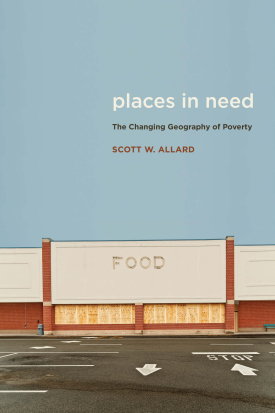
Places in Need
The Changing Geography of Poverty
About This Book
“Scott W. Allard is one of the nation’s foremost experts on poverty, and Places in Need is a tour de force. This carefully-researched book offers more than innovative economic analysis and important lessons for social policy. It represents a deeply moral call to update our thinking about vulnerable people across America and rethink outdated assumptions about how to assist them. Places in Need must become required reading for anyone who seeks to understand modern American poverty, let alone begin to combat it.”
—Arthur Brooks, president, American Enterprise Institute
“Places in Need tells the story of how poverty has grown dramatically in suburban America due to displacement, immigration, and job loss and how the existing social safety net is ill-equipped to address this new challenge. Scott W. Allard’s analysis expertly marshals both quantitative and qualitative data to give a nuanced account of the difficulties of meeting social needs in suburban locales. His insights and policy recommendations should be carefully studied by policymakers and social service providers as they come to grips with this new reality.”
—Paul Jargowsky, Professor of Public Policy, Rutgers University, Camden
“An exceptionally rich book that astutely focuses on key current issues related to the geography of poverty in the United States and trends therein. Scott W. Allard’s analysis is impressive in both its breadth and depth. His insights regarding the implications of geographic location for anti-poverty policy—how best to support low-income individuals and families in urban, suburban, and rural areas—make Places in Need essential reading for scholars, policymakers, and policy practitioners alike.”
—Lawrence M. Berger, Vilas Distinguished Achievement Professor of Social Work and director, Institute for Research on Poverty, University of Wisconsin
Americans think of suburbs as prosperous areas that are relatively free from poverty and unemployment. Yet, today more poor people live in the suburbs than in cities themselves. In Places in Need, social policy expert Scott W. Allard tracks how the number of poor people living in suburbs has more than doubled over the last 25 years, with little attention from either academics or policymakers. Rising suburban poverty has not coincided with a decrease in urban poverty, meaning that solutions for reducing poverty must work in both cities and suburbs. Allard notes that because the suburban social safety net is less developed than the urban safety net, a better understanding of suburban communities is critical for understanding and alleviating poverty in metropolitan areas.
Using census data, administrative data from safety net programs, and interviews with nonprofit leaders in the Chicago, Los Angeles, and Washington, D.C. metropolitan areas, Allard shows that poor suburban households resemble their urban counterparts in terms of labor force participation, family structure, and educational attainment. In the last few decades, suburbs have seen increases in single-parent households, decreases in the number of college graduates, and higher unemployment rates. As a result, suburban demand for safety net assistance has increased. Concerning is evidence suburban social service providers—which serve clients spread out over large geographical areas, and often lack the political and philanthropic support that urban nonprofit organizations can command—do not have sufficient resources to meet the demand.
To strengthen local safety nets, Allard argues for expanding funding and eligibility to federal programs such as SNAP and the Earned Income Tax Credit, which have proven effective in urban and suburban communities alike. He also proposes to increase the capabilities of community-based service providers through a mix of new funding and capacity-building efforts.
Places in Need demonstrates why researchers, policymakers, and nonprofit leaders should focus more on the shared fate of poor urban and suburban communities. This account of suburban vulnerability amidst persistent urban poverty provides a valuable foundation for developing more effective antipoverty strategies.
SCOTT W. ALLARD is professor of public policy at the University of Washington’s Daniel J. Evans School of Public Policy and Governance.
RSF Journal
View Book Series
Sign Up For Our Mailing List
Apply For Funding
Compared to the overall foreign-born population and to the native-born, Asian immigrants generally have higher levels of educational attainment and higher household incomes. They also make up the largest share of post-2009 immigrants—36 percent of these arrivals are Asian, compared to 31 percent Latino.
In a political climate marked by calls to ban Muslims from entering the country, tensions between non-Muslim and Muslim Arab Americans have intensified. How does this environment affect relationships between Muslim Arabs and other Americans? Can prejudice between the groups be reduced? And finally, can such reactions have long-lasting effects?