About This Book
A report of a 1915 study of child welfare agencies in Pennsylvania, with recommendations for improving conditions.
WILLIAM H. SLINGERLAND was a special agent in the Department of Child-Helping of the Russell Sage Foundation.
A report of a 1915 study of child welfare agencies in Pennsylvania, with recommendations for improving conditions.
WILLIAM H. SLINGERLAND was a special agent in the Department of Child-Helping of the Russell Sage Foundation.
A manual prepared in 1918 for the strengthening and standardization of the practice of placing orphaned or foster children in homes.
WILLIAM H. SLINGERLAND was a special agent in the Department of Child-Helping of the Russell Sage Foundation.
An address delivered before the Social Workers Section of the Southern Sociological Congress, in New Orleans in April 1916.
WILLIAM H. SLINGERLAND was a special agent in the Department of Child-Helping of the Russell Sage Foundation.
Twenty five papers contributed as supplement to "Child Welfare Work in Pennsylvania", a cooperative study of child-helping agencies and institutions.
WILLIAM H. SLINGERLAND was a special agent in the Department of Child-Helping of the Russell Sage Foundation.
CONTRIBUTORS: Charlotte Abbey, Joseph A. Beck, William Bradford Buck, Iva E. Burr, J. Bruce Byall, Bele Chalfant, Thomas F. Coakley, Rudolph I. Coffee, William A. Credditt, Max C. Currick, Aaron D. Faber, Martha P. Falconer, Mrs. Henry Finkelpearl, Alexander Fleisher, James Struthers Heberling, L. Walter Mason, Bernard J. Newman, F. H. Nibecker, Mrs. E. A. Puncheon, Bertha Rauh, H.P. Richardson, William H. Slingerland, Edwin D. Solenberger, Roy Smith Wallace, Bromley Wharton, Frank D. Witherbee
A study and recommendations on the care and cure of enuresis, or, bedwetting, in child-care institutions.
WILLIAM H. SLINGERLAND was a special agent in the Department of Child-Helping of the Russell Sage Foundation.
This book defines and explains the social case history. Published in 1920 as a guide for social scientists, it argues that case history is defined by its intended purpose; namely, the immediate purpose of furthering effective treatment of individual clients, the ultimate purpose of general social betterment, or the incidental purpose of establishing the case worker herself in critical thinking.
ADA ELIOT SHEFFIELD was director of the Boston Bureau on Illegitimacy.
This book, published in 1920, examines a then-recent phenomenon of combining educational material and presentations with transportation facilities: the putting of exhibits, demonstrations, films, and other campaigning equipment on railroad trains, trolley cars, and motor trucks so that they may tour a large area of land. These vehicles were used to teach health, sanitation, and safety. Presented here is a review of these practices, with commentary by the author, aiming to stimulate the creation of new forms of illustrative material.
MARY SWAIN ROUTZAHN was director at the Department of Social Work Interpretation of the Russell Sage Foundation.
A study of health and education conditions of two hundred children at the New York Orphanage. The research was first presented in a series of fourteen articles between 1906-1908.
RUDOLPH R. REEDER was superintendent of the Cottage Homes and School of the Orphan Asylum Society in the City of New York
A survey of health conditions in Topeka, Kansas in 1914, in four parts:
A Public Health Survey of Topeka by Franz Schenider, Jr.
Delinquency and Corrections by Zenas L. Potter
Municipal Administration in Topeka by D.O. Decker
Industrial Conditions in Topeka by Zenas L. Potter
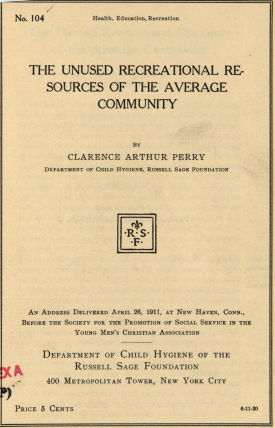
Address given before the Society for the Promotion of Social Service in the Young Men's Christian Association, New Haven, 1911.
CLARENCE ARTHUR PERRY, Department of Child Hygiene, Russell Sage Foundation