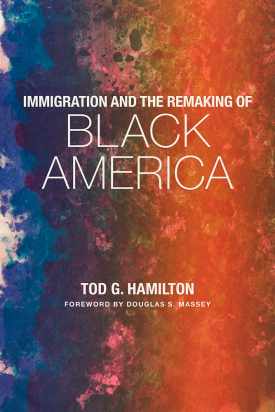
Cover image of the book Immigration and the Remaking of Black America
Books

Immigration and the Remaking of Black America

Author
Tod G. Hamilton
Paperback
$35.00
Add to Cart
Publication Date
6 in. × 9 in. 314 pages
ISBN
978-0-87154-407-0
Also Available From

About This Book

Winner of the 2020 Otis Dudley Duncan Award for Outstanding Scholarship in Social Demography

Honorable Mention for the 2020 Thomas and Znaniecki Award from the International Migration Section of the American Sociological Association

“Using the best available data, state-of-the-art analytical strategies, and sophisticated theoretical framing, Immigration and the Remaking of Black America offers the definitive statement about the diverse experiences of black immigrants to the United States and how they compare to their native-born African American counterparts. Professor Hamilton has unquestionably raised the bar for future scholars who would seek to further advance our understanding of this important, but heretofore poorly understood, population.”
—STEWART E. TOLNAY, S. Frank Miyamoto Professor Emeritus of Sociology, University of Washington

“In the most comprehensive study to date of voluntary black immigration to the United States, Tod Hamilton conducts a tempered and temperate demolition on cherished conventional claims about race, national origin, immigration, and social outcomes. Hamilton’s systematic comparisons of the characteristics and experiences of recent black immigrants vis-à-vis their fellow nationals who remain in their home country, of internal black migrants to the north vis-à-vis those blacks who remained in the south, and of recent black immigrants vis-à-vis the native black American population writ large eradicate cultural-cum-behavioral explanations for ongoing racial inequality in the United States. Immigration and the Remaking of Black America is a masterful study.”
—WILLIAM A. DARITY JR., Samuel DuBois Cook Professor of Public Policy, Professor of African and African American Studies, and Professor of Economics, Duke University

Immigration and the Remaking of Black America teaches us what it means to be black in America today. Its author, Tod G. Hamilton, provides a timely and accessible theoretical and empirical demographic benchmark describing America’s newest black immigrants. More importantly, Hamilton sets today’s black immigrant experience in comparison with native-born black Americans, who still feel the ancestral sting of forced migration from a much earlier and shameful period in U.S. history. America’s burgeoning immigrant and refugee populations from sub-Saharan Africa are too often overlooked but can tell us a great deal about contemporary race relations, race and class dynamics, and immigrant integration in a multiracial society. Immigration and the Remaking of Black America fills the current void.”
—DANIEL T. LICHTER, Ferris Family Professor, Cornell University

Over the last four decades, immigration from the Caribbean and sub-Saharan Africa to the U. S. has increased rapidly. In several states, African immigrants are now the primary drivers of growth in the black population. While social scientists and commentators have noted that these black immigrants’ social and economic outcomes often differ from those of their native-born counterparts, few studies have carefully analyzed the mechanisms that produce these disparities. In Immigration and the Remaking of Black America, sociologist Tod Hamilton shows how immigration is reshaping black America. He weaves together interdisciplinary scholarship with new data to enhance our understanding of the causes of socioeconomic stratification among both the native-born and newcomers.

Hamilton demonstrates that immigration from the Caribbean and sub-Saharan Africa is driven by selective migration, meaning that newcomers from these countries tend to have higher educational attainment and better health than those who stay behind. As a result, they arrive in the U.S. with some advantages over native-born blacks, and, in some cases, over whites. He also shows the importance of historical context: prior to the Civil Rights Movement, black immigrants’ socioeconomic outcomes resembled native-born blacks’ much more closely, regardless of their educational attainment in their country of origin. Today, however, certain groups of black immigrants have better outcomes than native-born black Americans—such as lower unemployment rates and higher rates of homeownership—in part because they immigrated at a time of expanding opportunities for minorities and women in general. Hamilton further finds that rates of marriage and labor force participation among native-born blacks that move away from their birth states resemble those of many black immigrants, suggesting that some disparities within the black population stem from processes associated with migration, rather than from
nativity alone.

Hamilton argues that failing to account for this diversity among the black population can lead to incorrect estimates of the social progress made by black Americans and the persistence of racism and discrimination. He calls for future research on racial inequality to disaggregate different black populations. By richly detailing the changing nature of black America, Immigration and the Remaking of Black America helps scholars and policymakers to better understand the complexity of racial disparities in the twenty-first century.

TOD G. HAMILTON is assistant professor of sociology at Princeton University.
RSF Journal
View Book Series
Sign Up For Our Mailing List
Apply For Funding
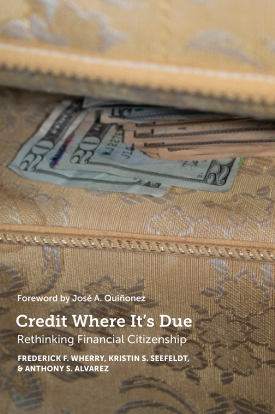
Cover image of the book Credit Where It’s Due
Books

Credit Where It’s Due

Rethinking Financial Citizenship
Authors
Frederick F. Wherry
Kristin S. Seefeldt
Anthony S. Alvarez
Paperback
$29.95
Add to Cart
Publication Date
6 in. × 9 in. 176 pages
ISBN
978-0-87154-866-5
Also Available From

About This Book

“Working hard and playing by the rules still casts aside millions. Credit Where It’s Due tells the inspiring story of the Mission Asset Fund’s pathway to belonging and financial citizenship. Inspired and well crafted, this book builds the case for making and illuminates how to make citizenship, immigrant integration, and democracy work for organizations, advocates, and anybody committed to building a better society.”
—THOMAS M. SHAPIRO, director and David R. Pokross Professor of Law and Social Policy, Institute on Assets and Social Policy, The Heller School, Brandeis University

Credit Where It’s Due is an original and masterful examination that goes well beyond the crowded scholarly field of finance and economic exploitation to document the ways in which systems of finance stratify society in areas as basic as human decency, belonging, and recognition. But, far from simply a doom and gloom story, the book presents financial alternatives grounded in the depth of contemporary personal narratives of how finance can be dignity affirming and structured to empower rather than socially degrading and exploitive. This book will advance the field in profound ways.”
—DARRICK HAMILTON, executive director, Kirwan Institute for the Study of Race and Ethnicity, The Ohio State University

An estimated 45 million adults in the U.S. lack a credit score at time when credit invisibility can reduce one’s ability to rent a home, find employment, or secure a mortgage or loan. As a result, individuals without credit—who are disproportionately African American and Latino—often lead separate and unequal financial lives. Yet, as sociologists and public policy experts Frederick Wherry, Kristin Seefeldt, and Anthony Alvarez argue, many people who are not recognized within the financial system engage in behaviors that indicate their credit worthiness. How might institutions acknowledge these practices and help these people emerge from the financial shadows? In Credit Where It’s Due, the authors evaluate an innovative model of credit-building and advocate for a new understanding of financial citizenship, or participation in a financial system that fosters social belonging, dignity, and respect.

Wherry, Seefeldt, and Alvarez tell the story of the Mission Asset Fund, a San Francisco-based organization that assists mostly low and moderate-income people of color with building credit. The Mission Asset Fund facilitates zero-interest lending circles, which have been practiced by generations of immigrants, but have gone largely unrecognized by mainstream financial institutions. Participants decide how the circles are run and how they will use their loans, and the organization reports their clients’ lending activity to credit bureaus. As the authors show, this system not only helps clients build credit, but also allows them to manage debt with dignity, have some say in the creation of financial products, and reaffirm their sense of social membership. The authors delve into the history of racial wealth inequality in the U.S. to show that for many black and Latino households, credit invisibility is not simply a matter of individual choices or inadequate financial education. Rather, financial marginalization is the result of historical policies that enabled predatory lending, discriminatory banking and housing practices, and the rollback of regulatory protections for first-time homeowners.

To rectify these inequalities, the authors propose common sense regulations to protect consumers from abuse alongside new initiatives that provide seed capital for every child, create affordable short-term loans, and ensure that financial institutions treat low- and moderate income clients with equal respect. By situating the successes of the Mission Asset Fund in the larger history of credit and debt, Credit Where It’s Due shows how to prioritize financial citizenship for all.

FREDERICK F. WHERRY is professor of sociology at Princeton University.
KRISTIN S. SEEFELDT is associate professor of social work and associate professor of public policy at the University of Michigan.

ANTHONY S. ALVAREZ is assistant professor of sociology at California State University, Fullerton.

RSF Journal
View Book Series
Sign Up For Our Mailing List
Apply For Funding
Cover image of the book A Survey of the Public Health Situation: Atlanta, Georgia
Books

A Survey of the Public Health Situation: Atlanta, Georgia

Author
Franz Schneider Jr.
Ebook
Publication Date
22 pages
RSF Journal
View Book Series
Sign Up For Our Mailing List
Apply For Funding
Cover image of the book Inter-relation of Social Movements
Books

Inter-relation of Social Movements

With Information About Sixty-Seven Organizations
Author
The Charity Organization Department of the Russell Sage Foundation
Ebook
Publication Date
32 pages

About This Book

This 1910 pamphlet presents a list of various social movement agencies or organizations with a brief statement of their purposes and plans, with the aim of promoting acquaintance and working together. Prepared by the Charity Organization Deaprtment of the Russell Sage Foundation.

RSF Journal
View Book Series
Sign Up For Our Mailing List
Apply For Funding
Cover image of the book Graphic Exhibits on Food Conservation at Fairs and Expositions
Books

Graphic Exhibits on Food Conservation at Fairs and Expositions

Authors
Evart G. Routzahn
Mary Swain Routzahn
Ebook
Publication Date
31 pages

About This Book

A study of food conservation efforts as documented across exhibits and demonstrations at state, district, and county fairs in the United States, focusing on efforts to conserve wheat and fats.

EVART G. ROUTZAHN was associate director of the Department of Surveys and Exhibits at the Russell Sage Foundation.

MARY SWAIN ROUTZAHN was director of the Department of Social Work Interpretation at the Russell Sage Foundation. 

RSF Journal
View Book Series
Sign Up For Our Mailing List
Apply For Funding
Cover image of the book American Red Cross Famine Relief in China, 1920-1921
Books

American Red Cross Famine Relief in China, 1920-1921

Report of the China Famine Relief American Red Cross
Author
Donald S. Howard
Ebook
Publication Date
250 pages

About This Book

This report details the American Red Cross's operations through the China Famine Relief, from its inception in 1920 to the closing of  offices in 1921.

Donald S. Howard was assistant director of the Charity Organization Department of the Russell Sage Foundation.

RSF Journal
View Book Series
Sign Up For Our Mailing List
Apply For Funding
Cover image of the book The American Relief Administration in Russia, 1921-1923
Books

The American Relief Administration in Russia, 1921-1923

From the Operations of the American Relief Administration
Author
H.H. Fisher
Ebook
Publication Date
27 pages

About This Book

Part of the Occasional Papers series, this pamphlet details the American Relief Administration's planning and administering of relief in Russia between 1921 and 1923.

H. H. Fisher was a member of the American Relief Administration.

RSF Journal
View Book Series
Sign Up For Our Mailing List
Apply For Funding
Cover image of the book For a Safe and Sane Fourth
Books

For a Safe and Sane Fourth

Author
Julia Hyneman Barnett Rice
Ebook
Publication Date
20 pages

About This Book

From "The Forum" for March, 1910, detailing efforts at reforming and regulating dangerous fireworks celebrations for Independence Day.

Julia Hyneman Barnett Rice was a member of the Department of Child Hygiene of the Russell Sage Foundation.

RSF Journal
View Book Series
Sign Up For Our Mailing List
Apply For Funding
Cover image of the book What Is Organized Charity?
Books

What Is Organized Charity?

Ten Pertinent Questions Briefly Answered
Author
The Charity Organization Department
Ebook
Publication Date
16 pages

About This Book

A 1910 pamphlet published by the Charity Organization Department of the Russell Sage Foundation explaining the work and aims of associated charities and their role in society.

RSF Journal
View Book Series
Sign Up For Our Mailing List
Apply For Funding
Cover image of the book Golden Years?
Books

Golden Years?

Social Inequality in Later Life
Author
Deborah Carr
Paperback
$35.00
Add to Cart
Publication Date
6 in. × 9 in. 376 pages
ISBN
978-0-87154-034-8
Also Available From

About This Book

A Volume in the American Sociological Association’s Rose Series in Sociology

Winner of the 2020 Gerontological Society of America’s Richard Kalish Innovation Publication Award

“Comprehensive, cogent, and carefully researched, Golden Years? provides a window onto the realities, risks, and disparities confronting the burgeoning numbers moving to and through life after age sixty-five. But Deborah Carr also showcases possibilities—ways governments, communities, and families can rewrite the scripts of later adulthood in ways that promote greater equality and life quality. This book is must reading for understanding both aging and our aging society—for individuals, family members, students, scholars, and policy makers. An instant classic!”
—PHYLLIS MOEN, director, Life Course Center and McKnight Endowed Presidential Chair in Sociology, University of Minnesota

“Deborah Carr provides an engaging and clearly written analysis of the key questions and controversies driving social science aging research. Golden Years? is essential reading for everyone from those engaged in this research to students who are being exposed to the topic for the first time.”
—PAMELA HERD, professor, McCourt School of Public Policy, Georgetown University

Thanks to advances in technology, medicine, Social Security, and Medicare, old age for many Americans is characterized by comfortable retirement, good health, and fulfilling relationships. But there are also millions of people over 65 who struggle with poverty, chronic illness, unsafe housing, social isolation, and mistreatment by their caretakers. What accounts for these disparities among older adults? Sociologist Deborah Carr’s Golden Years? draws insights from multiple disciplines to illuminate the complex ways that socioeconomic status, race, and gender shape nearly every aspect of older adults’ lives. By focusing on an often-invisible group of vulnerable elders, Golden Years? reveals that disadvantages accumulate across the life course and can diminish the well-being of many.

Carr connects research in sociology, psychology, epidemiology, gerontology, and other fields to explore the well-being of older adults. On many indicators of physical health, such as propensity for heart disease or cancer, black seniors fare worse than whites due to lifetimes of exposure to stressors such as economic hardships and racial discrimination and diminished access to health care. In terms of mental health, Carr finds that older women are at higher risk of depression and anxiety than men, yet older men are especially vulnerable to suicide, a result of complex factors including the rigid masculinity expectations placed on this generation of men. Carr finds that older adults’ physical and mental health are also closely associated with their social networks and the neighborhoods in which they live. Even though strong relationships with spouses, families, and friends can moderate some of the health declines associated with aging, women—and especially women of color—are more likely than men to live alone and often cannot afford home health care services, a combination that can be isolating and even fatal. Finally, social inequalities affect the process of dying itself, with white and affluent seniors in a better position to convey their end-of-life preferences and use hospice or palliative care than their disadvantaged peers.

Carr cautions that rising economic inequality, the lingering impact of the Great Recession, and escalating rates of obesity and opioid addiction, among other factors, may contribute to even greater disparities between the haves and the have-nots in future cohorts of older adults. She concludes that policies such as income supplements for the poorest older adults, expanded paid family leave, and universal health care could ameliorate or even reverse some disparities.

A comprehensive analysis of the causes and consequences of later-life inequalities, Golden Years? demonstrates the importance of increased awareness, strong public initiatives, and creative community- based programs in ensuring that all Americans have an opportunity to age well.

DEBORAH CARR is professor and chair of sociology at Boston University

RSF Journal
View Book Series
Sign Up For Our Mailing List
Apply For Funding