About This Book
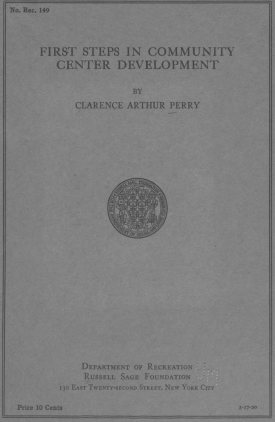
A pamphlet promoting the after-class use of school buildings for recreational, social, and civic community activities.
CLARENCE ARTHUR PERRY, Department of Child Hygiene, Russell Sage Foundation
A pamphlet promoting the after-class use of school buildings for recreational, social, and civic community activities.
CLARENCE ARTHUR PERRY, Department of Child Hygiene, Russell Sage Foundation
A report on the community center sessions at the N.E.A. Department of Superintendence meeting, Cleveland, February 1920 Published by the Department of Recreation of the Russell Sage Foundation.
CLARENCE ARTHUR PERRY, Department of Recreation, Russell Sage Foundation
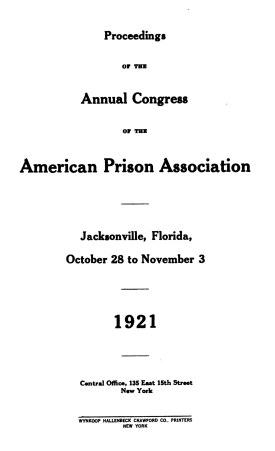
All the reports presented at the fifty-first Annual Congress of the American Prison Association in 1921. The subjects of the papers are wide in scope, many relating not only to the administration of prisons and the treatment of prisoners, but to probation, parole, mental health, juvenile delinquency, and other related subjects.
C. B. ADAMS was president of the American Prison Association.
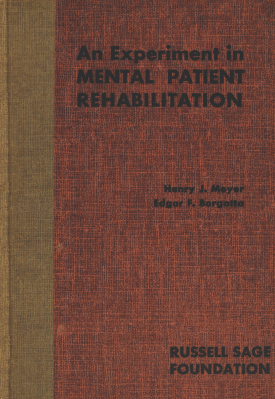
This report of research conducted at Altro Health and Rehabilitation Services was designed to develop a comparable fund of reported experiences of evaluative studies of mental health carried out in social welfare settings. It evaluates the program at Altro from the rehabilitation of post-hospitalized mental patients, based on research and in depth analysis on the resulting data.
HENRY J. MEYER was professor of social work and sociology at the University of Michigan.
EDGAR F. BORGATTA was social psychologist at the Russell Sage Foundation.
A volume of the Springfield survey of 1915. Published by the Department of Surveys and Exhibits of the Russell Sage Foundation.
FRANCIS H. McLEAN, Family Service Association of America.
Presented at the fifty-first congress of the American Prison Association in 1921, this paper presents the structure of the Westchester County Penitentiary, whose prisoners are employed on the farm the penitentiary rests on. It argues that, instead of being a liability to the county, the prison is an asset, and that, instead of being a place of punishment, it is a training school that returns its wards to society as better men because of their experiences on the farm. Key to this system is that the prisoners are self-governing through a method of classification and rewards that is outlined in detail in this paper.
V. EVERIT MACY was commissioner of public welfare, Westchester County, N.Y.
An analysis of how organized charities can work efficiently to best treat families in need in regards to health, education, employment, recreation, and spiritual development.
PORTER R. LEE was general secretary of the Philadelphia Society for Organizing Charity
A volume of the Pittsburgh Survey, carried out by the Russell Sage Foundation in 1914.
PAUL UNDERWOOD KELLOGG was director of the Pittsburgh Survey.
A volume of the Pittsburgh Survey carried out by the Russell Sage Foundation in 1914, focusing on Pittsburgh's history and growth, civic conditions, and education, recreation, and institutional facilities.
PAUL UNDERWOOD KELLOGG was director of the Pittsburgh Survey.
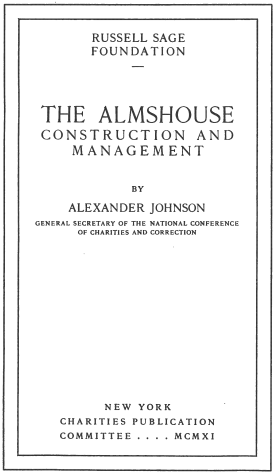
Written by Alexander Johnson, a former inspector of almshouses, in 1911, The Almshouse: Construction and Management is a detailed look at the successful practices of various charity institutions around the world. The book also touches on several ineffective aspects behind badly managed almshouses witnessed by the author firsthand. Topics range from proper living-quarter design to mental health and to strategies for efficient administration. Drawing upon his experiences, as well as the reports of various state boards of charity, Johnson depicts what makes a well-managed, comfortable place for poor people to live in.
ALEXANDER JOHNSON was general secretary of the National Conference of Charities and Correction.