This feature is part of an ongoing RSF blog series, Work in Progress, which highlights some of the research of our current class of Visiting Scholars.
Paul Osterman (MIT) is co-author of the 2011 RSF book Good Jobs America and a current Visiting Scholar. During his time in residence, Osterman is examining strategies for improving job quality in the low-wage labor market, specifically through initiatives that encourage employers to improve their human resource policies. In order to aid the development of policies that lead to better wages and benefits in the private sector, he will investigate the conditions that incentivize firms to improve their employment practices, focusing on the health care and manufacturing industries.
In a new interview with the Foundation, Osterman focused on low-wage home care aides, discussing the existing barriers to increasing their pay, and offering solutions for improving job quality for this group in the future.
Q. Your current research examines the plight of low-wage home care aides. What makes this group of workers especially vulnerable in ways that other professions in the medical industry are not?
RSF trustee Larry M. Bartels (Vanderbilt University) and former RSF Visiting Scholar Philip E. Tetlock (University of Pennsylvania) were recently named 2015 Andrew Carnegie Fellows. They will join an inaugural class of 30 other scholars, journalists, and authors as part of the Carnegie Corporation’s annual fellowship program that provides support for researchers in the social sciences and humanities.
Larry Bartels is currently May Werthan Shayne Chair of Public Policy and Social Science at Vanderbilt University. His scholarly work focuses on American democracy, including public opinion, electoral politics, public policy, and representation. His most recent book, Unequal Democracy (2008), was cited by Barack Obama on the campaign trail and appeared on the New York Times’ list of economics books of the year. Bartels is also a contributor to the RSF book Inequality and American Democracy (2007) and continues to serve on the RSF board of trustees.
Philip Tetlock is currently Leonore Annenberg University Professor of Psychology and Management at the University of Pennsylvania. During his time in residence at the Russell Sage Foundation (2005-2006), Tetlock studied the political implications of the ways in which people make decisions and systematically err in judgment. His work explored the decision-making of political experts, the ways in which a society’s moral boundaries limit new thinking, and how a person’s willingness to consider historical counterfactuals relates to their understanding of the past and the future.
 A sobering new report in the New York Times reveals the disproportionate number of black men “missing” from their communities due to incarceration or early deaths. The Times found that black women between the ages of 25 to 54 who are not incarcerated outnumber black men in that category by 1.5 million. Furthermore, about 900,000 fewer black men than women are alive today due to high mortality rates caused by homicide, heart disease, and respiratory disease—conditions that afflict black men more than any other demographic group.
Topping the list of places with the highest proportion of these “missing” black men was Ferguson, Missouri, the site of the racially charged police shooting of Michael Brown last November. As the authors of the article put it, “More than one out of every six black men who today should be between 25 and 54 years old have disappeared from daily life.”
The Times quoted Russell Sage Foundation author Becky Pettit (University of Texas-Austin), who stated, “The numbers are staggering.” Her book Invisible Men: Mass Incarceration and the Myth of Black Progress, published in 2012 by the Russell Sage Foundation, explores the extent to which mass incarceration has excluded scores of black men from national surveys, thereby concealing decades of racial inequality. As Pettit shows, because prison inmates are not included in most survey data, statistics that seem to indicate a narrowing black-white racial gap—on educational attainment, work force participation, and earnings—instead fail to capture persistent racial, economic, and social disadvantage among African Americans.
 The Russell Sage Foundation is very pleased to announce the establishment of the Margaret Olivia Sage Scholars program, which provides the opportunity for distinguished social scientists to spend brief periods in residence at the Russell Sage Foundation. The program is named in honor of RSF’s founder, Margaret Olivia Sage. Margaret Olivia Sage (MOS) Scholars are selected by the Foundation's Board of Trustees on the basis of their outstanding career accomplishments. While in residence at RSF, they will pursue their own research and participate in the intellectual activities of the Foundation through mentoring the annual class of Visiting Scholars and advising the President and program officers about both new and ongoing research initiatives.
Robert M. Solow continues as the Foundation’s Robert K. Merton Scholar, a position he has held since 2001. The Merton Scholar recognizes the enduring contributions of an eminent scholar to the social sciences. Solow, Institute Professor Emeritus at M.I.T., was Nobel Laureate in Economics in 1987.
In addition, each year RSF selects a class of 16-17 Visiting Scholars based on external peer review of submitted applications.
We are pleased to announce the first group of Margaret Olivia Sage Scholars who will be visiting the Foundation during the next several academic years:
Books
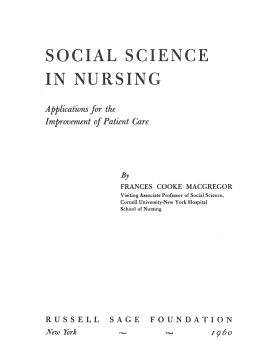
Social Science in Nursing
Applications for the Improvement of Patient Care
Publication Date
354 pages
About This Book
Social Science in Nursing was the product of a three year project examining the application of the social sciences to nursing, conducted at the Cornell University-New York Hospital School of Nursing.
FRANCES COOK MACGREGOR was visiting associate professor of social science at Cornell University-New York Hospital School of Nursing.
Download
RSF Journal
View Book Series
Sign Up For Our Mailing List
Apply For Funding
Books
Immigrant Gifts to American Life
Contributions of Our Foreign-Born Citizens to American Culture
Publication Date
185 pages
About This Book
Immigrant Gifts to American Life, published in 1932, describes the purpose and content of the Buffalo Exhibition and other similar expositions. The Buffalo Exhibition was a public show of the arts and skills foreigners have brought and contributed to in the United States, under the direction of Allen H. Eaton, author of this book and at that time field secretary of the American Federation of Arts. They utilized a common interest in the aesthetic values men live by to promote a better understanding of social and civic values.
ALLEN H. EATON, Department of Surveys and Exhibits, Russell Sage Foundation
Download
RSF Journal
View Book Series
Sign Up For Our Mailing List
Apply For Funding
Books
Disasters
And the American Red Cross in Disaster Relief
Publication Date
229 pages
About This Book
A collection of principles and methods for the application of disaster relief, this book explains the essential problems present in a variety of calamities, as well as the procedures determined best to deal with them effectively, based on the experience of the American Red Cross.
J. BYRON DEACON was general secretary of the Philadelphia Society for Organizing Charity and division director of Civilian Relief for Pennsylvania.