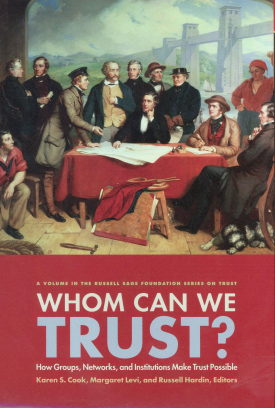
Whom Can We Trust?
About This Book
“This collection of essays from diverse scholars will become a standard reference book for those interested in the conditions generating trust and the effects of trust in interpersonal relations, groups, networks, organizations, and institutional systems. Taken together, the essays provide new explanatory insights on the properties and dynamics of trust at the micro, meso, and macro levels of social reality. Theoretical insights are illustrated with data collected by a range of methodologies and in a wide range of settings. Whom Can We Trust? is a book that will appeal to researchers and theorists within academia, but equally significant, it is a book that will prove useful to policy makers and applied social scientists dealing with real-world problems. Thus, for anyone interested in the mechanisms underpinning social relations and patterns of social organization, this book is a ‘must-read.’”
—Jonathan H. Turner, University of California, Riverside
“Whom Can We Trust? continues the highly successful Russell Sage Foundation series of volumes on trust. The central contribution of this volume is an examination of the factors facilitating trust-based cooperation. The chapters draw upon both laboratory and field research findings to provide a rich set of insights into the variety of social and institutional frameworks through which groups, organizations, and societies enable people to act based upon trust in others. This volume is relevant to everyone interested in the concept of trust but will be especially valuable to those whose focus is upon how to encourage cooperation in social settings.”
—Tom R. Tyler, New York University
Conventional wisdom holds that trust is essential for cooperation between individuals and institutions—such as community organizations, banks, and local governments. Not necessarily so, according to editors Karen Cook, Margaret Levi, and Russell Hardin. Cooperation thrives under a variety of circum-stances. Whom Can We Trust? examines the conditions that promote or constrain trust and advances our understanding of how cooperation really works.
From interpersonal and intergroup relations to large-scale organizations, Whom Can We Trust? uses empirical research to show that the need for trust and trustworthiness as prerequisites to cooperation varies widely. Part I addresses the sources of group-based trust. One chapter focuses on the assumption—versus the reality—of trust among coethnics in Uganda. Another examines the effects of social-network position on trust and trustworthiness in urban Ghana and rural Kenya. And a third demonstrates how cooperation evolves in groups where reciprocity is the social norm. Part II asks whether there is a causal relationship between institutions and feelings of trust in individuals. What does—and doesn’t—promote trust between doctors and patients in a managed-care setting? How do poverty and mistrust figure into the relations between inner city residents and their local leaders? Part III reveals how institutions and networks create environments for trust and cooperation. Chapters in this section look at trust as credit-worthiness and the history of borrowing and lending in the Anglo-American commercial world; the influence of the perceived legitimacy of local courts in the Philippines on the trust relations between citizens and the government; and the key role of skepticism, not necessarily trust, in a well-developed democratic society.
Whom Can We Trust? unravels the intertwined functions of trust and cooperation in diverse cultural, economic, and social settings. The book provides a bold new way of thinking about how trust develops, the real limitations of trust, and when trust may not even be necessary for forging cooperation.
KAREN S. COOK is Ray Lyman Wilbur Professor of Sociology and the current chair of the sociology department at Stanford University.
MARGARET LEVI is Jere L. Bacharach Professor of International Studies in the Department of Political Science at the University of Washington, Seattle.
RUSSELL HARDIN is professor of politics at New York University.
CONTRIBUTORS: Abigail Barr, Bruce G. Carruthers, Matthew R. Cleary, Jean Enminger, Henry Farrell, Margaret Foddy, Corina Graif, James Habyarimana, Philip T. Hoffman, Macartan Humphreys, Jeffrey C. Johnson, Roderick Kramer, Stefanie Mullborn, Gabriella R. Montinola, Elinor Ostrom, Daniel N. Posner, Gilles Postel-Vinay, Jean-Laureant Rosenthal, Robert J. Sampson, Irena Stepanikova, Susan C. Stokes, David Thom, James Walker, Jeremy M. Weinstein, Toshio Yamagishi.
A Volume in the Russell Sage Foundation Series on Trust