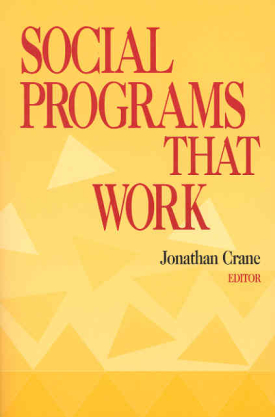
Cover image of the book Social Programs That Work
Books

Social Programs That Work

Editor
Jonathan Crane
Paperback
$24.95
Add to Cart
Publication Date
6 in. × 9 in. 336 pages
ISBN
978-0-87154-174-1
Also Available From

About This Book

"This book demonstrates how we can make substantial progress in the fight against educational failure, family dissolution, violent crime, substance abuse, unemployment, and poverty. It also shows that to do so we must insist that social programs produce demonstrable results and that demonstrably successful programs are replicated across the country. Social Programs that Work is one of the most encouraging and important public policy books written in recent years. Policy makers, educators, parents, everyone who cares about our children and our society should read it."
-CONGRESSMAN RICHARD A. GEPHARDT

"This book offers a powerful antidote to the nihilistic, 'nothing works' mentality that pervades much of the discussion of social policy today. It evidences a candid, rigorous, and often skeptical search for programs that pass a high threshold for impact and credibility. Each program is presented and examined with care and clarity. Social Programs that Work not only offers essential evidence that some programs really ought to be expanded, it also illustrates how rigorous evaluation can allow a nation to learn about and expand those special programs that really do make a difference. Anyone looking for ways to fight our social ills should read this book."
-DAVID ELLWOOD, Harvard University

Many Americans seem convinced that government programs designed to help the poor have failed. Social Programs That Work shows that this is not true. Many programs have demonstrably improved the lives of people trapped at the bottom of the social and economic ladder. Social Programs That Work provides an in-depth look at some of the nation's best interventions over the past few decades, and considers their potential for national expansion.

Examined here are programs designed to improve children's reading skills, curb juvenile delinquency and substance abuse, and move people off welfare into the workforce. Each contributor discusses the design and implementation of a particular program, and assesses how well particular goals were met. Among the critical issues addressed: Are good results permanent, or do they fade over time? Can they be replicated successfully under varied conditions? Are programs cost effective, and if so are the benefits seen immediately or only over the long term? How can public support be garnered for a large upfront investment whose returns may not be apparent for years? Some programs discussed in this volume were implemented only on a small, experimental scale, prompting discussion of their viability at the national level.

An important concern for social policy is whether one-shot programs can lead to permanent results. Early interventions may be extremely effective at reducing future criminal behavior, as shown by the results of the High/Scope Perry preschool program. Evidence from the Life Skills Training Program suggests that a combination of initial intervention and occasional booster sessions can be an inexpensive and successful approach to reducing adolescent substance abuse. Social Programs That Work also acknowledges that simply placing welfare recipients in jobs isn't enough; they will also need long-term support to maintain those jobs.

The successes and failures of social policy over the last thirty-five years have given us valuable feedback about the design of successful social policy. Social Programs That Work represents a landmark attempt to use social science criteria to identify and strengthen the programs most likely to make a real difference in addressing the nation's social ills.

JONATHAN CRANE is director of the National Center for Research on Social Programs in Chicago, Illinois.

CONTRIBUTORS: Clancy Blair, Gilbert J. Bovin, Frances A. Campbell, Patricia Chamberlain, Barbara Devaney, Marcella Dianda, Lawrence J. Dolan, Phyllis L. Ellickson, George Farkas, Nancy A. Madden, Lawrence M. Mead, Kevin Moore, Craig T. Ramey, Arthur J. Reynolds, Steven M. Ross, Lawrence J. Schweinhart, Robert E. Slavin, Lana J. Smith, Barbara A. Wasik, David P. Weikart.

RSF Journal
View Book Series
Sign Up For Our Mailing List
Apply For Funding
Cover image of the book Trust in Society
Books

Trust in Society

Editor
Karen S. Cook
Paperback
$34.95
Add to Cart
Publication Date
6 in. × 9 in. 432 pages
ISBN
978-0-87154-181-9
Also Available From

About This Book

"The Russell Sage project on trust has been one of the most intellectually fecund enterprises anywhere in the social sciences over the last five years. This latest compendium of the fruits of that project is a wonderfully rich introduction to the research frontiers in the rapidly evolving study of trust, ranging across approaches as diverse as political philosophy, anthropological field work, microeconomic theory, and comparative survey research."
-ROBERT D. PUTNAM, Harvard University

"Drawing insights from a variety of social science disciplines, each essay in Trust in Society is a gem in its own right, but together, the package of chapters underscores how much we know about the dynamics of trust, and yet, how much there is to learn. It is rare for a book to stimulate a scholarly agenda for further theorizing and research, while at the same time, to provide so many leads for public policy and practice. I recommend this book to my fellow theorists, to researchers in search of important new lines of inquiry, and to policymakers.Trust in Society has something for all."
-JONATHAN H. TURNER, University of California, Riverside

"Trust in Society brings together a broad set of scholars from multiple disciplines, all of whom have something insightful to say about trust. Trust plays a crucial role in all social relationships as varying as those of incorporating immigrants in a society, building trust among members of corporate team, or creating a viable congregation. Readers from all disciplines will find many chapters that they can immediately use in their own research and in teaching graduate and undergraduate students."
-ELINOR OSTROM, Indiana University 

Trust plays a pervasive role in social affairs, even sustaining acts of cooperation among strangers who have no control over each other's actions. But the full importance of trust is rarely acknowledged until it begins to break down, threatening the stability of social relationships once taken for granted. Trust in Society uses the tools of experimental psychology, sociology, political science, and economics to shed light on the many functions trust performs in social and political life. The authors discuss different ways of conceptualizing trust and investigate the empirical effects of trust in a variety of social settings, from the local and personal to the national and institutional.

Drawing on experimental findings, this book examines how people decide whom to trust, and how a person proves his own trustworthiness to others. Placing trust in a person can be seen as a strategic act, a moral response, or even an expression of social solidarity. People often assume that strangers are trustworthy on the basis of crude social affinities, such as a shared race, religion, or hometown. Likewise, new immigrants are often able to draw heavily upon the trust of prior arrivals—frequently kin—to obtain work and start-up capital.

Trust in Society explains how trust is fostered among members of voluntary associations—such as soccer clubs, choirs, and church groups—and asks whether this trust spills over into other civic activities of wider benefit to society. The book also scrutinizes the relationship between trust and formal regulatory institutions, such as the law, that either substitute for trust when it is absent, or protect people from the worst consequences of trust when it is misplaced. Moreover, psychological research reveals how compliance with the law depends more on public trust in the motives of the police and courts than on fear of punishment.

The contributors to this volume demonstrate the growing analytical sophistication of trust research and its wide-ranging explanatory power. In the interests of analytical rigor, the social sciences all too often assume that people act as atomistic individuals without regard to the interests of others. Trust in Society demonstrates how we can think rigorously and analytically about the many aspects of social life that cannot be explained in those terms.

KAREN S. COOK is the Ray Lyman Wilbur Professor of Sociology at Stanford University.

CONTRIBUTORS: Michael Bacharach, Jean Ensminger, Diego Gambetta, Robert Gibbons, Russell Hardin, Carol A. Heimer, Jack Knight, Roderick M. Kramer, Gerry Mackie, David M. Messick, Gary Miller, Victor Nee, Jimy Sanders, Dietlind Stolle, Tom R. Tyler, Toshio Yamagishi.

A Volume in the Russell Sage Foundation Series on Trust

RSF Journal
View Book Series
Sign Up For Our Mailing List
Apply For Funding
Cover image of the book Meta-Analysis for Explanation
Books

Meta-Analysis for Explanation

A Casebook
Editor
Thomas D. Cook
Paperback
$32.00
Add to Cart
Publication Date
6 in. × 9 in. 392 pages
ISBN
978-0-87154-228-1
Also Available From

About This Book

Social science research often yields conflicting results: Does juvenile delinquent rehabilitation work? Is teenage pregnancy prevention effective? In an effort to improve the value of research for shaping social policy, social scientists are increasingly employing a powerful technique called meta-analysis. By systematically pulling together findings of a particular research problem, meta-analysis allows researchers to synthesize the results of multiple studies and detect statistically significant patterns among them.

Meta-Analysis for Explanation brings exemplary illustrations of research synthesis together with expert discussion of the use of meta-analytic techniques. The emphasis throughout is on the explanatory applications of meta-analysis, a quality that makes this casebook distinct from other treatments of this methodology. The book features four detailed case studies by Betsy Jane Becker, Elizabeth C. Devine, Mark W. Lipsey, and William R. Shadish, Jr. These are offered as meta-analyses that seek both to answer the descriptive questions to which research synthesis is traditionally directed in the health and social sciences, and also to explore how a more systematic method of explanation might enhance the policy yield of research reviews.

To accompany these cases, a group of the field’s leading scholars has written several more general chapters that discuss the history of research synthesis, the use of meta-analysis and its value for scientific explanation, and the practical issues and challenges facing researchers who want to try this new technique. As a practical resource, Meta-Analysis for Explanation guides social scientists to greater levels of sophistication in their efforts to synthesize the results of social research.

"This is an important book...[it is] another step in the continuing exploration of the wider implications and powers of meta-analytic methods." —Contemporary Psychology

THOMAS D. COOK is at Northwestern University.

HARRIS COOPER is at the University of Missouri.

DAVID S. CORDRAY is at Vanderbilt University.

HEIDI HARTMANN is at Institute for Women's Policy Research.

LARRY V. HEDGES is at University of Chicago.

RICHARD J. LIGHT is at Harvard University.

THOMAS A. LOUIS is at University of Minnesota.

FREDERICK MOSTELLER is at Harvard University.

RSF Journal
View Book Series
Sign Up For Our Mailing List
Apply For Funding
Cover image of the book Democracy and the Culture of Skepticism
Books

Democracy and the Culture of Skepticism

Political Trust in Argentina and Mexico
Authors
Matthew R. Cleary
Susan Stokes
Paperback
$34.95
Add to Cart
Publication Date
6 in. × 9 in. 264 pages
ISBN
978-0-87154-065-2
Also Available From

About This Book

"As a primer in quantitative political research, this book is without peer. As an analysis of local politics in Mexico and Argentina, it has rarely been equaled. This book should be read by every social scientist. It is a classic example of what the discipline of political science can and should be."
-CHOICE

"This is an excellent contribution to the literature on trust and democracy. The empirical focus of the previous literature on this subject has been almost exclusively on the advanced industrial democracies. Matthew R. Cleary and Susan C. Stokes fruitfully analyze this relationship in the very different context of Argentina and Mexico. They debunk the argument that interpersonal trust helps build solid democracies and persuasively argue that democracy hinges more on institutional trust. Democracy and the Culture of Skepticism has fascinating new data and makes important theoretical contributions."
-SCOTT MAINWARING, Eugene Conley Professor of Political Science and director, Kellogg Institute for International Studies, University of Notre Dame

"I was long skeptical that anyone would prick the trust balloon that has been flying high over democratic theory. But Matthew R. Cleary and Susan C. Stokes have done so with verve and data, teaching us why the experience of democracy leads attentive citizens to expect venal politicians. Democratic life according to this perceptive study is sustained by rational skepticism rather than interpersonal trust."
-DAVID LAITIN, James T. Watkins IV and Elise V. Watkins Professor of Political Science, Stanford University

Some theorists claim that democracy cannot work without trust. According to this argument, democracy fails unless citizens trust that their governing institutions are serving their best interests. Similarly, some assert that democracy works best when people trust one another and have confidence that politicians will look after citizen interests. Questioning such claims, Democracy and the Culture of Skepticism, by Matthew Cleary and Susan Stokes, suggests that skepticism, not trust, is the hallmark of political culture in well-functioning democracies.

Drawing on extensive research in two developing democracies, Argentina and Mexico, Democracy and the Culture of Skepticism shows that in regions of each country with healthy democracies, people do not trust one another more than those living in regions where democracy functions less well, nor do they display more personal trust in governments or politicians. Instead, the defining features of the healthiest democracies are skepticism of government and a belief that politicians act in their constituents' best interest only when it is personally advantageous for them to do so. In contrast to scholars who lament what they see as a breakdown in civic life, Cleary and Stokes find that people residing in healthy democracies do not participate more in civic organizations than others, but in fact, tend to retreat from civic life in favor of private pursuits. The authors conclude that governments are most efficient and responsive when they know that institutions such as the press or an independent judiciary will hold them accountable for their actions.

The question of how much citizens should trust politicians and governments has consumed political theorists since America's founding. In Democracy and the Culture of Skepticism, Matthew Cleary and Susan Stokes test the relationship between trust and the quality of governance, showing that it is not trust, but vigilance and skepticism that provide the foundation for well-functioning democracies.

MATTHEW R. CLEARY is assistant professor of political science in the Maxwell School of Citizenship and Public Affairs at Syracuse University.

SUSAN C. STOKES is professor of political science at Yale University.

A Volume in the Russell Sage Foundation Series on Trust

RSF Journal
View Book Series
Sign Up For Our Mailing List
Apply For Funding
Cover image of the book An American Dilemma Revisited
Books

An American Dilemma Revisited

Race Relations in a Changing World
Editor
Obie Clayton, Jr.
Paperback
$31.95
Add to Cart
Publication Date
6 in. × 9 in. 360 pages
ISBN
978-0-87154-157-4
Also Available From

About This Book

"This book must be regarded as a greatly important contribution to race relations literature. It is invaluable for the manner in which authors combine the lessons of history with insightful analyses of empirical data to demonstrate patterns of change over the past fifty years in the status of African Americans... Provocative and stimulating reading."—James E. Blackwell, University of Massachusetts, Boston

"Presents a wide-ranging reanalysis of the seminal work done by Gunnar Myrdal in 1944, examining virtually every issue that Myrdal noted as relevant to the American race question. In so doing, Clayton and his contributors have brought the matter up to date and shown how the American dilemma continues into the twenty-first century." —Stanford M. Lyman, Florida Atlantic University

Fifty years after the publication of An American Dilemma, Gunnar Myrdal's epochal study of racism and black disadvantage, An American Dilemma Revisited again confronts the pivotal issue of race in American society and explores how the status of African Americans has changed over the past half century. African Americans have made critical strides since Myrdal's time. Yet despite significant advances, strong economic and social barriers persist, and in many ways the plight of African Americans remains as acute now as it was then. Using Myrdal as a benchmark, each essay analyzes historical developments, examines current conditions, and investigates strategies for positive change within the core arenas of modern society—political, economic, educational, and judicial.

The central question posed by this volume is whether the presence of a disproportionately African American underclass has become a permanent American phenomenon. Several contributors tie the unevenness of black economic mobility to educational limitations, social isolation, and changing workplace demands. The evolution of a more suburban, service-dominated economy that places a premium on advanced academic training has severely constrained the employment prospects of many urban African Americans with limited education. An American Dilemma Revisited argues that there is hope to be found both in black educational institutions, which account for the largest proportion of advanced educational degrees among African Americans, and in the promotion of black community enterprises.

An American Dilemma Revisited asks why the election of many African American leaders has failed to translate into genuine political power or effective policy support for black issues. The rise in membership in Pentecostal and Islamic denonimations suggests that many blacks, frustrated with the political detachment of more traditional churches, continue to pursue more socially concerned activism at a local level. Three essays trace social disaffection among blacks to a legacy of police and judicial discrimination. Mistrust of the police persists, particularly in cities, and black offenders continue to experience harsher treatment at all stages of the trial process.

As Myrdal's book did fifty years ago, An American Dilemma Revisited offers an insightful look at the continuing effects of racial inequality and discrimination in American society and examines different means for removing the specter of racism in the United States.

OBIE CLAYTON, JR. is director of the Morehouse Research Institute and associate professor of sociology at Morehouse College.

CONTRIBUTORS: Walter R. Allen, Timothy Bledsoe, Sissela Bok, John Sibley Butler, Obie Clayton, Jr., Michael W. Combs, William Darity, Jr., Robert A. Dentler, Reynolds Farley, Ronald F. Ferguson, Stephen Graubard, Joseph O. Jewell, Antonio McDaniel, Lee Sigelman, Cassia C. Spohn, Samuel Walker, Wilbur Watson, Susan Welch, and Doris Wilkinson

RSF Journal
View Book Series
Sign Up For Our Mailing List
Apply For Funding
Cover image of the book Black Fathers in Contemporary American Society
Books

Black Fathers in Contemporary American Society

Strengths, Weaknesses, and Strategies for Change
Editors
Obie Clayton
Ronald B. Mincy
David Blankenhorn
Paperback
$25.95
Add to Cart
Publication Date
6 in. × 9 in. 196 pages
ISBN
978-0-87154-158-1
Also Available From

About This Book

"Perhaps the greatest social science debate as we move into the twenty-first century is the changing nature of the American family, and all the consequences of these changes. Black Fathers in Contemporary American Society is one of the few books that takes a non-politically correct view of these changes. Using research on black fathers as data, the work presents an academic view of the difficult relationships between men and women, who benefits from such relationships, and the differences in socioeconomic categories. This work should set the standard and be a reference for all research in the area of marriage and the family."
-JOHN SIBLEY BUTLER, professor of sociology and management, The University of Texas at Austin

"Fathers must be brought back into the picture, especially in a social context in which a huge absolute percentage of black families are single-parent, female-headed households and in which African Americans, especially young black men, face an alarmingly high lifetime probability of incarceration. Both the research and policymaking communities should sift carefully through this important set of studies, which make a vital contribution to filling the enormous gap in our thinking about African American fathers and families."
-LAWRENCE D. BOBO, Norman Tishman and Charles M. Diker Professor of Sociology and African American Studies, Harvard University, from the foreword of Black Fathers in Contemporary American Society

The majority of African American children live in homes without their fathers, but the proportion of African American children living in intact, two-parent families has risen significantly since 1995. Black Fathers in Contemporary American Society looks at father absence from two sides, offering an in-depth analysis of how the absence of African American fathers affects their children, their relationships, and society as a whole, while countering the notion that father absence and family fragmentation within the African American community is inevitable.

Editors Obie Clayton, Ronald B. Mincy, and David Blankenhorn lead a diverse group of contributors encompassing a range of disciplines and ideological perspectives who all agree that father absence among black families is one of the most pressing social problems today. In part I, the contributors offer possible explanations for the decline in marriage among African American families. William Julius Wilson believes that many men who live in the inner city no longer consider marriage an option because their limited economic prospects do not enable them to provide for a family. Part II considers marriage from an economic perspective, emphasizing that it is in part a wealth-producing institution. Maggie Gallagher points out that married people earn, invest, and save more than single people, and that when marriage rates are low in a community, it is the children who suffer most. In part III, the contributors discuss policies to reduce absentee fatherhood. Wornie Reed demonstrates how public health interventions, such as personal development workshops and work-related skill-building services, can be used to address the causes of fatherlessness. Wade Horn illustrates the positive results achieved by fatherhood programs, especially when held early in a man's life. In the last chapter, Enola Aird notes that from 1995 to 2000, the proportion of African American children living in two-parent, married couple homes rose from 34.8 to 38.9 percent; a significant increase indicating the possible reversal of the long-term shift toward black family fragmentation.

Black Fathers in Contemporary American Society provides an in-depth look at a problem affecting millions of children while offering proof that the trend of father absence is not irrevocable.

OBIE CLAYTON is professor and chair of the Sociology Department at Morehouse College and executive director of the Morehouse Research Institute.

RONALD B. MINCY is the Maurice V. Russell Professor of Social Policy and Social Work Practice at the School of Social Work, Columbia University.

DAVID BLANKENHORN is president of the Institute for American Values.

CONTRIBUTORS: Enola G. Aird, David Blankenhorn, Lawrence D. Bobo, Obie Clayton, Maggie Gallagher, Wade F. Horn, Ronald B. Mincy, Joan W. Moore, Barbara Morrison-Rodriguez, Steven L. Nock, Hillard Pouncy, Wornie L. Reed, and William Julius Wilson.

RSF Journal
View Book Series
Sign Up For Our Mailing List
Apply For Funding
Cover image of the book Resilient City
Books

Resilient City

The Economic Impact of 9/11
Editor
Howard Chernick
Paperback
$34.95
Add to Cart
Publication Date
6 in. × 9 in. 352 pages
ISBN
978-0-87154-170-3
Also Available From

About This Book

The strike against the World Trade Center on September 11, 2001, was a violent blow against the United States and a symbolic attack on capitalism and commerce. It shut down one of the world’s busiest commercial centers for weeks, destroyed or damaged billions of dollars worth of property, and forced many New York City employers to slash their payrolls or move jobs to other areas. The immediate economic effect was substantial, but how badly did 9/11 affect New York City’s economy in the longer term? In Resilient City, Howard Chernick and a team of economic experts examine the city’s economic recovery in the three years following the destruction of the Twin Towers.

Assessing multiple facets of the New York City economy in the years after 9/11, Resilient City discerns many hopeful signs among persistent troubles. Analysis by economist Sanders Korenman indicates that the value of New York–based companies did not fall relative to other firms, indicating that investors still believe that there are business advantages to operating in New York despite higher rates of terrorism insurance and concerns about future attacks. Cordelia Reimers separates the economic effect of 9/11 from the effects of the 2001 recession by comparing employment and wage trends for disadvantaged workers in New York with those in five major U.S. cities. She finds that New Yorkers fared at least as well as people in other cities, suggesting that the decline in earnings and employment for low-income New York workers in 2002 was due more to the recession than to the effects of 9/11. Still, troubles remain for New York City. Howard Chernick considers the substantial fiscal implications of the terrorist attacks on New York City, estimating that the attack cost the city about $3 billion in the first two years alone; a sum that the city now must make up through large tax increases, spending cuts, and substantial additional borrowing, which will inevitably be a burden on future budgets.

The terrorist attacks of September 11 dealt a severe blow to the economy of New York City, but it was far from a knock-out punch. Resilient City shows that New York’s dynamic, flexible economy has absorbed the hardships inflicted by the attacks, and provides a thorough, authoritative assessment of what, so far, has been a strong recovery.


HOWARD CHERNICK is professor of economics at Hunter College of the City University of New York.

CONTRIBUTORS:  Joshua Chang,  Oliver D. Cooke,  Franz Fuerst,  Andrew F. Haughwout,  Edward W. Hill,  Sanders Korenman,  Iryna Lendel,  James A. Parrott,  Cordelia W. Reimers,  Jonathan A. Schwabish. 

A September 11 Initiative Volume

RSF Journal
View Book Series
Sign Up For Our Mailing List
Apply For Funding
Cover image of the book Putting Children First
Books

Putting Children First

How Low-Wage Working Mothers Manage Child Care
Author
Ajay Chaudry
Paperback
$29.95
Add to Cart
Publication Date
6 in. × 9 in. 368 pages
ISBN
978-0-87154-172-7
Also Available From

About This Book

Semi-Finalist for the Robert F. Kennedy Memorial Book Award

"Putting Children First is must reading for anyone making decisions that affect low-income mothers as they struggle to balance work and family responsibilities-in fact, for anyone who cares about the future of children. Ajay Chaudry makes crystal clear the pitfalls of making social policy from an altitude of 50,000 feet. Knowing the facts on the ground is the first step to a sensible child-care system. We have a long way to go, but this book is a great step in the right direction."
-PETER B. EDELMAN, Professor of Law, Georgetown University Law Center

"Ajay Chaudry's Putting Children First is the most insightful and poignant study of the child-care problems of poor single mothers in urban areas that I have read. This book should be required reading not only for students of urban poverty, but also for national policy makers of welfare reform who have yet to address many of the unique challenges of single motherhood in low-income urban neighborhoods."
-WILLIAM JULIUS WILSON, Lewis P. and Linda L. Geyser University Professor, Harvard University

"An honest, poignant ethnography, Putting Children First provides an extraordinary window into the child care worries of poorly paid working mothers who find that good care for their children is unaffordable and scarce. Ajay Chaudry reminds us what it costs to drop the best interests of children from our national policy agenda. Sharp, focused, and wise."
-CAROL STACK, Professor of Social and Cultural Studies in Education, University of California, Berkeley

"Ajay Chaudry skillfully takes us into the reality of the child care struggles of low-income working parents, and the picture is both disturbing and illuminating. The findings will almost certainly alter the reader's thinking about the dilemmas mothers and policy makers face and the strategies for doing better. If one cares about welfare reform, or low-income workers, or most importantly the future of our children, this book is important reading."
-DAVID T. ELLWOOD, Dean and Scott M. Black Professor of Political Economy, John F. Kennedy School of Government, Harvard University

In the five years following the passage of federal welfare reform law, the labor force participation of low-income, single mothers with young children climbed by more than 25 percent. With significantly more hours spent outside the home, single working mothers face a serious childcare crunch—how can they provide quality care for their children? In Putting Children First, Ajay Chaudry follows forty-two low-income families in New York City over three years to illuminate the plight of these mothers and the ways in which they respond to the difficult challenge of providing for their children’s material and developmental needs with limited resources.

Using the words of the women themselves, Chaudry tells a startling story. Scarce subsidies, complicated bureaucracies, inflexible work schedules, and limited choices force families to piece together care arrangements that are often unstable, unreliable, inconvenient, and of limited quality. Because their wages are so low, these women are forced to rely on inexpensive caregivers who are often under-qualified to serve the developmental needs of their children. Even when these mothers find good, affordable care, it rarely lasts long because their volatile employment situations throw their needs into constant flux. The average woman in Chaudry’s sample had to find five different primary caregivers in her child’s first four years, while over a quarter of them needed seven or more in that time.

This book lets single, low-income mothers describe the childcare arrangements they desire and the ways that options available to them fail to meet even their most basic needs. As Chaudry tracks these women through erratic childcare spells, he reveals the strategies they employ, the tremendous costs they incur and the anxiety they face when trying to ensure that their children are given proper care.

Honest, powerful, and alarming, Putting Children First gives a fresh perspective on work and family for the disadvantaged. It infuses a human voice into the ongoing debate about the effectiveness of welfare reform, showing the flaws of a social policy based solely on personal responsibility without concurrent societal responsibility, and suggesting a better path for the future.

AJAY CHAUDRY is a writer on social policy issues and a faculty and senior research fellow in urban policy and management at New School University.

RSF Journal
View Book Series
Sign Up For Our Mailing List
Apply For Funding
Cover image of the book Won't You Be My Neighbor?
Books

Won't You Be My Neighbor?

Race, Class, and Residence in Los Angeles
Author
Camille Zubrinsky Charles
Paperback
$28.95
Add to Cart
Publication Date
6 in. × 9 in. 264 pages
ISBN
978-0-87154-071-3
Also Available From

About This Book

"A persuasive message here is that understanding Los Angeles provides important insights into the future of the American metropolis. Charles offers the most compre hensive study yet of racial attitudes, how these attitudes influence housing preferences, and how these preferences shape the racial comprehension of neighborhoods."
-CITY & COMMUNITY

"Won't You Be My Neighbor?, featuring a survey of a large multiracial sample of Los Angeles County residents, is an important contribution to the literatyre on race and ethnic relations. With thoughtful theoretical arguments and a careful analysis of an impressive empirical data set, Camille Zubrinsky Charles has provided one of the most sophisticated studies of how race and class affect the process of residential decisionmaking."
-WILLIAM JULIUS WILSON, Lewis P. and Linda L. Geyser University Professor, Harvard University

"Nearly four decades after the Fair Housing Act, racial residential segregation persists at high levels in American cities. In Won't You Be My Neighbor? Camille Zubrinsky Charles systematically demolishes the white lies that Americans like to tell themselves as they cling to the myth of a 'race-blind society.' ... Segregation is alive and well in urban America and it is all about race."
-DOUGLAS S. MASSEY, Henry G. Bryant Professor of Sociology and Public Affairs, Woodrow Wilson School, Princeton University

"Won't You Be My Neighbor? is sociology at its best. The book is as theoretically rich as it is analytically rigorous. Charles has given us the most carefully argued and compelling assessment of why race still matters since Douglas S. Massey and Nancy A. Denton's American Apartheid. This book is a genuine must read for any one concerned with understanding the future of our increasingly diverse major urban centers."
-LAWRENCE D. BOBO, Martin Luther King Jr. Centennial Professor and director, Center for Comparative Studies in Race and Ethnicity and Program in African and African American Studies, Stanford University

Los Angeles is a city of delicate racial and ethnic balance. As evidenced by the 1965 Watts violence, the 1992 Rodney King riots, and this year’s award-winning film Crash, the city’s myriad racial groups coexist uneasily together, often on the brink of confrontation. In fact, Los Angeles is highly segregated, with racial and ethnic groups clustered in homogeneous neighborhoods. These residential groupings have profound effects on the economic well-being and quality of life of residents, dictating which jobs they can access, which social networks they can tap in to, and which schools they attend. In Won’t You Be My Neighbor?, sociologist Camille Zubrinsky Charles explores how modern racial attitudes shape and are shaped by the places in which people live.

Using in-depth survey data and information from focus groups with members of L.A.’s largest racial and ethnic groups, Won’t You Be My Neighbor? explores why Los Angeles remains a segregated city. Charles finds that people of all backgrounds prefer both racial integration and a critical mass of same-race neighbors. When asked to reveal their preferred level of racial integration, people of all races show a clear and consistent order of preference, with whites considered the most highly desired neighbors and blacks the least desirable. This is even true among recent immigrants who have little experience with American race relations. Charles finds that these preferences, which are driven primarily by racial prejudice and minority-group fears of white hostility, taken together with financial considerations, strongly affect people’s decisions about where they live. Still, Charles offers reasons for optimism: over time and with increased exposure to other racial and ethnic groups, people show an increased willingness to live with neighbors of other races.

In a racially and ethnically diverse city, segregated neighborhoods can foster distrust, reinforce stereotypes, and agitate inter-group tensions. Won’t You Be My Neighbor? zeroes in on segregated neighborhoods to provide a compelling examination of the way contemporary racial attitudes shape, and are shaped by, the places where we live.

CAMILLE ZUBRINSKY CHARLES is associate professor of sociology and faculty associate director of the Center for Africana Studies at the University of Pennsylvania.

RSF Journal
View Book Series
Sign Up For Our Mailing List
Apply For Funding
Cover image of the book Women in Academe
Books

Women in Academe

Progress and Prospects
Editor
Mariam K. Chamberlain
Paperback
$26.95
Add to Cart
Publication Date
6 in. × 9 in. 448 pages
ISBN
978-0-87154-218-2
Also Available From

About This Book

The role of women in higher education, as in many other settings, has undergone dramatic changes during the past two decades. This significant period of progress and transition is definitively assessed in the landmark volume, Women in Academe.

Crowded out by returning veterans and pressed by social expectations to marry early and raise children, women in the 1940s and 1950s lost many of the educational gains they had made in previous decades. In the 1960s women began to catch up, and by the 1970s women were taking rapid strides in academic life. As documented in this comprehensive study, the combined impact of the women’s movement and increased legislative attention to issues of equality enabled women to make significant advances as students and, to a lesser extent, in teaching and academic administration. Women in Academe traces the phenomenal growth of women’s studies programs, the notable gains of women in non-traditional fields, the emergence of campus women’s centers and research institutes, and the increasing presence of minority and re-entry women. Also examined are the uncertain future of women’s colleges and the disappointingly slow movement of women into faculty and administrative positions.

This authoritative volume provides more current and extensive data on its subject than any other study now available. Clearly and objectively, it tells an impressive story of progress achieved—and of important work still to be done.

MARIAM K. CHAMBERLAIN is founding president of the National Council for Research on Women.

CONTRIBUTORS: Helen S. Astin,  Jean W. Campbell, Mary Ellen S. Capek,  Maren Lockwood Carden,  Mariam K. Chamberlain,  Carol Frances,  Jane Gould,  Lilli S. Hornig,  Florence Howe,  Marjorie Lightman,  Virginia Davis Nordin,  Patricia Ann Palmieri, Bernice R. Sandler,  Cynthia Secor,  Donna Shavlik,  Margaret C. Simms.

RSF Journal
View Book Series
Sign Up For Our Mailing List
Apply For Funding