Cover image of the book Legal Instruments of Foundations
Books

Legal Instruments of Foundations

Editor
F. Emerson Andrews
Hardcover
Add to Cart
Publication Date
6 in. × 9 in. 320 pages
ISBN
978-0-87154-020-1
Also Available From

About This Book

This study contains fifty-eight documents from forty-nine different foundations, selected to represent a wide variety of these organizations. Included are documents from at least one perpetuity, dissolving fund, discretionary perpetuity; at least one company-sponsored foundation, family foundation, foundation engaged in unrelated business activities, association of foundations, "captive" foundation; at least one research foundation, special-purpose foundation, community trust scholarship fund. Several documents have been included for historical interest; documents of two foreign foundations for their comparison values. A final chapter introduces certain operational documents: grant notification form, agreement with consultants, outline for grant applicants, publication agreement.

F. Emerson Andrews was director of publications at the Russell Sage Foundation.

CONTRIBUTORS: James Coleman, James Davis, Beverly Duncan, Otis Dudley Duncan, Mark Evans, David L. Featherman, Robert M. Hauser, Kenneth C. Land, Judah Matras, David D. McFarland, Aage B. Sorenson, Seymour Spilerman, Arthur Stinchcombe, Richard Stone, Kermit Terrell, Donald J. Treiman, James Wendt, H.H. Winsborough.

RSF Journal
View Book Series
Sign Up For Our Mailing List
Apply For Funding
Cover image of the book Philanthropic Giving
Books

Philanthropic Giving

Author
F. Emerson Andrews
Hardcover
Add to Cart
Publication Date
6 in. × 9 in. 328 pages
ISBN
978-0-87154-022-5
Also Available From

About This Book

This book presents an informing picture of giving in the United States. It glances briefly at the history of philanthropy, including its growth in government services, but its emphasis is on recent changes and special opportunities for today. It offers estimates of giving, as to amounts, sources, and benefiting agencies. It includes a discussion of legal and tax aspects of philanthropy.

F. EMERSON ANDREWS was a staff member of Russell Sage Foundation since 1928, a consultant on publications to the Twentieth Century Fund since 1940, and served as a consultant to a number of other organizations in the welfare field. This book grew out of the requests of many donors for advice and help, which came to him as co-author of American Foundations for Social Welfare.


RSF Journal
View Book Series
Sign Up For Our Mailing List
Apply For Funding
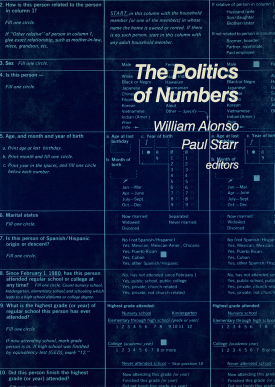
Cover image of the book The Politics of Numbers
Books

The Politics of Numbers

Population of the United States in the 1980s: A Census Monograph Series
Editors
William Alonso
Paul Starr
Paperback
$30.50
Add to Cart
Publication Date
6.63 in. × 9.25 in. 496 pages
ISBN
978-0-87154-016-4
Also Available From

About This Book

The Politics of Numbers is the first major study of the social and political forces behind the nation's statistics. In more than a dozen essays, its editors and authors look at the controversies and choices embodied in key decisions about how we count—in measuring the state of the economy, for example, or enumerating ethnic groups. They also examine the implications of an expanding system of official data collection, of new computer technology, and of the shift of information resources intot he private sector.

WILLIAM ALONSO is at Harvard University.

PAUL STARR is at Princeton University.

A Volume in the RSF Census Series

RSF Journal
View Book Series
Sign Up For Our Mailing List
Apply For Funding
Cover image of the book Housing America in the 1980s
Books

Housing America in the 1980s

Population of the United States in the 1980s: A Census Monograph Series
Author
John S. Adams
Hardcover
$81.50
Add to Cart
Publication Date
11.13 in. × 9.5 in. 400 pages
ISBN
978-0-87154-003-4
Also Available From

About This Book

Housing provides shelter, in a variety of forms, but it is also resonant with meaning on many other levels--as a financial asset, a status symbol, an expression of private aspirations and identities, a means of inclusion or exclusion, and finally as a battleground for social change.

John Adams' impressive new study explores this complex topic in all its dimensions. Using census data and other housing surveys, Adams describes the recent history of housing in America; the nature of housing supply and demand; patterns of housing use; and selected housing policy questions. Adams supplements this national and regional analysis with a remarkable set of small-area analyses, revealing how neighborhood settings affect housing use and how market forces and other trends interact to shape a neighborhood. These analyses focus on a sample of over fifty urbanized areas, including the nation's three largest cities (New York, Los Angeles, and Chicago). Special two-color maps illustrate the dynamics of housing use in each of these communities.

Clearly and insightfully, this volume paints a unique picture of the American "housing landscape," a landscape that reflects and regulates significant aspects of our national life.

JOHN S. ADAMS is professor of geography at the University of Minnesota.

A Volume in the RSF Census Series

RSF Journal
View Book Series
Sign Up For Our Mailing List
Apply For Funding
Cover image of the book Brokered Boundaries
Books

Brokered Boundaries

Creating Immigrant Identity in Anti-Immigrant Times
Authors
Douglas S. Massey
Magaly Sánchez R.
Paperback
$34.95
Add to Cart
Publication Date
6 in. × 9 in. 316 pages
ISBN
978-0-87154-580-0
Also Available From

About This Book

“In this fresh look at the dynamics of U.S. immigration, Massey and Sanchez document the effects on [immigrants’] identities of the current harsh anti-immigration environment they encounter in the United States. Hewing to the dominant view in the sociology of immigration, the authors model immigrant assimilation not as a straight-line process of gradual adoption of the dominant culture, but as a two-way process of group-boundary negotiation between newcomers and native-born citizens. . . . This sobering account of the experiences of immigrant reform is highly detrimental, not only for the immigrants themselves, but also for American society at large.”
—Population & Development Review 

“Based on statistical and ethnographic accounts, Douglas Massey and Magaly Sánchez have written a book that offers an insightful portrait of new Latin American immigrants and also challenges the prevailing anti-immigrant hysteria. The lives of the new immigrants, told in their own words, are full of hard work and dreams for a small piece of the American dream. Some make it, but most struggle at multiple jobs with no benefits and with little chance of upward mobility. The overwhelming evidence shows that almost all new immigrants are hopeful, law abiding, family and community orientated, and working hard to secure a better life for themselves and their children. The harshness of American policies has not reduced immigration, but has legitimized discrimination that has marginalized immigrants and weakened the fabric of American society.”
—Charles Hirschman, Boeing International Professor, University of Washington 

“Brokered Boundaries is a timely, unflinching, compelling, and rigorously reasoned analysis of the consequences of a hostile context of reception for immigrant destinies and identities. In an era of widening inequality, rising xenophobia, and unprecedented state persecution of millions of undocumented immigrants and their children, the authors trace the trajectories and stories of a sample of Latin Americans in the urban northeast. In the process they tackle empirical puzzles, challenge conventional wisdom, debunk the sunny ethnocentrism embedded in formulaic discourses of ‘assimilation’ in American life, and offer a sober reconsideration of policy courses for the American future.”
—Rubén G. Rumbaut, professor of sociology, University of California, Irvine

Anti-immigrant sentiment reached a fever pitch after 9/11, but its origins go back much further. Public rhetoric aimed at exposing a so-called invasion of Latino immigrants has been gaining ground for more than three decades—and fueling increasingly restrictive federal immigration policy. Accompanied by a flagging U.S. economy—record-level joblessness, bankruptcy, and income inequality—as well as waning consumer confidence, these conditions signaled one of the most hostile environments for immigrants in recent memory. In Brokered Boundaries, Douglas Massey and Magaly Sánchez untangle the complex political, social, and economic conditions underlying the rise of xenophobia in U.S. society. The book draws on in-depth interviews with Latin American immigrants in metropolitan New York and Philadelphia and—in their own words and images—reveals what life is like for immigrants attempting to integrate in anti-immigrant times.

What do the social categories “Latino” and “American” actually mean to today’s immigrants? Brokered Boundaries analyzes how first- and second-generation immigrants from Central and South America and the Caribbean navigate these categories and their associated meanings as they make their way through U.S. society. Massey and Sánchez argue that the mythos of immigration, in which newcomers gradually shed their respective languages, beliefs, and cultural practices in favor of a distinctly American way of life, is, in reality, a process of negotiation between new arrivals and native-born citizens. Natives control interactions with outsiders by creating institutional, social, psychological, and spatial mechanisms that delimit immigrants’ access to material resources and even social status. Immigrants construct identities based on how they perceive and respond to these social boundaries. The authors make clear that today’s Latino immigrants are brokering boundaries in the context of unprecedented economic uncertainty, repressive anti-immigrant legislation, and a heightening fear that upward mobility for immigrants translates into downward mobility for the native-born. Despite an absolute decline in Latino immigration, immigration-related statutes have tripled in recent years, including many that further shred the safety net for legal permanent residents as well as the undocumented.

Brokered Boundaries shows that, although Latin American immigrants come from many different countries, their common reception in a hostile social environment produces an emergent Latino identity soon after arrival. During anti-immigrant times, however, the longer immigrants stay in America, the more likely they are to experience discrimination and the less likely they are to identify as Americans.

DOUGLAS S. MASSEY is Henry G. Bryant Professor of Sociology and Public Affairs at the Woodrow Wilson School.

MAGALY SÁNCHEZ R. is senior researcher and visiting scholar at the Office of Population Research at Princeton University.

RSF Journal
View Book Series
Sign Up For Our Mailing List
Apply For Funding