About This Book
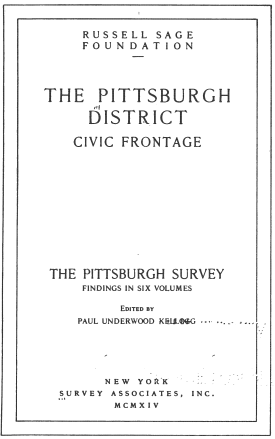
A volume of the Pittsburgh Survey, carried out by the Russell Sage Foundation in 1914.
PAUL UNDERWOOD KELLOGG was director of the Pittsburgh Survey.
A volume of the Pittsburgh Survey, carried out by the Russell Sage Foundation in 1914.
PAUL UNDERWOOD KELLOGG was director of the Pittsburgh Survey.
A volume of the Pittsburgh Survey carried out by the Russell Sage Foundation in 1914, focusing on Pittsburgh's history and growth, civic conditions, and education, recreation, and institutional facilities.
PAUL UNDERWOOD KELLOGG was director of the Pittsburgh Survey.
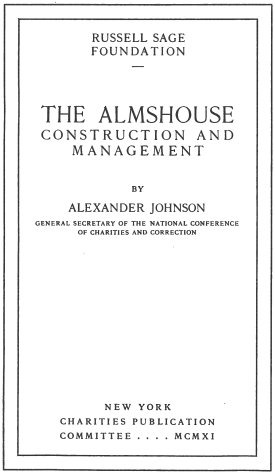
Written by Alexander Johnson, a former inspector of almshouses, in 1911, The Almshouse: Construction and Management is a detailed look at the successful practices of various charity institutions around the world. The book also touches on several ineffective aspects behind badly managed almshouses witnessed by the author firsthand. Topics range from proper living-quarter design to mental health and to strategies for efficient administration. Drawing upon his experiences, as well as the reports of various state boards of charity, Johnson depicts what makes a well-managed, comfortable place for poor people to live in.
ALEXANDER JOHNSON was general secretary of the National Conference of Charities and Correction.
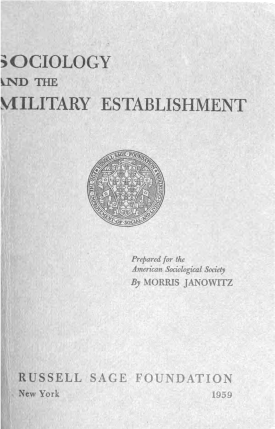
Prepared for the American Sociological Society in 1959, Sociology and the Military Establishment explores the relationship between the military and the possible contributions of sociologists, particularly after World War II. It argues for more effective utilization of sociological theory and research in the analysis of problems to the military and makes evident that research on military problems would provide extremely valuable opportunities for testing sociological theory and method.
MORRIS JANOWITZ was professor of sociology at the University of Michigan.
A volume of the Springfield Survey published in 1914, this report presents a clear idea of the housing conditions in Springfield at the time, as well as the methods taken to keep conditions up to standard. Topics include land overcrowding, unhealthy circumstances in apartments, and housing for miners, with an argument of what the city could do to improve conditions.
JOHN IHLDER, Springfield Survey Committee
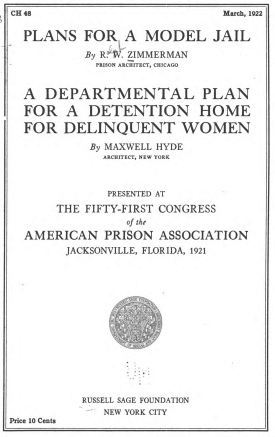
Presented at the fifty-first congress of the American Prison Association in 1921, this pamphlet attempts to develop proper, universal plans for a model jail. Arguing that each prison would have specific building requirements and characteristics, the author presents several well-established canons of architecture and building which should be followed in any jail, emphasizing humane conditions and required needs. Printed with A Departmental Plan for a Detention Home for Delinquent Women by Maxwell Hyde.
R. W. ZIMMERMAN, prison architect, Chicago
This is a pamphlet of two reports on munition work during World War I, the second is by Henriette R. Walter, entitled Munition Workers in England and France: A Summary of Reports Issued by the British Ministry of Munitions.
AMY HEWES was professor of economics and sociology at Mount Holyoke College.
This 1910 book is a study of juvenile court laws in the United States, including a summary of all juvenile court legislation in the country until that time and an abstract of state laws governing the trial and disposition of juvenile offenders, divided by state and topic. This volume is intended to supplement Preventive Treatment of Neglected Children by Hastings. H. Hart.
HASTINGS H. HART was director of the Department of Child-Helping of the Russell Sage Foundation.
A paper read before the American Public Health Association at Rochester, New York in 1915.
HASTINGS H. HART was director of the Department of Child-Helping of the Russell Sage Foundation.
A paper read before the American Prison Association in Baltimore in 1912.
HASTINGS H. HART was director of the Department of Child-Helping at the Russell Sage Foundation.