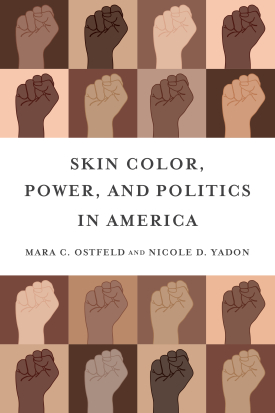
Cover image of the book Skin Color, Power, and Politics in America
Books

Skin Color, Power, and Politics in America

Authors
Mara C. Ostfeld
Nicole D. Yadon
Paperback
$37.50
Add to Cart
Publication Date
1 in. × 1 in. 284 pages
ISBN
978-0-87154-637-1

About This Book

"Skin Color, Power, and Politics in America offers a compelling study examining the linkage between skin color and politics in the United States. Importantly, Mara Ostfeld and Nicole Yadon embark on a careful comparative analysis that examines the nuances and varied effects of skin color on the political attitudes of the three major ethnoracial groups in the United States."
—MARISA ABRAJANO, professor of political science, University of California, San Diego

"The conception of race as a social construct is not novel. What is novel and what makes Skin Color, Power, and Politics in America an essential read is its nuanced and deeper understanding—from measurement to meaning—of the multifaceted ways that people are stratified by skin shade both across and within broadly defined racial groups, and how that sorting links to power and politics."
—DARRICK HAMILTON, university professor and Henry Cohen Professor of Economics and Urban Policy, The New School

"Skin Color, Power, and Politics in America is a landmark achievement. It provides new and important insights about how skin tone shapes politics within and across ethnoracial categories. By looking beyond broad ethnoracial categories using novel data, Mara Ostfeld and Nicole Yadon carefully reveal the manifold pathways through which race, gender, color, and class influence political ideologies and ethnoracial politics in the United States. In so doing, Skin Color, Power, and Politics in America is an indispensable resource and a must-read for anyone interested in enriching their understanding of contemporary ethnoracial politics in the United States."
—ELLIS MONK, associate professor of sociology, Harvard University

A person’s skin color affects their life experiences including income, educational attainment, health outcomes, exposure to discrimination, interactions with the criminal justice system and one’s sense of ethnoracial group belonging. But, do these disparate experiences affect the relationship between skin color and political views? In Skin Color, Power, and Politics in America, political scientists Mara Ostfeld and Nicole Yadon explore the relationship between skin color and political views in the U.S. among Latino, Black, and White Americans. They examine how skin color influences an individual’s politics and whether a person’s political views influence how they assess their own skin color.

Ostfeld and Yadon surveyed over 1,300 people about their political views, including party affiliation, their opinions on welfare, and the importance of speaking English in the U.S. The authors created a matrix grounded in their “Roots of Race” framework, which predicts the relationship between skin color and political attitudes for each ethnoracial group based on the blurriness of the group’s boundaries and historical levels of privilege. They draw upon three distinct measures of skin color to conceptualize the relationship between skin color and political views: “Machine-Rated Skin Color,” measured with a light-reflectance meter; “Self-Assessed Skin Color,” using the Yadon-Ostfeld Skin Color Scale; and “Skin Color Discrepancy,” the difference between one’s Machine-Rated and Self-Assessed Skin Color.

Ostfeld and Yadon examine patterns that emerge among these measures, and their relationships with life experiences and political stances. Among Latinos, a group with relatively blurry group boundaries and low levels of historical privilege, the authors find a robust relationship between political views and Self-Assessed Skin Color. Latinos who overestimate the lightness of their skin color are more likely to hold conservative views on current racialized political issues, such as policing. Latinos who overestimate the darkness of their skin color, on the other hand, are more likely to hold liberal political views. As America’s major political parties remain divided on issues of race, this suggests that for Latinos, self-reported skin color is used as a means of aligning oneself with valued political coalitions.

African Americans, another group with low levels of historical privilege but with more clearly defined group boundaries, demonstrated no significant relationship between skin color and political attitudes. Thus, the lived experiences associated with being African American appeared to supersede the differences in life experiences due to skin color.

Whites, a group with more historical privilege and increasingly blurry group boundaries, showed a clear relationship between machine-assessed skin color and attitudes on political issues. Those with darker Machine-Rated Skin Color are more likely to hold conservative views, suggesting that they are responding to the threat of losing their privilege in a multicultural society.

At a time when the U.S. is both more diverse and politically divided, Skin Color, Power, and Politics in America is a timely account of the ways in which skin color and politics are intertwined.

MARA OSTFELD is an assistant research scientist at the Gerald R. Ford  School of Public Policy at the University of Michigan.

NICOLE YADON is an assistant professor of political science at The Ohio State University.
RSF Journal
View Book Series
Sign Up For Our Mailing List
Apply For Funding
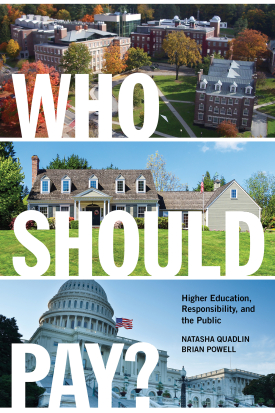
Cover image of the book Who Should Pay?
Books

Who Should Pay?

Higher Education, Responsibility, and the Public
Authors
Natasha Quadlin
Brian Powell
Paperback
$37.50
Add to Cart
Publication Date
1 in. × 1 in.
ISBN
978-0-87154-685-2

About This Book

“Sociologists Natasha Quadlin and Brian Powell take us on a well-reasoned, accessible, and engaging journey of how public opinion has changed over time regarding college access and paying for it. Their findings suggest a cultural shift in the American mindset about higher education inequality, and Who Should Pay? merits a strong read to learn what it is and why.”
Prudence L. Carter, Sarah and Joseph Jr. Dowling Professor of Sociology, Brown University

“One of the most pressing issues of today is whether a public college education should be free for every eligible high school graduate, and if so, how will it be funded? This provocative book based on over a thousand adults contacted before and during the pandemic discusses how public views of access and funding of higher education have changed. Addressing problems of individual versus collective interests, this excellent volume raises questions regarding our commitment to future generations of youth, democratic values, and American productivity.”
Barbara Schneider, John A. Hannah University Distinguished Professor, Michigan State University

Americans now obtain college degrees at a higher rate than at any time in recent decades in the hopes of improving their career prospects. At the same time, the rising costs of an undergraduate education have increased dramatically, forcing students and families to take out often unmanageable levels of student debt. The cumulative amount of student debt reached nearly $1.5 trillion in 2017, and calls for student loan forgiveness have gained momentum. Yet public policy to address college affordability has been mixed. While some policymakers support more public funding to broaden educational access, others oppose this expansion. Noting that public opinion often shapes public policy, sociologists Natasha Quadlin and Brian Powell examine public opinion on who should shoulder the increasing costs of higher education and why.

Who Should Pay? draws on a decade’s worth of public opinion surveys analyzing public attitudes about whether parents, students, or the government should be primarily responsible for funding higher education. Quadlin and Powell find that between 2010 and 2019, public opinion has shifted dramatically in favor of more government funding. In 2010, Americans overwhelming believed that parents and students were responsible for the costs of higher education. Less than a decade later, the percentage of Americans who believed that federal or state/local government should be the primary financial contributor has more than doubled. The authors also find increased public endorsement of shared responsibility between individuals and the government in paying for higher education. They additionally examine attitudes on the accessibility of college for all, whether higher education at public universities should be free, and whether college is worth the costs.

Quadlin and Powell also explore why Americans hold these beliefs. They identify individualistic and collectivist world views that shape public perspectives on the questions of funding, accessibility, and worthiness of college. Those with more individualistic orientations believed parents and students should pay for college, and that if students want to attend college, then they should work hard and find ways to achieve their goals. Those with collectivist orientations believed in a model of shared responsibility—one in which the government takes a greater level of responsibility for funding education while acknowledging the social and economic barriers to obtaining a college degree for many students. The authors find that these belief systems differ among sociodemographic groups and that bias—sometimes unconscious and sometimes deliberate—regarding race and class affects responses from both individualistic and collectivist-oriented participants.

Public opinion is typically very slow to change. Yet Who Should Pay? provides an illuminating account of just how quickly public opinion has shifted regarding the responsibility of paying for a college education and its implications for future generations of students.

NATASHA QUADLIN is assistant professor of sociology at the University of California, Los Angeles.

BRIAN POWELL is James H. Rudy Professor of Sociology at Indiana University.

RSF Journal
View Book Series
Sign Up For Our Mailing List
Apply For Funding
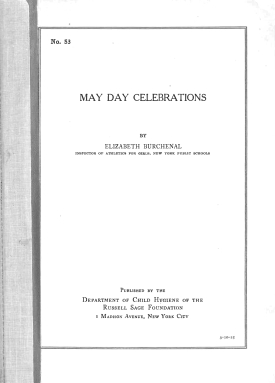
Cover image of the book May Day Celebrations
Books

May Day Celebrations

Author
Elizabeth Burchenal
Ebook
Publication Date
1 in. × 1 in. 14 pages

About This Book

This 1925 pamphlet, published by the Department of Child Hygiene of the Russell Sage Foundation, gathers suggestions for organizing May Day festivals. An appendix of May Day songs, speeches, and games is included.


Elizabeth Burchenal was inspector of athletics for girls in New York public schools.

RSF Journal
View Book Series
Sign Up For Our Mailing List
Apply For Funding
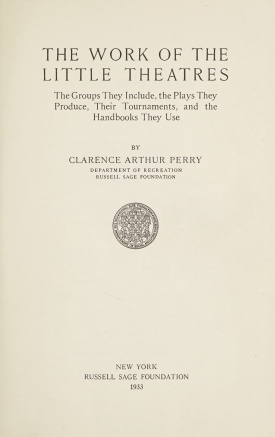
Cover image of the book The Work of the Little Theatres
Books

The Work of the Little Theatres

The Groups They Include, the Plays They Produce, Their Tournaments, and the Handbooks They Use
Author
Clarence Arthur Perry
Ebook
Publication Date
1 in. × 1 in. 228 pages

About This Book

A survey of amateur and community theatrical productions and activity in the early twentieth century, in particular dramatics for children through public and private schools, playground and community centers, and various voluntary organizations. With a selected bibliography for amateur workers in drama.

Clarence Arthur Perry was the author of Wider Use of the School Plant, Housing for the Machine Age, and The Rebuilding of Blighted Areas.

RSF Journal
View Book Series
Sign Up For Our Mailing List
Apply For Funding
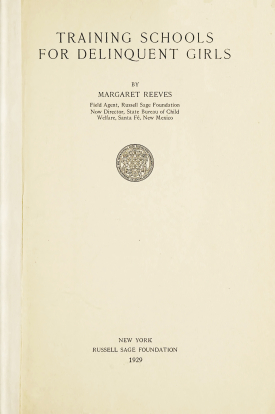
Cover image of the book Training Schools for Delinquent Girls
Books

Training Schools for Delinquent Girls

Author
Margaret Reeves
Ebook
Publication Date
1 in. × 1 in. 455 pages

About This Book

The Department of Child Helping of the Russell Sage Foundation completed a detailed study of 151 public institutions for delinquent youth in the United States in 1924, including a few private institutions supported chiefly by public funds. The work of such schools is unique, technical, and vitally important, but up to the time that this study was undertaken no complete and detailed information regarding these institutions was available. The department undertook the study with the goal of informing the public and awakening its interest in these schools, and of assisting trustees and superintendents to improve the methods, standards, and conditions of their work. This book examines academics, physical care, and parole for delinquent girls, as well as building conditions, salaries in training schools, record-keeping, and community aspects of institutional life.

Margaret Reeves was field agent of the Russell Sage Foundation and director of the State Bureau of Child Welfare, Santa Fe, New Mexico.

RSF Journal
View Book Series
Sign Up For Our Mailing List
Apply For Funding
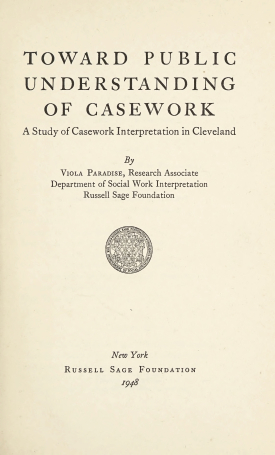
Cover image of the book Toward Public Understanding of Casework
Books

Toward Public Understanding of Casework

A Study of Casework Interpretation in Cleveland
Author
Viola Paradise
Ebook
Publication Date
1 in. × 1 in. 244 pages

About This Book

This book aimed to bring about a wider public knowledge of social casework—to examine and report upon the ways in which social caseworkers and social casework agencies go about the task of securing public understanding, and the ways in which the usefulness of casework has grown through good understanding. It is directed particularly to the casework field, but its analysis of how casework is interpreted in one community has importance for all branches of social work.

Viola Paradise was research associate in the Department of Social Work Interpretation of the Russell Sage Foundation.

RSF Journal
View Book Series
Sign Up For Our Mailing List
Apply For Funding
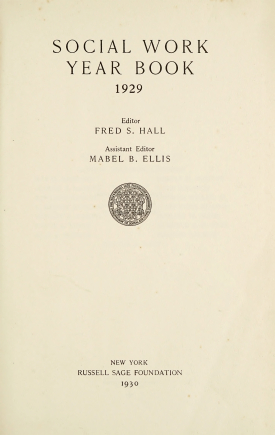
Cover image of the book Social Work Year Book, 1929
Books

Social Work Year Book, 1929

Editors
Fred S. Hall
Mabel B. Ellis
Ebook
Publication Date
1 in. × 1 in. 600 pages

About This Book

Part of a series documenting annual research and activity in the field of social work. It is a record of organized efforts in the United States to deal with social problems and social conditions. Topics include adult education, health, mental hygiene, crime and penal conditions, children, community organization, the disabled, and religious social work.

Fred S. Hall was joint author of American Marriage Laws.

RSF Journal
View Book Series
Sign Up For Our Mailing List
Apply For Funding
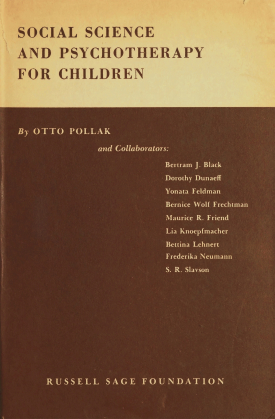
Cover image of the book Social Science and Psychotherapy for Children
Books

Social Science and Psychotherapy for Children

Contributions of the Behavior Sciences to Practice in a Psychoanalytically Oriented Child Guidance Clinic
Author
Otto Pollak
Ebook
Publication Date
1 in. × 1 in. 254 pages

About This Book

Social Science and Psychotherapy for Children was a study undertaken jointly by the Russell Sage Foundation and the Jewish Board of Guardians under direction of Dr. Otto Pollak, a faculty member of the University of Pennsylvania, who was made available by the foundation as social science consultant to the Board’s Child Guidance Institute. With many specific cases as illustrations, Dr. Pollak and his collaborators show ways in which the social sciences may enrich child therapy. They examine the implications of family structure, social interaction, anxiety, extra-familial influences, culture conflicts, and age-sex factors. They also consider the effective use of volunteers in treatment and the occasional necessity for setting limited treatment goals.

Collaborators: Bertram J. Black, Dorothy Dunaeff, Yonata Feldman, Bernice Wolf Frechtman, Maurice R. Friend, Lia Knoepfmacher, Bettina Lehnert, Frederika Neumann, S. R. Slavson

RSF Journal
View Book Series
Sign Up For Our Mailing List
Apply For Funding
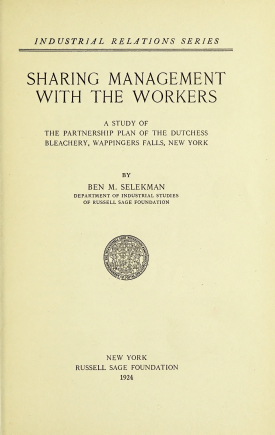
Cover image of the book Sharing Management with the Workers
Books

Sharing Management with the Workers

A Study of the Partnership Plan of the Dutchess Bleachery, Wappingers Falls, New York
Author
Ben M. Selekman
Ebook
Publication Date
1 in. × 1 in. 156 pages

About This Book

Part of the Industrial Relations Series, a series by the Department of Industrial Studies of the Russell Sage Foundation investigating early twentieth-century experiments in the organization of relations between employers and employees in industrial enterprises in the United States. It examines the plan for employee representation of a mill in Wappingers Falls, New York, and the relationship between workers and management.

Ben M. Selekman, Department of Industrial Studies, Russell Sage Foundation

RSF Journal
View Book Series
Sign Up For Our Mailing List
Apply For Funding