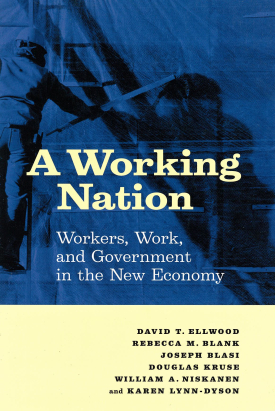
Cover image of the book A Working Nation
Books

A Working Nation

Workers, Work, and Government in the New Economy
Authors
Rebecca M. Blank
Joseph Blasi
Douglas Kruse
Karen Lynn-Dyson
William A. Niskane
David T. Ellwood
Paperback
Add to Cart
Publication Date
6 in. × 9 in. 168 pages
ISBN
978-0-87154-247-2
Also Available From

About This Book

"This rigorous but readable collection of essays offers penetrating analyses of the changes in earnings and working conditions over the past generation, along with diverse proposals for addressing the challenges of change. These essays are a valuable point of reference for policies designed to improve the well-being of American workers."
-WILLIAM A. GALSTON, University of Maryland

"Few people know more, care more, or think more practically about the struggles and aspirations of the working poor than David Ellwood and the authors of this volume. This book is a clear and eloquent call for a national commitment to a simple moral proposition: Americans who work ought not to be poor. The authors offer remedies that cut through the ideological barriers and political bickering that so often block the quest for solutions. May both parties, and all citizens, take this book to heart."
-E.J. DIONNE, Author of Why Americans Hate Politics

The nature of work in the United States is changing dramatically, as new technologies, a global economy, and more demanding investors combine to create a far more competitive marketplace. Corporate efforts to respond to these new challenges have yielded mixed results. Headlines about instant millionaires and innovative e-businesses mingle with coverage of increasing job insecurity and record wage gaps between upper management and hourly workers. A Working Nation tracks the profound implications the changing workplace has had for all workers and shows who the real economic winners and losers have been in the past twenty-five years.

A Working Nation sorts fact from fiction about the new relationship between workers and firms, and addresses several critical issues: Who are the real winners and losers in this new economy? Has the relationship between workers and firms really been transformed? How have employees become more integrated into or disconnected from corporate strategies and performance? Should government step into this new economic reality and how should it intervene?

Among the topics investigated, David T. Ellwood explores and explains the apparent paradox between the steady rise in per capita national income and the stagnant wages of middle- and working-class workers. Douglas Kruse and Joseph Blasi study relative changes in long-term vs. temporary work, and evaluate the introduction of profit-sharing schemes and high performance workplace programs. William A. Niskanen and Rebecca M. Blank, both former members of the president's Council of Economic Advisers, offer their perspectives on what direction government might take to make this a working nation for everyone. Though Niskanen and Blank take alternative approaches, they both conclude that the primary policy emphasis ought to be on the problems of the least skilled more than on inequality per se, and that a focus on childhood education and tax supports for low-income working families should be of primary concern.

A Working Nation paints a compelling and surprisingly consistent picture of today's workplace. While the booming economy has created millions of new jobs, it has also lead to an alarmingly unbalanced system of rewards that puts less-skilled, and many middle-class, workers at risk. This book is essential reading for those seeking the most efficient answers to the challenges and opportunities of the evolving economy.

DAVID T. ELLWOOD is Lucius N. Littauer Professor of Political Economy at the John F. Kennedy School of Government, Harvard University. He is also director of the Aspen Domestic Strategy Group.

REBECCA M. BLANK was a member of the Council of Economic Advisers under President Clinton. She is Henry Carter Adams Collegiate Professor of Public Policy, dean of the Gerald R. Ford School of Public Policy, and professor of economics at the University of Michigan.

JOSEPH BLASI is professor of sociology at the School of Management and Labor Relations, Rutgers University.

DOUGLAS KRUSE is professor of economics at the School of Management and Labor Relations, Rutgers University. He is also research associate  of the National Bureau of Economic Research.

WILLIAM A. NISKANEN was a member of the Council of Economic Advisers under President Reagan and is chairman of the Cato Institute.

KAREN LYNN-DYSON is associate director of the Aspen Institute’s Domestic Strategy Group.

RSF Journal
View Book Series
Sign Up For Our Mailing List
Apply For Funding
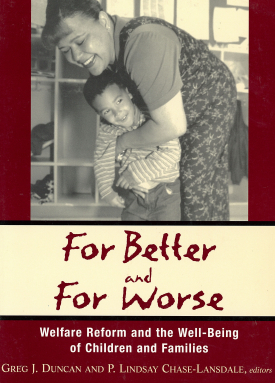
Cover image of the book For Better and For Worse
Books

For Better and For Worse

Welfare Reform and the Well-Being of Children and Families
Editors
Greg J. Duncan
P. Lindsay Chase-Lansdale
Paperback
Add to Cart
Publication Date
6.63 in. × 9.25 in. 344 pages
ISBN
978-0-87154-263-2
Also Available From

About This Book

"For Better and For Worse is an important contribution to the field of social policy. Greg J. Duncan and P. Lindsay Chase-Lansdale have incorporated the work of some of the best researchers and policy analysts on poverty and welfare in the country. The net result is the most authoritative volume to date on the impact of welfare reform on children and families in the United States."
-WILLIAM JULIUS WILSON, Lewis P. and Linda L. Geyser University Professor, Harvard University

"For Better or Worse provides a much-needed description of how children are faring since the welfare reforms of the 1990s. Perhaps even more important is the focus on family's responses to various policy packages being implemented across the country. The volume is a perfect blend of economic, sociological, and psychological perspectives on child policy and well- being."
-JEANNE BROOKS-GUNN, Virginia and Leonard Marx Professor of Child Development and Education, Teachers College, Columbia University

The 1996 welfare reform bill marked the beginning of a new era in public assistance. Although the new law has reduced welfare rolls, falling caseloads do not necessarily mean a better standard of living for families. In For Better and For Worse, editors Greg J. Duncan and P. Lindsay Chase-Lansdale and a roster of distinguished experts examine the evidence and evaluate whether welfare reform has met one of its chief goals-improving the well-being of the nation's poor children.

For Better and For Worse opens with a lively political history of the welfare reform legislation, which demonstrates how conservative politicians capitalize on public concern over such social problems as single parenthood to win support for the radical reforms. Part I reviews how individual states redesigned, implemented, and are managing their welfare systems. These chapters show that most states appear to view maternal employment, rather that income enhancement and marriage, as key to improving child well-being. Part II focuses on national and multistate evaluations of the changes in welfare to examine how families and children are actually faring under the new system. These chapters suggest that work-focused reforms have not hurt children, and that reforms that provide financial support for working families can actually enhance children's development. Part III presents a variety of perspectives on policy options for the future. Remarkable here is the common ground for both liberals and conservatives on the need to support work and at the same time strengthen safety-net programs such as Food Stamps.

Although welfare reform-along with the Earned Income Tax Credit and the booming economy of the nineties-has helped bring mothers into the labor force and some children out of poverty, the nation still faces daunting challenges in helping single parents become permanent members of the workforce. For Better and For Worse gathers the most recent data on the effects of welfare reform in one timely volume focused on improving the life chances of poor children.

GREG J. DUNCAN is professor of economics in the School of Education and Social Policy and a faculty fellow at the Institute for Policy Research at Northwestern University.

P. LINDSAY CHASE-LANSDALE is professor of developmental psychology in the School of Education and Social Policy and a faculty fellow at the Institute for Policy Research at Northwestern University.

CONTRIBUTORS: P. Lindsay Chase-Lansdale, Greg J. Duncan, David M. Casey, Danielle A. Crosby, Sandra K. Danziger, Kristina Daugirdas, Rachel E. Dunifon, Kathryn Edin, Paula England, Nancy Folbre, Thomas L. Gais, Ron Haskins, Ann E. Horvath-Rose, Aletha C. Huston, Cathy M. Johnson, Ariel Kalil, Andrew S. London, Joan Maya Mazelis, Rashmita S. Mistry, Kristin Anderson Moore, H. Elizabeth Peters, Wendell Primus, Marika N. Ripke, Jennifer L. Romich, Ellen K. Scott, Jack Tweedie, Morgan B. Ward Doran, Alan Weil, Thomas S. Weisner, and W. Jean Young.

RSF Journal
View Book Series
Sign Up For Our Mailing List
Apply For Funding
Cover image of the book Trust in Society
Books

Trust in Society

Editor
Karen S. Cook
Paperback
$34.95
Add to Cart
Publication Date
6 in. × 9 in. 432 pages
ISBN
978-0-87154-181-9
Also Available From

About This Book

"The Russell Sage project on trust has been one of the most intellectually fecund enterprises anywhere in the social sciences over the last five years. This latest compendium of the fruits of that project is a wonderfully rich introduction to the research frontiers in the rapidly evolving study of trust, ranging across approaches as diverse as political philosophy, anthropological field work, microeconomic theory, and comparative survey research."
-ROBERT D. PUTNAM, Harvard University

"Drawing insights from a variety of social science disciplines, each essay in Trust in Society is a gem in its own right, but together, the package of chapters underscores how much we know about the dynamics of trust, and yet, how much there is to learn. It is rare for a book to stimulate a scholarly agenda for further theorizing and research, while at the same time, to provide so many leads for public policy and practice. I recommend this book to my fellow theorists, to researchers in search of important new lines of inquiry, and to policymakers.Trust in Society has something for all."
-JONATHAN H. TURNER, University of California, Riverside

"Trust in Society brings together a broad set of scholars from multiple disciplines, all of whom have something insightful to say about trust. Trust plays a crucial role in all social relationships as varying as those of incorporating immigrants in a society, building trust among members of corporate team, or creating a viable congregation. Readers from all disciplines will find many chapters that they can immediately use in their own research and in teaching graduate and undergraduate students."
-ELINOR OSTROM, Indiana University 

Trust plays a pervasive role in social affairs, even sustaining acts of cooperation among strangers who have no control over each other's actions. But the full importance of trust is rarely acknowledged until it begins to break down, threatening the stability of social relationships once taken for granted. Trust in Society uses the tools of experimental psychology, sociology, political science, and economics to shed light on the many functions trust performs in social and political life. The authors discuss different ways of conceptualizing trust and investigate the empirical effects of trust in a variety of social settings, from the local and personal to the national and institutional.

Drawing on experimental findings, this book examines how people decide whom to trust, and how a person proves his own trustworthiness to others. Placing trust in a person can be seen as a strategic act, a moral response, or even an expression of social solidarity. People often assume that strangers are trustworthy on the basis of crude social affinities, such as a shared race, religion, or hometown. Likewise, new immigrants are often able to draw heavily upon the trust of prior arrivals—frequently kin—to obtain work and start-up capital.

Trust in Society explains how trust is fostered among members of voluntary associations—such as soccer clubs, choirs, and church groups—and asks whether this trust spills over into other civic activities of wider benefit to society. The book also scrutinizes the relationship between trust and formal regulatory institutions, such as the law, that either substitute for trust when it is absent, or protect people from the worst consequences of trust when it is misplaced. Moreover, psychological research reveals how compliance with the law depends more on public trust in the motives of the police and courts than on fear of punishment.

The contributors to this volume demonstrate the growing analytical sophistication of trust research and its wide-ranging explanatory power. In the interests of analytical rigor, the social sciences all too often assume that people act as atomistic individuals without regard to the interests of others. Trust in Society demonstrates how we can think rigorously and analytically about the many aspects of social life that cannot be explained in those terms.

KAREN S. COOK is the Ray Lyman Wilbur Professor of Sociology at Stanford University.

CONTRIBUTORS: Michael Bacharach, Jean Ensminger, Diego Gambetta, Robert Gibbons, Russell Hardin, Carol A. Heimer, Jack Knight, Roderick M. Kramer, Gerry Mackie, David M. Messick, Gary Miller, Victor Nee, Jimy Sanders, Dietlind Stolle, Tom R. Tyler, Toshio Yamagishi.

A Volume in the Russell Sage Foundation Series on Trust

RSF Journal
View Book Series
Sign Up For Our Mailing List
Apply For Funding
Cover image of the book Democracy and the Culture of Skepticism
Books

Democracy and the Culture of Skepticism

Political Trust in Argentina and Mexico
Authors
Matthew R. Cleary
Susan Stokes
Paperback
$34.95
Add to Cart
Publication Date
6 in. × 9 in. 264 pages
ISBN
978-0-87154-065-2
Also Available From

About This Book

"As a primer in quantitative political research, this book is without peer. As an analysis of local politics in Mexico and Argentina, it has rarely been equaled. This book should be read by every social scientist. It is a classic example of what the discipline of political science can and should be."
-CHOICE

"This is an excellent contribution to the literature on trust and democracy. The empirical focus of the previous literature on this subject has been almost exclusively on the advanced industrial democracies. Matthew R. Cleary and Susan C. Stokes fruitfully analyze this relationship in the very different context of Argentina and Mexico. They debunk the argument that interpersonal trust helps build solid democracies and persuasively argue that democracy hinges more on institutional trust. Democracy and the Culture of Skepticism has fascinating new data and makes important theoretical contributions."
-SCOTT MAINWARING, Eugene Conley Professor of Political Science and director, Kellogg Institute for International Studies, University of Notre Dame

"I was long skeptical that anyone would prick the trust balloon that has been flying high over democratic theory. But Matthew R. Cleary and Susan C. Stokes have done so with verve and data, teaching us why the experience of democracy leads attentive citizens to expect venal politicians. Democratic life according to this perceptive study is sustained by rational skepticism rather than interpersonal trust."
-DAVID LAITIN, James T. Watkins IV and Elise V. Watkins Professor of Political Science, Stanford University

Some theorists claim that democracy cannot work without trust. According to this argument, democracy fails unless citizens trust that their governing institutions are serving their best interests. Similarly, some assert that democracy works best when people trust one another and have confidence that politicians will look after citizen interests. Questioning such claims, Democracy and the Culture of Skepticism, by Matthew Cleary and Susan Stokes, suggests that skepticism, not trust, is the hallmark of political culture in well-functioning democracies.

Drawing on extensive research in two developing democracies, Argentina and Mexico, Democracy and the Culture of Skepticism shows that in regions of each country with healthy democracies, people do not trust one another more than those living in regions where democracy functions less well, nor do they display more personal trust in governments or politicians. Instead, the defining features of the healthiest democracies are skepticism of government and a belief that politicians act in their constituents' best interest only when it is personally advantageous for them to do so. In contrast to scholars who lament what they see as a breakdown in civic life, Cleary and Stokes find that people residing in healthy democracies do not participate more in civic organizations than others, but in fact, tend to retreat from civic life in favor of private pursuits. The authors conclude that governments are most efficient and responsive when they know that institutions such as the press or an independent judiciary will hold them accountable for their actions.

The question of how much citizens should trust politicians and governments has consumed political theorists since America's founding. In Democracy and the Culture of Skepticism, Matthew Cleary and Susan Stokes test the relationship between trust and the quality of governance, showing that it is not trust, but vigilance and skepticism that provide the foundation for well-functioning democracies.

MATTHEW R. CLEARY is assistant professor of political science in the Maxwell School of Citizenship and Public Affairs at Syracuse University.

SUSAN C. STOKES is professor of political science at Yale University.

A Volume in the Russell Sage Foundation Series on Trust

RSF Journal
View Book Series
Sign Up For Our Mailing List
Apply For Funding
Princeton University
at time of fellowship
Columbia University
at time of fellowship